

ETH at $2,050: Can Ethereum Foundation Staking Trigger a Breakout?
Ethereum traded near $2,055 as renewed attention on the Ethereum Foundation’s treasury staking program raised questions about whether the initiative could help ETH break out of its current range. With broader crypto sentiment stuck in extreme fear territory, the staking catalyst faces a difficult backdrop.
Why Ethereum Foundation staking is back in focus
The Ethereum Foundation announced on February 24, 2026 that it had begun staking a portion of its treasury, with a target of approximately 70,000 ETH. Staking rewards would be directed back to the EF treasury, and the first validators were already live at the time of the announcement.
The initiative gained fresh attention after CCN reported that the foundation staked about 22,517 ETH across 11 transactions, calling it the EF’s largest single staking event to date. The remaining deposits were expected to follow in the coming weeks as the foundation works toward its full target.
For traders, the significance is less about the yield and more about the signal. The Ethereum Foundation has historically been cautious about participating in staking, and its decision to commit tens of thousands of ETH to validators suggests growing institutional confidence in the network’s proof-of-stake infrastructure. That shift in posture, not the staking itself, is what has driven renewed chatter around ETH in recent days.
Why the $2,050 ETH level matters for traders
ETH was trading at $2,054.95 with a 24-hour change of just +0.08%, a market cap of $247.93 billion, and 24-hour volume of $5.89 billion. The near-flat daily movement reflects a market sitting at a decision point rather than trending in either direction.
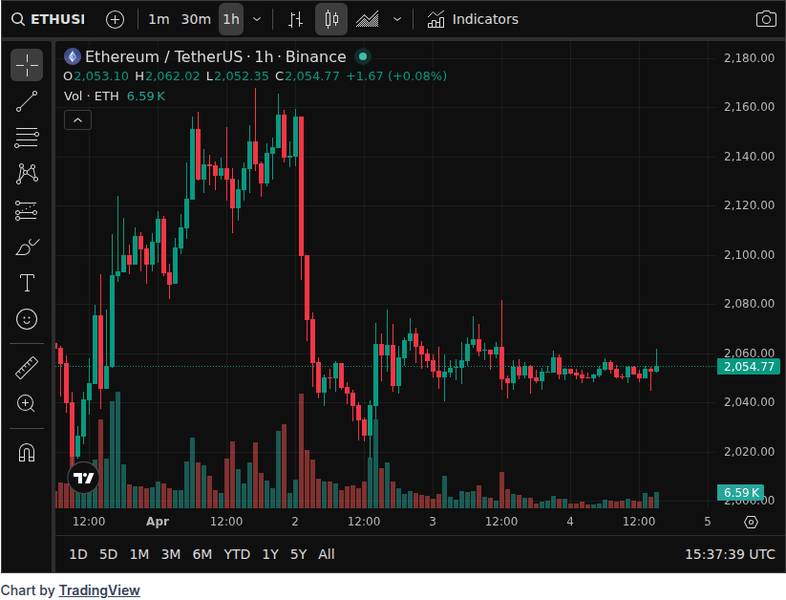 CoinGecko chart illustrating the price backdrop referenced in this article on ethereum.
The $2,050 zone is notable because ETH has consolidated around it without building clear momentum in either direction. Holding above this level keeps the door open for a push toward resistance near $2,149, a level flagged by analysts as the next meaningful hurdle.
A sustained drop below $2,050 would shift the picture. Bearish scenarios have pointed to potential downside toward roughly $1,728 if demand fails to materialize, a risk that becomes more concrete if volume continues to thin out at current levels.
Meanwhile, Ethereum’s DeFi ecosystem showed total value locked of about $52.765 billion, suggesting that on-chain activity remains substantial even as price action stalls. Protocol-level engagement has not dried up, which provides some floor for the network’s valuation case.
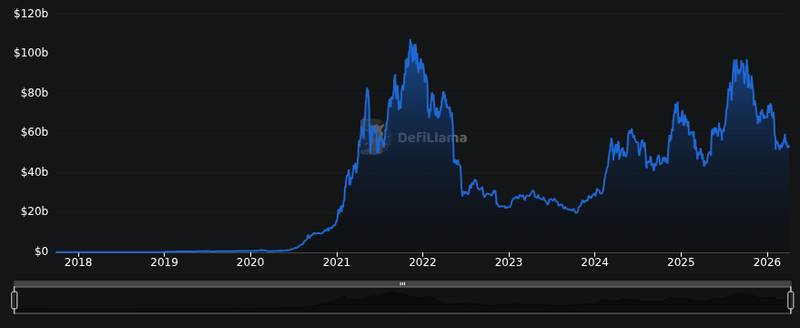 DefiLlama protocol snapshot backing the DeFi usage narrative around ethereum.
What needs to happen for ETH to break out from here
The Ethereum Foundation staking initiative is a supportive narrative, but the evidence does not confirm it as a standalone breakout catalyst. The broader market’s Fear and Greed Index sat at 11, deep in “Extreme Fear” territory, on April 4, 2026. That kind of sentiment environment typically suppresses the follow-through buying needed to sustain a move higher.
For ETH to convincingly break above $2,050 and challenge resistance, several conditions would need to align. Trading volume, currently at $5.89 billion over 24 hours, would need to expand meaningfully. The broader crypto market, including Bitcoin’s trajectory and ETF flow dynamics, would need to stabilize or turn constructive.
The EF staking program removes supply from circulation, which is mechanically supportive. Approximately 70,000 ETH locked in validators is material, though it represents a small fraction of ETH’s total circulating supply. The real test is whether it shifts sentiment enough to attract fresh capital.
On the other side, analysts have argued that EF staking alone may not be enough to prevent further downside if macro conditions or broader DeFi weakness persist. The conditional framing of the headline, “can staking spark a breakout,” reflects the genuine uncertainty in the current setup.
ETH sits at a level where the staking narrative provides a reason for optimism, but the extreme fear reading and thin momentum suggest that traders will need more than one catalyst before committing to a directional move. The next few weeks, as the EF completes its remaining validator deposits, will test whether the initiative’s signal value translates into measurable price action.
Disclaimer: This article is for informational purposes only and does not constitute financial or investment advice. Cryptocurrency and digital asset markets carry significant risk. Always do your own research before making decisions.


You May Also Like

Coinbase Urges Treasury to Clarify GENIUS Act Implementation

Q2 Market Insights: Bitcoin regains dominance in risk-averse environment, ETFs remain critical to market structure




