Praetorian Group CEO Ramil Ventura Palafox pleads guilty to $200M Bitcoin Ponzi scheme that defrauded 90,000 investors. Ramil Ventura Palafox, the chief executive of Praetorian Group International (PGI), has pleaded guilty to wire fraud and money laundering.  Prosecutors say that he ran a Bitcoin Ponzi scheme that drew more than $201 million from 90,000 investors […] The post Ramil Palafox Pleads Guilty To Defrauding More Than 90,000 Investors Of $200M appeared first on Live Bitcoin News.Praetorian Group CEO Ramil Ventura Palafox pleads guilty to $200M Bitcoin Ponzi scheme that defrauded 90,000 investors. Ramil Ventura Palafox, the chief executive of Praetorian Group International (PGI), has pleaded guilty to wire fraud and money laundering.  Prosecutors say that he ran a Bitcoin Ponzi scheme that drew more than $201 million from 90,000 investors […] The post Ramil Palafox Pleads Guilty To Defrauding More Than 90,000 Investors Of $200M appeared first on Live Bitcoin News.

Ramil Palafox Pleads Guilty To Defrauding More Than 90,000 Investors Of $200M

2025/09/19 14:30
3 min read
For feedback or concerns regarding this content, please contact us at crypto.news@mexc.com

Praetorian Group CEO Ramil Ventura Palafox pleads guilty to $200M Bitcoin Ponzi scheme that defrauded 90,000 investors.

Ramil Ventura Palafox, the chief executive of Praetorian Group International (PGI), has pleaded guilty to wire fraud and money laundering. 

Prosecutors say that he ran a Bitcoin Ponzi scheme that drew more than $201 million from 90,000 investors between 2019 and 2021.

The 60-year-old, a dual citizen of the United States and the Philippines, promised investors daily profits of 0.5% to 3%. In reality, PGI never operated a trading program that was capable of producing such returns. Instead, Palafox ran what is now being described as a “textbook Ponzi scheme”.

How the Bitcoin Ponzi Scheme Worked

PGI promoted itself as a high-volume Bitcoin trading platform that used “AI arbitrage” to secure profits. Its marketing materials and a multi-level marketing structure encouraged members to recruit others, which fueled its growth.

Between December 2019 and October 2021, PGI collected $30.3 million in cash and more than 8,000 Bitcoin worth about $171.5 million at the time.

Investors logged into an online portal that displayed fake account balances and fake growth. These updates reassured participants that their funds were safe and growing, even as losses mounted in the background.

The interesting aspect of this scam is that it was similar to other crypto schemes like BitConnect, PlusToken, and OneCoin. 

It promised unrealistic returns, aggressive recruitment and used fake dashboards to deceive investors. By late 2021, PGI collapsed and left investors unable to recover their funds.

Lavish Spending With Investor Funds

Court filings show that Palafox treated investor deposits as his personal bank account. He spent about $3 million on 20 luxury vehicles like Lamborghinis, Ferraris, Porsches, McLarens, Bentleys, and BMW models.

He bought four homes in Las Vegas and Los Angeles worth over $6 million. Records also show $329,000 spent on penthouse hotel stays and another $3 million on high-end clothing, watches, jewellery and furnishings from brands like Cartier, Rolex, Gucci and Hermes.

At least $800,000 in cash and 100 Bitcoin, valued at $3.3 million at the time, were transferred to a family member. While PGI raised over $201 million, prosecutors estimate that victims collectively lost at least $62.7 million.

SEC and DOJ Crackdown on PGI

The U.S. Securities and Exchange Commission charged Palafox and PGI in April of this year and accused him of defrauding investors through a crypto and forex Ponzi scheme. 

The SEC noted that PGI collapsed in 2021, and its website was seized after its UK operations were shut down.

The Justice Department’s case resulted in Palafox’s guilty plea this week in Virginia. 

He agreed to repay $62.7 million in restitution to victims. Additionally, He faces sentencing before Judge Leonie M. Brinkema on February 3. Even though the charges carry a maximum of 40 years in prison, his sentence will likely be shorter under federal guidelines.

What Comes Next For Palafox

Palafox is scheduled for sentencing next year. While prosecutors are pushing for a lengthy term, the final sentence will depend on federal guidelines and his plea agreement.

For the 90,000 investors who lost money, restitution of $62.7 million is still on the table. Still, considering the scale of the scheme, many will never recover their full investments.

The PGI case is another case in the long list of crypto frauds that show the need for careful investing.

Market Opportunity
Moonveil Logo
Moonveil Price(MORE)
$0.0001558
$0.0001558$0.0001558
+3.17%
USD
Moonveil (MORE) Live Price Chart
Disclaimer: The articles reposted on this site are sourced from public platforms and are provided for informational purposes only. They do not necessarily reflect the views of MEXC. All rights remain with the original authors. If you believe any content infringes on third-party rights, please contact crypto.news@mexc.com for removal. MEXC makes no guarantees regarding the accuracy, completeness, or timeliness of the content and is not responsible for any actions taken based on the information provided. The content does not constitute financial, legal, or other professional advice, nor should it be considered a recommendation or endorsement by MEXC.

You May Also Like

Top Low-Cost Cryptocurrencies Analysts Are Watching for 2027

Top Low-Cost Cryptocurrencies Analysts Are Watching for 2027

Investors are now hunting for projects that combine affordability with actual utility. While famous names still hold the spotlight, a new crypto era of decentralized
Share
Techbullion2026/03/14 10:49
Google Cloud taps EigenLayer to bring trust to agentic payments
Google Cloud taps EigenLayer to bring trust to agentic payments

The post Google Cloud taps EigenLayer to bring trust to agentic payments appeared on BitcoinEthereumNews.com. Two days after unveiling AP2 — a universal payment layer for AI agents that supports everything from credit cards to stablecoins — Google and EigenLayer have released details of their partnership to bring verifiability and restaking security to the stack, using Ethereum. In addition to enabling verifiable compute and slashing-backed payment coordination, EigenCloud will support insured and sovereign AI agents, which introduce consequences for failure or deviation from specified behavior. Sovereign agents are positioned as autonomous actors that can own property, make decisions, and execute actions independently — think smart contracts with embedded intelligence. From demos to dollars AP2 extends Google’s agent-to-agent (A2A) protocol using the HTTP 402 status code — long reserved for “payment required” — to standardize payment requests between agents across different networks. It already supports stablecoins like USDC, and Coinbase has demoed an agent checkout using its Wallet-as-a-Service. Paired with a system like Lit Protocol’s Vincent — which enforces per-action policies and key custody at signing — Google’s AP2 with EigenCloud’s verifiability and cross-chain settlement could form an end-to-end trust loop. Payments between agents aren’t as simple as they are often made to sound by “Crypto x AI” LARPs. When an AI agent requests a payment in USDC on Base and the payer’s funds are locked in ETH on Arbitrum, the transaction stalls — unless something abstracts the bridging, swapping and delivery. That’s where EigenCloud comes in. Sreeram Kannan, founder of EigenLayer, said the integration will create agents that not only run on-chain verifiable compute, but are also economically incentivized to behave within programmable bounds. Through restaked operators, EigenCloud powers a verifiable payment service that handles asset routing and chain abstraction, with dishonest behavior subject to slashing. It also introduces cryptographic accountability to the agents themselves, enabling proofs that an agent actually executed the task it…
Share
BitcoinEthereumNews2025/09/19 03:52
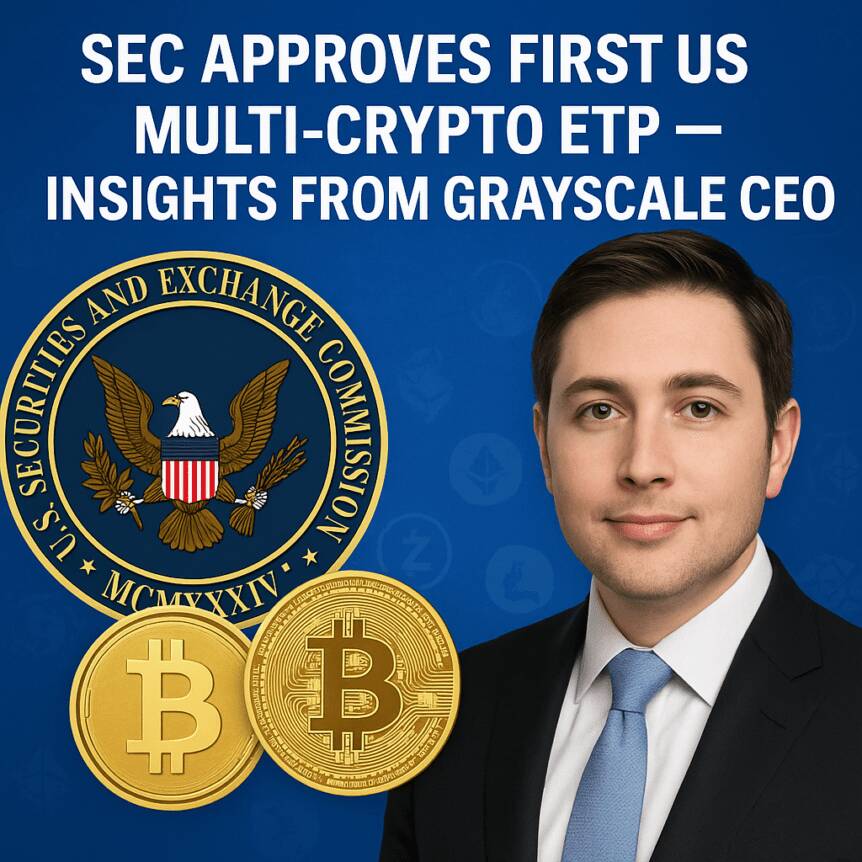
SEC Approves First US Multi-Crypto ETP — Insights from Grayscale CEO

SEC Approves First US Multi-Crypto ETP — Insights from Grayscale CEO

The U.S. Securities and Exchange Commission (SEC) has greenlit the first multi-asset cryptocurrency exchange-traded product (ETP) in the United States, authorizing Grayscale’s Digital Large Cap Fund (GLDC) for public listing. This groundbreaking development offers investors exposure to five leading cryptocurrencies: Bitcoin (BTC), Ethereum (ETH), XRP (XRP), Solana (SOL), and Cardano (ADA). The approval, disclosed in [...]
Share
Crypto Breaking News2025/09/18 17:26