The post Mamadou Kwidjim Toure, Founder and CEO at Ubuntu Tribe appeared on BitcoinEthereumNews.com. Questions: The visionary man, Mamadou Kwidjim Toure, has led an initiative, Africa 2.0, to transform and empower the country by uniting a diverse group of young emerging leaders from all across Africa. Toure, who has been featured as one of the top 10 most powerful men of Africa by Forbes, has shared deep insights into his journey with CoinEdition in an interview. 1. You’ve had a long 20 years of career in the finance sector, and currently you are heading the Ubuntu Group as CEO.  Can you tell us the moment or realization that made you pivot into blockchain and token-based models? I didn’t wake up one morning and decide to “do crypto.” My journey started in development finance, working with institutions like the IFC and the World Bank ecosystem, where I kept seeing the same paradox: Africa is one of the richest regions in natural and human resources, yet its people are among the poorest. There was clearly a structural problem in how value is created, stored, and distributed. The real inflection point came around 2015–2016, when I began to deeply study blockchain. For the first time, I saw a technology that could hard-code transparency, fractional ownership, and borderless access into the financial system itself. Later, when we launched Ubuntu Tribe, the insight was simple: if you can tokenize gold down to 1 milligram and make it accessible from a basic smartphone, you are rewriting who gets to participate in the global store of value. So it wasn’t a pivot away from finance; it was a continuation of the same mission with better tools. Blockchain and tokenization are, for me, the missing rails to deliver what development finance has promised for decades: shared prosperity, not just for institutions and elites, but for everyday people. 2. Why do you think… The post Mamadou Kwidjim Toure, Founder and CEO at Ubuntu Tribe appeared on BitcoinEthereumNews.com. Questions: The visionary man, Mamadou Kwidjim Toure, has led an initiative, Africa 2.0, to transform and empower the country by uniting a diverse group of young emerging leaders from all across Africa. Toure, who has been featured as one of the top 10 most powerful men of Africa by Forbes, has shared deep insights into his journey with CoinEdition in an interview. 1. You’ve had a long 20 years of career in the finance sector, and currently you are heading the Ubuntu Group as CEO.  Can you tell us the moment or realization that made you pivot into blockchain and token-based models? I didn’t wake up one morning and decide to “do crypto.” My journey started in development finance, working with institutions like the IFC and the World Bank ecosystem, where I kept seeing the same paradox: Africa is one of the richest regions in natural and human resources, yet its people are among the poorest. There was clearly a structural problem in how value is created, stored, and distributed. The real inflection point came around 2015–2016, when I began to deeply study blockchain. For the first time, I saw a technology that could hard-code transparency, fractional ownership, and borderless access into the financial system itself. Later, when we launched Ubuntu Tribe, the insight was simple: if you can tokenize gold down to 1 milligram and make it accessible from a basic smartphone, you are rewriting who gets to participate in the global store of value. So it wasn’t a pivot away from finance; it was a continuation of the same mission with better tools. Blockchain and tokenization are, for me, the missing rails to deliver what development finance has promised for decades: shared prosperity, not just for institutions and elites, but for everyday people. 2. Why do you think…

Mamadou Kwidjim Toure, Founder and CEO at Ubuntu Tribe

Questions:

The visionary man, Mamadou Kwidjim Toure, has led an initiative, Africa 2.0, to transform and empower the country by uniting a diverse group of young emerging leaders from all across Africa. Toure, who has been featured as one of the top 10 most powerful men of Africa by Forbes, has shared deep insights into his journey with CoinEdition in an interview.

1. You’ve had a long 20 years of career in the finance sector, and currently you are heading the Ubuntu Group as CEO.  Can you tell us the moment or realization that made you pivot into blockchain and token-based models?

I didn’t wake up one morning and decide to “do crypto.” My journey started in development finance, working with institutions like the IFC and the World Bank ecosystem, where I kept seeing the same paradox: Africa is one of the richest regions in natural and human resources, yet its people are among the poorest. There was clearly a structural problem in how value is created, stored, and distributed.

The real inflection point came around 2015–2016, when I began to deeply study blockchain. For the first time, I saw a technology that could hard-code transparency, fractional ownership, and borderless access into the financial system itself. Later, when we launched Ubuntu Tribe, the insight was simple: if you can tokenize gold down to 1 milligram and make it accessible from a basic smartphone, you are rewriting who gets to participate in the global store of value.

So it wasn’t a pivot away from finance; it was a continuation of the same mission with better tools. Blockchain and tokenization are, for me, the missing rails to deliver what development finance has promised for decades: shared prosperity, not just for institutions and elites, but for everyday people.

2. Why do you think blockchain and AI are essential for the economic empowerment of Africa?

Africa is young, mobile-first, and still largely excluded from traditional financial and data infrastructure. That combination is both a risk and a huge opportunity. Blockchain gives us a way to build trust where institutions are weak, and AI gives us a way to turn data and creativity into economic value at scale. Together, they compress the time it takes for a young African to go from “idea” to “global participant.”

On the blockchain side, tokenization allows us to connect our real assets—gold, commodities, infrastructure, even carbon and culture—to global capital markets in a transparent way. Instead of value being extracted and booked elsewhere, it can be shared more fairly, and people can hold digital claims to real assets from as little as a few cents. That is extremely powerful for savings, remittances, and resilience in volatile economies.

AI then sits on top as a multiplier and an equalizer. It can help farmers get better prices and forecasts, SMEs access credit scoring based on real behavior rather than lack of paperwork, and young developers build applications in weeks that used to take years for large teams. If we combine blockchain’s trust layer with AI’s intelligence layer, we can design systems where Africans are not just users, but co-owners and co-creators of the value they generate.

3. What are the problems the $GIFT gold fungible token is solving in terms of financial and social mobility?

Gold has always been a store of value, but for most people—especially in emerging markets—it’s been difficult to access in a safe, liquid, and affordable way. With $GIFT Gold, we took a very simple idea: make gold ownable by the milligram on-chain, 100% backed by audited, insured physical gold in secure vaults, and regulated under European law. That means someone can start saving in gold from around ten cents, directly from their phone.

The first problem we solve is accessible savings in a hard asset. In many African and emerging economies, people save in cash or unstable local currencies. By allowing micro-savings in tokenized gold, $GIFT helps protect purchasing power and offers a gateway to long-term wealth preservation. The second problem is mobility: because $GIFT is on-chain, you can send value across borders in minutes, not days, often at a fraction of the cost of traditional remittances.

There is also a social mobility dimension. When communities have an easy, trusted way to accumulate assets, they can start thinking beyond survival—investing in education, entrepreneurship, and local projects. In the long run, we see $GIFT as part of a broader ecosystem where tokenized real-world assets become collateral for credit, participation in DeFi, and collective investment vehicles that were previously reserved for the few.

4. In the African context, what are the biggest challenges that you’re facing right now in implementing blockchain-based asset models, and how are you navigating them?

The first big challenge is regulatory clarity. Many African regulators are still in the exploratory phase around digital assets. They are rightly concerned about consumer protection, capital flight, and systemic risk. At the same time, the absence of clear frameworks can slow down innovation and scare away serious players. Our approach has been to build under strong jurisdictions—like Europe’s MiCA framework for $GIFT—while engaging African policymakers through dialogue, education, and pilot projects rather than confrontation.

The second challenge is education and trust. For a farmer, trader, or teacher, “tokenized gold on a blockchain” is abstract. People need to see, touch, and understand the benefits. That’s why we invest heavily in partnerships with local fintechs, mobile money operators, and community organizations, so that digital gold becomes as intuitive as topping up airtime. We also emphasize that each token is backed by real gold in real vaults—this is not speculation, it’s asset ownership.

Finally, there’s infrastructure: connectivity, identity, and on/off-ramps. You can’t scale tokenized assets without reliable ways to move between cash, mobile money, crypto, and back. We’re solving this step by step by integrating with existing rails—cards, wallets, exchanges—and by designing our products to work on low-bandwidth devices. It’s slower than building for a fully banked market, but it’s also where the deepest impact lies.

5. How are Africa 2.0 initiatives supporting technological innovation and economic stability in society? What I ask here is the impact that is being created through this initiative

When we launched Africa 2.0 back in 2010, the idea was to create a “D-ink tank”—a think tank that does things—bringing together emerging African leaders with a shared vision for the continent. We developed a Manifesto for Africa, not just as a document, but as a roadmap to mobilize talent, capital, and policy toward shared prosperity.

In practice, Africa 2.0 has been a platform to prototype solutions: from entrepreneurship and youth employment programs to policy recommendations on governance, infrastructure, and digital transformation. It has helped incubate projects, convene stakeholders, and create a new narrative: that Africans are not victims of history, but co-authors of their future. Many of the leaders involved have gone on to launch companies, funds, and initiatives that are now shaping the tech and innovation landscape.

For me personally, Africa 2.0 was the “leadership school” that led to the Ubuntu Group and the Ubuntu Tribe. The work we do today in tokenization and inclusive finance is a direct continuation of that original mission: using cutting-edge tools to solve age-old problems. So the impact of Africa 2.0 is both tangible—in programs, policies, networks—and symbolic: it has helped shift the mindset from aid-dependency to co-creation and ownership.

6. Before exploring the blockchain, you have spent over a decade of experience in development finance. So, can you please take us through the advantages that blockchain brings that the traditional financial system lacks?

Traditional finance has done important things: it financed infrastructure, supported trade, and helped many countries grow. But it was never designed for inclusivity at the edge. It is expensive to serve low-income customers, slow to adapt, and highly centralized. In my years in development finance, I saw how capital often stopped at the level of governments and large corporates, with very little trickling down to the micro-entrepreneur, the farmer, or the informal worker.

Blockchain changes the physics of how value moves. First, it enables programmable trust: rules can be encoded into smart contracts, reducing the need for expensive intermediaries. This lowers transaction costs and allows us to economically serve a person who wants to save or send just a few dollars. Second, it introduces radical transparency: every transaction can be auditable, which is crucial in environments where corruption and leakages have historically undermined development efforts.

Third, blockchain enables fractional and borderless ownership. You can now hold a fraction of a building, a kilogram of cocoa, or a milligram of gold, and trade or collateralize it from your phone. That is something traditional finance has struggled to offer at scale without complex and costly structures. Importantly, I don’t see blockchain as replacing the old system overnight. I see it as a new layer that, if built responsibly, can extend the reach of finance to billions of people who have talent and ambition, but lack access to fair tools.

Disclaimer: The information presented in this article is for informational and educational purposes only. The article does not constitute financial advice or advice of any kind. Coin Edition is not responsible for any losses incurred as a result of the utilization of content, products, or services mentioned. Readers are advised to exercise caution before taking any action related to the company.

Source: https://coinedition.com/mamadou-kwidjim-toure-founder-and-ceo-at-ubuntu-group/

Market Opportunity
TRIBE Logo
TRIBE Price(TRIBE)
$0.5102
$0.5102$0.5102
-0.01%
USD
TRIBE (TRIBE) Live Price Chart
Disclaimer: The articles reposted on this site are sourced from public platforms and are provided for informational purposes only. They do not necessarily reflect the views of MEXC. All rights remain with the original authors. If you believe any content infringes on third-party rights, please contact service@support.mexc.com for removal. MEXC makes no guarantees regarding the accuracy, completeness, or timeliness of the content and is not responsible for any actions taken based on the information provided. The content does not constitute financial, legal, or other professional advice, nor should it be considered a recommendation or endorsement by MEXC.

You May Also Like

China Blocks Nvidia’s RTX Pro 6000D as Local Chips Rise

China Blocks Nvidia’s RTX Pro 6000D as Local Chips Rise

The post China Blocks Nvidia’s RTX Pro 6000D as Local Chips Rise appeared on BitcoinEthereumNews.com. China Blocks Nvidia’s RTX Pro 6000D as Local Chips Rise China’s internet regulator has ordered the country’s biggest technology firms, including Alibaba and ByteDance, to stop purchasing Nvidia’s RTX Pro 6000D GPUs. According to the Financial Times, the move shuts down the last major channel for mass supplies of American chips to the Chinese market. Why Beijing Halted Nvidia Purchases Chinese companies had planned to buy tens of thousands of RTX Pro 6000D accelerators and had already begun testing them in servers. But regulators intervened, halting the purchases and signaling stricter controls than earlier measures placed on Nvidia’s H20 chip. Image: Nvidia An audit compared Huawei and Cambricon processors, along with chips developed by Alibaba and Baidu, against Nvidia’s export-approved products. Regulators concluded that Chinese chips had reached performance levels comparable to the restricted U.S. models. This assessment pushed authorities to advise firms to rely more heavily on domestic processors, further tightening Nvidia’s already limited position in China. China’s Drive Toward Tech Independence The decision highlights Beijing’s focus on import substitution — developing self-sufficient chip production to reduce reliance on U.S. supplies. “The signal is now clear: all attention is focused on building a domestic ecosystem,” said a representative of a leading Chinese tech company. Nvidia had unveiled the RTX Pro 6000D in July 2025 during CEO Jensen Huang’s visit to Beijing, in an attempt to keep a foothold in China after Washington restricted exports of its most advanced chips. But momentum is shifting. Industry sources told the Financial Times that Chinese manufacturers plan to triple AI chip production next year to meet growing demand. They believe “domestic supply will now be sufficient without Nvidia.” What It Means for the Future With Huawei, Cambricon, Alibaba, and Baidu stepping up, China is positioning itself for long-term technological independence. Nvidia, meanwhile, faces…
Share
BitcoinEthereumNews2025/09/18 01:37
Ripple-Backed Evernorth Faces $220M Loss on XRP Holdings Amid Market Slump

Ripple-Backed Evernorth Faces $220M Loss on XRP Holdings Amid Market Slump

TLDR Evernorth invested $947M in XRP, now valued at $724M, a loss of over $220M. XRP’s price dropped 16% in the last 30 days, leading to Evernorth’s paper losses
Share
Coincentral2025/12/26 03:56
Lovable AI’s Astonishing Rise: Anton Osika Reveals Startup Secrets at Bitcoin World Disrupt 2025

Lovable AI’s Astonishing Rise: Anton Osika Reveals Startup Secrets at Bitcoin World Disrupt 2025

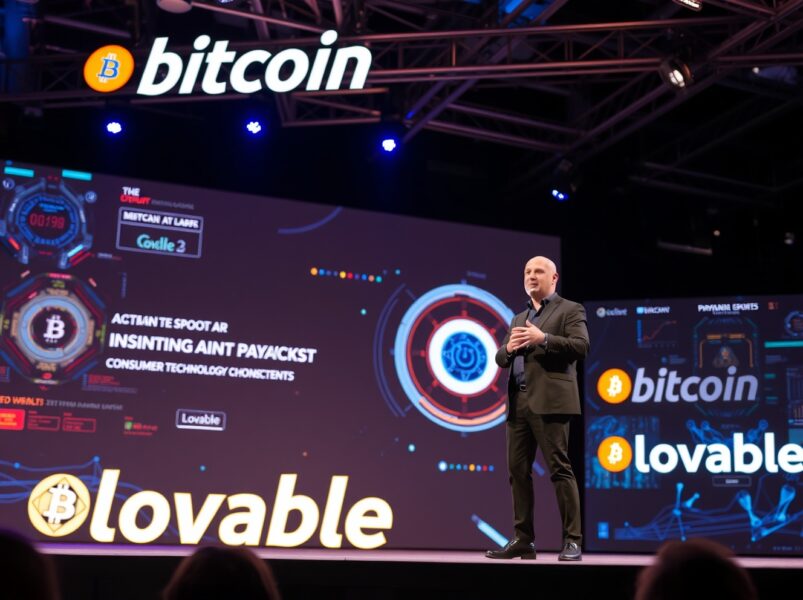
BitcoinWorld Lovable AI’s Astonishing Rise: Anton Osika Reveals Startup Secrets at Bitcoin World Disrupt 2025 Are you ready to witness a phenomenon? The world of technology is abuzz with the incredible rise of Lovable AI, a startup that’s not just breaking records but rewriting the rulebook for rapid growth. Imagine creating powerful apps and websites just by speaking to an AI – that’s the magic Lovable brings to the masses. This groundbreaking approach has propelled the company into the spotlight, making it one of the fastest-growing software firms in history. And now, the visionary behind this sensation, co-founder and CEO Anton Osika, is set to share his invaluable insights on the Disrupt Stage at the highly anticipated Bitcoin World Disrupt 2025. If you’re a founder, investor, or tech enthusiast eager to understand the future of innovation, this is an event you cannot afford to miss. Lovable AI’s Meteoric Ascent: Redefining Software Creation In an era where digital transformation is paramount, Lovable AI has emerged as a true game-changer. Its core premise is deceptively simple yet profoundly impactful: democratize software creation. By enabling anyone to build applications and websites through intuitive AI conversations, Lovable is empowering the vast majority of individuals who lack coding skills to transform their ideas into tangible digital products. This mission has resonated globally, leading to unprecedented momentum. The numbers speak for themselves: Achieved an astonishing $100 million Annual Recurring Revenue (ARR) in less than a year. Successfully raised a $200 million Series A funding round, valuing the company at $1.8 billion, led by industry giant Accel. Is currently fielding unsolicited investor offers, pushing its valuation towards an incredible $4 billion. As industry reports suggest, investors are unequivocally “loving Lovable,” and it’s clear why. This isn’t just about impressive financial metrics; it’s about a company that has tapped into a fundamental need, offering a solution that is both innovative and accessible. The rapid scaling of Lovable AI provides a compelling case study for any entrepreneur aiming for similar exponential growth. The Visionary Behind the Hype: Anton Osika’s Journey to Innovation Every groundbreaking company has a driving force, and for Lovable, that force is co-founder and CEO Anton Osika. His journey is as fascinating as his company’s success. A physicist by training, Osika previously contributed to the cutting-edge research at CERN, the European Organization for Nuclear Research. This deep technical background, combined with his entrepreneurial spirit, has been instrumental in Lovable’s rapid ascent. Before Lovable, he honed his skills as a co-founder of Depict.ai and a Founding Engineer at Sana. Based in Stockholm, Osika has masterfully steered Lovable from a nascent idea to a global phenomenon in record time. His leadership embodies a unique blend of profound technical understanding and a keen, consumer-first vision. At Bitcoin World Disrupt 2025, attendees will have the rare opportunity to hear directly from Osika about what it truly takes to build a brand that not only scales at an incredible pace in a fiercely competitive market but also adeptly manages the intense cultural conversations that inevitably accompany such swift and significant success. His insights will be crucial for anyone looking to understand the dynamics of high-growth tech leadership. Unpacking Consumer Tech Innovation at Bitcoin World Disrupt 2025 The 20th anniversary of Bitcoin World is set to be marked by a truly special event: Bitcoin World Disrupt 2025. From October 27–29, Moscone West in San Francisco will transform into the epicenter of innovation, gathering over 10,000 founders, investors, and tech leaders. It’s the ideal platform to explore the future of consumer tech innovation, and Anton Osika’s presence on the Disrupt Stage is a highlight. His session will delve into how Lovable is not just participating in but actively shaping the next wave of consumer-facing technologies. Why is this session particularly relevant for those interested in the future of consumer experiences? Osika’s discussion will go beyond the superficial, offering a deep dive into the strategies that have allowed Lovable to carve out a unique category in a market long thought to be saturated. Attendees will gain a front-row seat to understanding how to identify unmet consumer needs, leverage advanced AI to meet those needs, and build a product that captivates users globally. The event itself promises a rich tapestry of ideas and networking opportunities: For Founders: Sharpen your pitch and connect with potential investors. For Investors: Discover the next breakout startup poised for massive growth. For Innovators: Claim your spot at the forefront of technological advancements. The insights shared regarding consumer tech innovation at this event will be invaluable for anyone looking to navigate the complexities and capitalize on the opportunities within this dynamic sector. Mastering Startup Growth Strategies: A Blueprint for the Future Lovable’s journey isn’t just another startup success story; it’s a meticulously crafted blueprint for effective startup growth strategies in the modern era. Anton Osika’s experience offers a rare glimpse into the practicalities of scaling a business at breakneck speed while maintaining product integrity and managing external pressures. For entrepreneurs and aspiring tech leaders, his talk will serve as a masterclass in several critical areas: Strategy Focus Key Takeaways from Lovable’s Journey Rapid Scaling How to build infrastructure and teams that support exponential user and revenue growth without compromising quality. Product-Market Fit Identifying a significant, underserved market (the 99% who can’t code) and developing a truly innovative solution (AI-powered app creation). Investor Relations Balancing intense investor interest and pressure with a steadfast focus on product development and long-term vision. Category Creation Carving out an entirely new niche by democratizing complex technologies, rather than competing in existing crowded markets. Understanding these startup growth strategies is essential for anyone aiming to build a resilient and impactful consumer experience. Osika’s session will provide actionable insights into how to replicate elements of Lovable’s success, offering guidance on navigating challenges from product development to market penetration and investor management. Conclusion: Seize the Future of Tech The story of Lovable, under the astute leadership of Anton Osika, is a testament to the power of innovative ideas meeting flawless execution. Their remarkable journey from concept to a multi-billion-dollar valuation in record time is a compelling narrative for anyone interested in the future of technology. By democratizing software creation through Lovable AI, they are not just building a company; they are fostering a new generation of creators. His appearance at Bitcoin World Disrupt 2025 is an unmissable opportunity to gain direct insights from a leader who is truly shaping the landscape of consumer tech innovation. Don’t miss this chance to learn about cutting-edge startup growth strategies and secure your front-row seat to the future. Register now and save up to $668 before Regular Bird rates end on September 26. To learn more about the latest AI market trends, explore our article on key developments shaping AI features. This post Lovable AI’s Astonishing Rise: Anton Osika Reveals Startup Secrets at Bitcoin World Disrupt 2025 first appeared on BitcoinWorld.
Share
Coinstats2025/09/17 23:40