85% Hyperliquid validators voted in support of the permanent burning of HYPE tokens in the Assistance Fund address. HYPE price plunged to $23.93 despite token burn85% Hyperliquid validators voted in support of the permanent burning of HYPE tokens in the Assistance Fund address. HYPE price plunged to $23.93 despite token burn

Hyper Foundation Confirms Permanent Burn of HYPE Tokens at Assistance Fund Address

  • 85% Hyperliquid validators voted in support of the permanent burning of HYPE tokens in the Assistance Fund address.
  • HYPE price plunged to $23.93 despite token burn and other major developments on the Hyperliquid network.

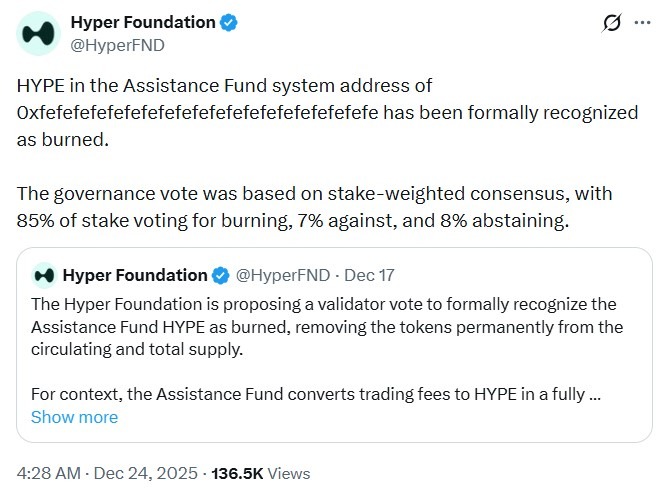
The Hyper Foundation has confirmed the permanent burn of all HYPE tokens in the Assistance Fund Address. This move is backed by an 85% stake-weighted validator positive vote, while 7% voted against and 8% abstained. Hyper Foundation, the organization behind Hyperliquid, a decentralized perpetual futures exchange, confirmed the HYPE token burn on X.

The Assistance Fund is a built-in protocol mechanism in Hyperliquid. It automatically converts a portion of the platform’s trading fees into HYPE tokens. These tokens are transferred to a special system address, 0xfefefefefefefefefefefefefefefefefefefefe.
Hyperliquid Token BurnsHyperliquid Token Burns | Source: Hyper Foundation

This Assistance Fund address has no private key and is designed to be inaccessible, similar to the zero address. The tokens there are mathematically irretrievable without a major protocol hard fork or upgrade. While the HYPE tokens were technically already out of circulation, they were still counted in the official total circulating supply metrics. 

Hence, the Hyper Foundation proposed a governance validator vote on December 17, which ran until December 24, 2025. They designed the proposal as a binding social consensus via governance. Validators’ votes were weighted by the amount of HYPE staked or delegated to them. Accordingly, token holders could delegate their stake to influence the vote outcome. According to the result, 85% validators voted in favor of burning, 7% against, while 8% were absent. 

In the future, trading fees routed to the Assistance Fund will also be considered burned. Accordingly, trading fees now act like a continuous buyback-and-burn mechanism. Additionally, the confirmation from Hyper Foundation removes uncertainty about whether the Assistance Fund tokens could return to circulation.

A Strong Hyperliquid Network

The burning of all HYPE tokens on the Assistance Fund address is a major governance win for Hyperliquid. It formalizes a deflationary move that aligns reported token economics with the actual design of the protocol.  Additionally, it signals strong community support for long-term scarcity and transparency. Furthermore, it shows that validators can make technical and economic decisions without relying on emergency upgrades. 

It also highlights a growing trend in blockchain governance. Networks increasingly rely on social consensus to formalize outcomes that code already enforces. Currently, the HYPE token is down 1.7% over the previous day to trade at $23.93. The daily trading volume also decreased by 14.05% to $179.7 million.

Intriguingly, the HYPE token burn news follows some major developments on the network. For instance, Hyperliquid has introduced a portfolio margin for spot and perps integration. As we discussed earlier, the new feature allows positions to be managed from a single, unified balance.

In a related development, Sonnet BioTherapeutics shareholders approved a merger between Hyperliquid Strategies and Rorschach I LLC. This approval clears the final hurdle in its transition into a digital asset treasury holding HYPE tokens.

]]>
Disclaimer: The articles reposted on this site are sourced from public platforms and are provided for informational purposes only. They do not necessarily reflect the views of MEXC. All rights remain with the original authors. If you believe any content infringes on third-party rights, please contact service@support.mexc.com for removal. MEXC makes no guarantees regarding the accuracy, completeness, or timeliness of the content and is not responsible for any actions taken based on the information provided. The content does not constitute financial, legal, or other professional advice, nor should it be considered a recommendation or endorsement by MEXC.

You May Also Like

Social engineering kost crypto miljarden in 2025

Social engineering kost crypto miljarden in 2025

De grootste dreiging voor crypto zit niet altijd in bugs of fouten in de code. Vaak gaat het fout bij mensen zelf. Nieuwe cijfers over 2025 laten zien hoe misleiding
Share
Coinstats2025/12/26 03:01
Christmas Stocking Stuffers? Don't Ignore These Bitcoin Mining Stocks That Gave Impressive Returns In 2025

Christmas Stocking Stuffers? Don't Ignore These Bitcoin Mining Stocks That Gave Impressive Returns In 2025

Christmas brings cheer, cakes and cozy vibes, but it can also be a perfect time for kicking off investments you may not have considered before.read more
Share
Coinstats2025/12/26 03:01
China Blocks Nvidia’s RTX Pro 6000D as Local Chips Rise

China Blocks Nvidia’s RTX Pro 6000D as Local Chips Rise

The post China Blocks Nvidia’s RTX Pro 6000D as Local Chips Rise appeared on BitcoinEthereumNews.com. China Blocks Nvidia’s RTX Pro 6000D as Local Chips Rise China’s internet regulator has ordered the country’s biggest technology firms, including Alibaba and ByteDance, to stop purchasing Nvidia’s RTX Pro 6000D GPUs. According to the Financial Times, the move shuts down the last major channel for mass supplies of American chips to the Chinese market. Why Beijing Halted Nvidia Purchases Chinese companies had planned to buy tens of thousands of RTX Pro 6000D accelerators and had already begun testing them in servers. But regulators intervened, halting the purchases and signaling stricter controls than earlier measures placed on Nvidia’s H20 chip. Image: Nvidia An audit compared Huawei and Cambricon processors, along with chips developed by Alibaba and Baidu, against Nvidia’s export-approved products. Regulators concluded that Chinese chips had reached performance levels comparable to the restricted U.S. models. This assessment pushed authorities to advise firms to rely more heavily on domestic processors, further tightening Nvidia’s already limited position in China. China’s Drive Toward Tech Independence The decision highlights Beijing’s focus on import substitution — developing self-sufficient chip production to reduce reliance on U.S. supplies. “The signal is now clear: all attention is focused on building a domestic ecosystem,” said a representative of a leading Chinese tech company. Nvidia had unveiled the RTX Pro 6000D in July 2025 during CEO Jensen Huang’s visit to Beijing, in an attempt to keep a foothold in China after Washington restricted exports of its most advanced chips. But momentum is shifting. Industry sources told the Financial Times that Chinese manufacturers plan to triple AI chip production next year to meet growing demand. They believe “domestic supply will now be sufficient without Nvidia.” What It Means for the Future With Huawei, Cambricon, Alibaba, and Baidu stepping up, China is positioning itself for long-term technological independence. Nvidia, meanwhile, faces…
Share
BitcoinEthereumNews2025/09/18 01:37