

Why Is Crypto Up Today? – January 13, 2026
The crypto market is trading slightly higher today, with total cryptocurrency market capitalization rising by around 1.7% over the past 24 hours to approximately $3.22 trillion. Despite the modest gain, price action across major assets remains mixed. Total 24-hour trading volume stands at roughly $115.6 billion, signaling steady but restrained activity compared with recent peaks.
TLDR:
- Crypto market cap rose 1.7% in the past 24 hours to $3.22T;
- BTC is up 1.7% near $92,169, while ETH gained 0.7% to $3,136;
- VanEck called 2026 a “risk-on” year, citing clearer fiscal and monetary policy visibility;
- Bitcoin remains range-bound near $91K–$92K as global stocks rally;
- ETH faces resistance at $3,180–$3,300 and support around $3,100–$3,000;
- Crypto sentiment is neutral, with the Fear & Greed Index at 41;
- US BTC spot ETFs saw $116.67M in net inflows, lifting cumulative inflows to $56.52B;
- US ETH spot ETFs posted modest inflows of $5.04M;
- Former NYC Mayor Eric Adams’ NYC Token briefly hit a $580M market cap before crashing 80%.
Crypto Winners & Losers
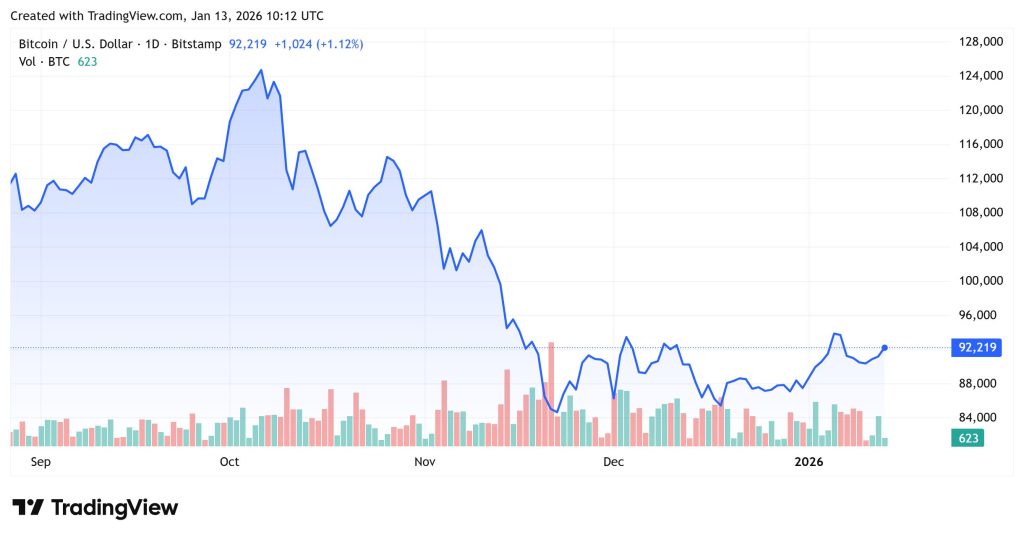
Bitcoin (BTC) is trading near $92,169, up about 1.7% over the past 24 hours, helping support the broader market.
Ethereum (ETH) is also in positive territory, rising 0.7% to around $3,136, though it remains lower on a weekly basis.
Solana (SOL) is among the stronger performers in the top 10, climbing 3.0% to roughly $141.79.
It is followed by TRON (TRX), which gained 2.3%, trading near $0.299. BNB (BNB) posted a modest 0.1% increase, changing hands around $908.50.
On the downside, XRP (XRP) is the weakest performer among major tokens, sliding 11.5% over the past seven days and trading near $2.06.
Dogecoin (DOGE) has also struggled, dropping 6.8% on the week to about $0.1396. Cardano (ADA) is down 5.3% over the same period, currently priced near $0.393.
Outside the top 10, privacy-focused Monero (XMR) is the standout gainer, surging more than 50% over the past seven days and trading around $671.61.
Dash (DASH) has also seen strong momentum, rising nearly 37% over the past week to approximately $51.08.
Among the top gainers, Pirate Chain (ARRR) and Dolomite (DOLO) posted gains of more than 50%.
Meanwhile, VanEck has declared 2026 a “risk-on” year for investors despite Bitcoin breaking its traditional four-year cycle, with CEO Jan van Eck positioning artificial intelligence, private credit, and gold as compelling opportunities following late-2025 corrections.
The asset manager’s Q1 2026 outlook emphasizes unprecedented visibility into fiscal and monetary policy, marking a sharp departure from recent years, when economic uncertainty dominated markets, and contrasting with Goldman Sachs’ forecast of 11% global stock returns driven primarily by equities over alternative assets.
Bitcoin Holds Near $91K as Global Stocks Rally and CPI Looms
Bitcoin hovered around $91,000 on Tuesday, showing little direction as traders focused on global equity moves and awaited fresh US macro signals. Japan’s stock market stole the spotlight, with the Nikkei and Topix both hitting record highs, driven by post-holiday catch-up buying, election speculation, and a weaker yen that boosted export-heavy stocks.
Risk appetite remained broadly intact across Asia and the US, following record closes on Wall Street, even as headlines around a Justice Department investigation involving Federal Reserve Chair Jerome Powell lingered in the background. Crypto prices, however, slipped modestly, with Bitcoin, Ether, and XRP all lower on the day, reflecting a pause rather than panic.
Attention is now squarely on US inflation data, with traders viewing the upcoming CPI report and Fed communications as key catalysts for crypto and broader risk assets. Market watchers say Bitcoin appears stuck in a consolidation phase, with rate expectations, dollar moves, and ETF flows likely to dictate the next meaningful move once macro data resets positioning.
Meanwhile, Bitwise Chief Investment Officer Matt Hougan has pushed back sharply against renewed concerns that Bitcoin is too volatile to be considered for retirement accounts.
He called efforts to block the asset from 401(k) plans “ridiculous” and out of step with how risk is treated elsewhere in financial markets.
Levels & Events to Watch Next
At the time of writing on Tuesday, Bitcoin was trading near $92,200, after posting a strong intraday rebound. The price spent much of the prior session consolidating before pushing higher, climbing from an intraday low near $91,100 to a session high around $92,350. Momentum has cooled slightly since, but price remains supported above the $92,000 level.
Over the past week, BTC has traded within a broad $88,500–$94,500 range, reflecting ongoing consolidation after the sharp sell-off seen in November. On a weekly basis, Bitcoin remains modestly lower, with downside moves repeatedly finding buyers in the high-$80,000s.
A sustained close above $92,500 could open the door for a move toward $94,000, followed by a potential retest of the $96,000–$98,000 resistance zone. On the downside, failure to hold above $91,000 would expose support at $89,800, with deeper pullbacks bringing $87,500 into view.
Ethereum is currently trading near $3,136, after recovering from earlier weakness. The token moved sideways for much of the session before dipping toward $3,080, then rebounding sharply to an intraday high close to $3,170. Price has since eased but remains firmly above the $3,100 level.

On a one-week basis, ETH is down roughly 2%, trading within a $2,950–$3,300 range. While volatility has compressed, buyers continue to defend dips near the psychological $3,000 mark, suggesting ongoing accumulation rather than distribution.
If Ethereum can secure a daily close above $3,180, it may attempt a move toward $3,250, followed by resistance near $3,300. A break above that zone would shift focus toward $3,400–$3,450. Conversely, a loss of $3,100 support could trigger a slide toward $3,000, with further downside risk extending to $2,880.
Moreover, crypto market sentiment remains subdued, holding close to neutral levels despite recent price fluctuations. The Crypto Fear and Greed Index is currently at 41, unchanged from yesterday, placing it firmly in the neutral zone, though well below last week’s reading near 50.
The data suggests traders are cautious rather than optimistic, with risk appetite still restrained after the volatility seen over the past month, when sentiment briefly dipped into fear territory.
US Bitcoin spot exchange-traded funds (ETFs) recorded net inflows of $116.67 million on the latest trading day, pushing cumulative net inflows to $56.52 billion. Total value traded across the products reached $3.14 billion, while total net assets climbed to $118.65 billion, equivalent to about 6.5% of Bitcoin’s market capitalization.
Flows were concentrated in a handful of funds. Fidelity’s FBTC led the inflows with $111.75 million, followed by Grayscale’s GBTC, which added $64.25 million, and VanEck’s HODL, which brought in $6.48 million. These gains helped offset continued pressure on other products, including BlackRock’s IBIT, which saw withdrawal of $70.66 million.
US Ether spot ETFs also ended the latest session with modest net inflows of $5.04 million, bringing cumulative net inflows to approximately $12.44 billion. Total value traded across Ether ETFs reached about $940.7 million, while total net assets climbed to $18.88 billion, representing roughly 5% of Ethereum’s market capitalization.
Flows were mixed at the fund level. Grayscale’s ETHE led inflows with $50.67 million, alongside Grayscale’s ETH fund, which added $29.28 million. 21Shares’ TETH also posted a smaller inflow of $4.97 million, helping keep overall flows in positive territory. These gains were partially offset by continued outflows from BlackRock’s ETHA, which recorded $79.88 million in redemptions on the day.
Meanwhile, former New York City Mayor Eric Adams has launched NYC Token, a memecoin he says is aimed at countering what he describes as rising antisemitism and anti-Americanism, while promoting blockchain education.
The token’s launch was quickly overshadowed by controversy. NYC Token briefly surged to an estimated $580 million market capitalization before collapsing by about 80% within minutes, amid claims of a rug pull and extreme token centralization.
You May Also Like

Franklin Templeton CEO Dismisses 50bps Rate Cut Ahead FOMC

WIF price reclaims 200-day moving average
