

World Order Shift Sparks New Crypto Cycle, Analyst Predicts
A fraying global order and a renewed bid for gold may be the early setup for the next crypto cycle, even if Bitcoin hasn’t confirmed the signal yet. That’s the argument from Will Taylor (@Cryptoinsightuk), who laid out a macro-to-crypto framework in a Jan. 17 X post.
Taylor framed his post as an attempt to timestamp his thinking rather than deliver a clean forecast. “I’m going to try and relate this as much to crypto as possible, because that’s where the majority of my investments reside,” he wrote.
Taylor’s starting point is qualitative but clear: “something feels different,” and the shift has accelerated over the last five to six years. He points to a US-led “rules-based order” showing “early signs of fragility,” referencing Trump’s tariffs and the Russia-Ukraine war, particularly the decision to limit Russia’s ability to transact in US dollars.
Gold, in his view, is the market’s canary. He argues sanctions pressure may have helped push gold out of a long consolidation, and that gold’s acceleration is less about a simple inflation trade and more about confidence. “When you see an acceleration in gold… what it’s displaying… is a lack of trust in the world’s current economy and structure,” he wrote. “The lack of trust is displayed by the price accelerating higher… because that trust is starting to break.”
That’s where Taylor turns the lens onto crypto. If the defining macro variable is trust decay — a scenario where decentralisation should be valuable — why isn’t crypto already repricing? Taylor frames it as a fork: either crypto’s value proposition is impaired, or the market is simply in a short-term pullback inside a larger cycle.
Taylor highlights a specific narrative pressure point: Bitcoin’s relationship to gold. Since October, he says Bitcoin has deviated from its prior correlation with gold. To realign that relationship, he argues Bitcoin would need to be “currently around $170,000.” He presents that level less as a target and more as a marker for how wide the gap has become between “gold is screaming uncertainty” and “Bitcoin is still negotiating its role.”
He also acknowledges the uncomfortable alternative: that the narrative breaks and the correlation doesn’t return. Taylor’s counterweight is a late-cycle liquidity argument. He notes that in end-of-cycle transitions “everything in the market pumps,” pointing to historical episodes where asset prices surged before major resets, and he argues governments will lean on the familiar lever: fiat creation to try to preserve the current system. In that framing, gold’s strength could be a symptom of currency debasement already underway, while Bitcoin’s lag could be exactly that: lag.
The Bull Case: Exponential Repricing, Crypto Rotation
Taylor ultimately leans toward a sharp upside repricing. He argues Bitcoin is technically coiled and narratively positioned as a borderless asset in a world drifting toward bipolar or multipolar blocs. Even if the system becomes more fractured — and even if there is “rot” in parts of crypto — he argues the market lacks a better digital alternative for portability and speed, especially for machine-driven activity.
He then pushes the idea into a mania scenario, writing that Bitcoin could reach $200,000 to $500,000, and potentially “$500,000 plus” if liquidity from larger markets moves meaningfully into Bitcoin. His core mechanism is not just market-cap arithmetic, but supply-demand dynamics: a concentrated wave of demand colliding with limited marginal supply can move price faster than most models expect.
Taylor’s more distinctive claim is that altcoins could lead the next leg. “If crypto is going to survive as an asset class, it won’t be Bitcoin as leading the market,” he wrote, arguing Bitcoin is largely a store-of-value rail, while a functional financial layer requires faster value transfer, smart contracts, and “a bunch of other financial tools” associated with legacy markets. In his view, if crypto becomes infrastructure — for AI-era payments and global settlement — “an altcoin is going to, or a mixture of altcoins are going to have to come to the center of the stage.”
Volatility Compression And Price Targets
Taylor also leans on technical signals. He points to a broader bearish structure in Bitcoin dominance and tight Bollinger Band compression as evidence that volatility is “around the corner.” He notes the emergence of a “quantum risk” narrative around Bitcoin’s cryptography, while arguing that negative narratives tend to cluster when sentiment is already depressed.
On cycle structure, he argues crypto cycles have compressed in both duration and magnitude: 22,000% over 853 days (2015 to Feb. 2018), then roughly 1,200% over 395 days in the next cycle (starting from the C19 sell-off). Extending that pattern, he suggests the market could add roughly 600% “within 184 days,” sketching a “back of the napkin” path toward a total crypto value around $16 trillion.
From there he proposes a scenario where $6 trillion flows into stablecoins and the remainder into liquid crypto exposure, implying downstream effects on DeFi and the networks stablecoins run on. Under that backdrop, he floats aggressive price outcomes: ETH at $30,000–$40,000, XRP at $20–$25, and Solana at $2,000 — while acknowledging how extreme those projections look from today’s vantage point.
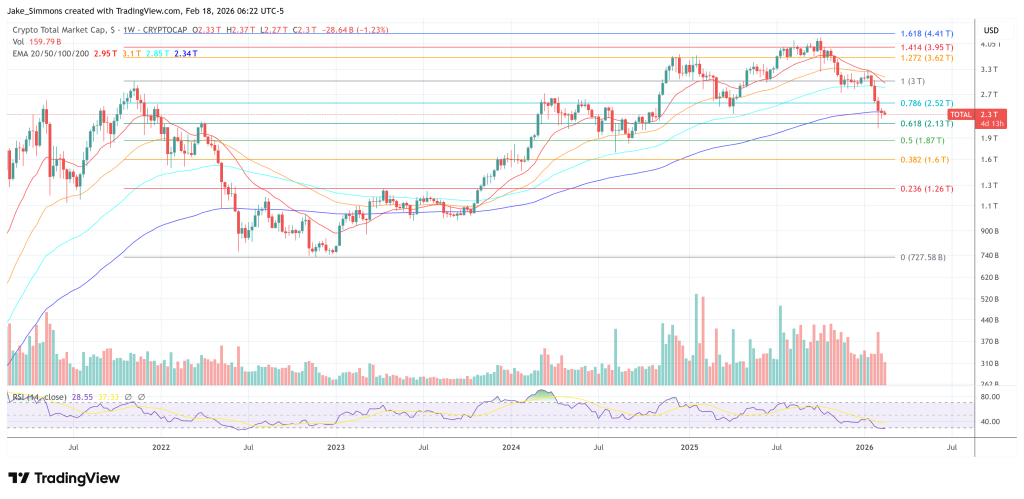
At press time, the total crypto market cap stood at $2.3 trillion.
You May Also Like

Trump adviser demands Fed economists be 'disciplined' for arguing with presidential tactic

CME Group to launch options on XRP and SOL futures
