

From Growth To Certainty: Fireside Chat At HSC Asset Management Explores Market Shifts And China’s Global Influence
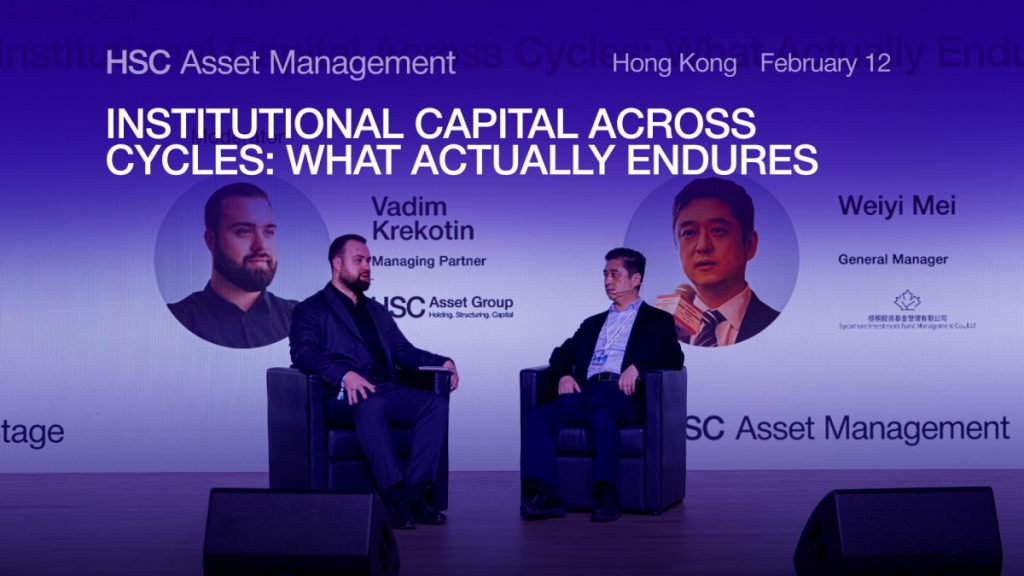
On February 12th, HSC Asset Management hosted its latest event in Hong Kong, bringing together senior market participants to review current developments and explore emerging opportunities in the institutional digital-asset sector.
A highlight of the agenda was the fireside chat, “Institutional Capital Across Cycles: What Actually Endures,” featuring Vadim Krekotin, Managing Partner at HSC Asset Group, and Weiyi Mei, General Manager of Sycamore Investment Fund Management.
During the conversation, the speakers explored how institutional strategies evolve across market cycles, emphasizing resilience, disciplined capital management, and the importance of strong fundamentals over speculative momentum.
Shifting Market Sentiments And The Search For Certainty
The discussion started with reflections on how markets have evolved over the past few years. Will May, General Manager at Sycamore Investment Funds, highlighted a major shift from growth-oriented investment narratives to those emphasizing safety and predictability. Investors, he noted, are increasingly seeking resilient cash flows and concrete paths to profitability rather than speculative growth. “The risk appetite is still there,” he explained, “but capital now demands more visible outcomes.” The conversation underscored how recent market cycles, including speculative bubbles and valuation resets, have recalibrated investor expectations and fostered a more disciplined allocation of capital.
China’s Expanding Global Influence
The speakers then turned to the role of Chinese capital in shaping global markets. Will emphasized that China’s strength lies in its comprehensive industrial ecosystem, spanning hundreds of industries, from electric vehicles and batteries to advanced manufacturing and supply chains. He pointed out that Chinese capital is becoming more selective and strategic, flowing primarily into sectors like green energy, AI, and technological infrastructure, while avoiding sensitive areas. Looking ahead 10–30 years, Will predicted a structural transformation: China evolving from a mere exporter of capital into a model of “patient capital,” using long-term investment strategies to gain influence and establish alternative financial standards globally.
The conversation also explored China’s technological trajectory. Will identified full-stack AI, integrated new energy solutions, grid intelligence, industrial robotics, synthetic biology, ultra-high voltage transmission, and next-generation semiconductors as key areas defining China’s next phase of global expansion. These technologies, he explained, are not pursued in isolation but integrated into broader system-level platforms, supported by capital, engineering capabilities, and strategic planning.
Global Capital Flows And The Responsibility Of Investors
Finally, the discussion shifted to where Chinese technology and capital are likely to be most impactful. Will highlighted Belt and Road countries, Europe, the Middle East, Southeast Asia, and parts of Africa as receptive regions, noting the high demand for industrialization, infrastructure, and green energy solutions. He emphasized the importance of strategic capital allocation: large investors have a responsibility to distinguish between short-term financial engineering and long-term value creation. “We focus on tangible reward assets,” he said, pointing to sectors like manufacturing, logistics, biology, and agriculture that offer sustainable growth over time.
The conversation concluded with reflections on the evolving role of capital in driving global innovation and economic development. As markets become more disciplined and strategic, investors and allocators are called upon not only to generate returns but also to shape industries and technologies that will define the next generation of global markets.
The post From Growth To Certainty: Fireside Chat At HSC Asset Management Explores Market Shifts And China’s Global Influence appeared first on Metaverse Post.
You May Also Like

CME Group to launch options on XRP and SOL futures
Vitalik Buterin Reveals Ethereum’s Long-Term Focus on Quantum Resistance
