The post U.S. Treasury Buys Back $2.8 Billion in Debt Securities appeared first on Coinpedia Fintech News The U.S. Treasury recently repurchased $2.8 billion ofThe post U.S. Treasury Buys Back $2.8 Billion in Debt Securities appeared first on Coinpedia Fintech News The U.S. Treasury recently repurchased $2.8 billion of

U.S. Treasury Buys Back $2.8 Billion in Debt Securities

CLARITY Act

The post U.S. Treasury Buys Back $2.8 Billion in Debt Securities appeared first on Coinpedia Fintech News

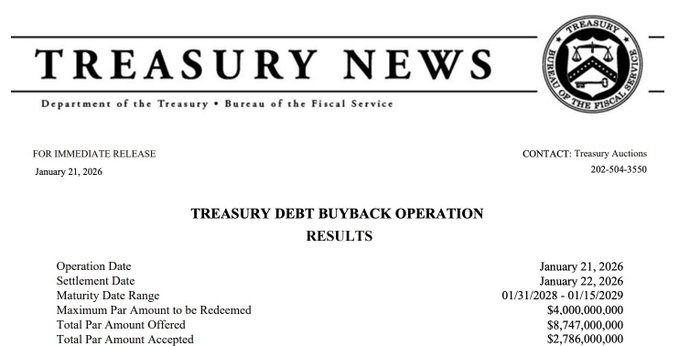
The U.S. Treasury recently repurchased $2.8 billion of its own debt, a move that sent a strong signal across bond markets. While bond yields stayed steady near 4.25%, showing no panic or stress. 

These buybacks help manage liquidity, but also change how investors think about the crypto market next.

U.S. Treasury Buys Back $2.8 Billion

The U.S. Treasury is again buying back its own debt, including a recent $2.8 billion purchase of bonds due in 2028–2029. However, the dealer has offered about $8.7 billion, but the Treasury accepted only 32%, showing a careful and targeted approach to improve trading in less active bonds.

The Treasury has not always used buybacks. Between 2000 and 2002, the Treasury bought back over $67.5 billion in debt to improve liquidity and manage maturities. After many quiet years, buybacks returned as market conditions changed.
U.S. Treasury Buys Back $2.8 Billion in Debt Securities

Last year, in 2025, the Treasury carried out its largest buyback ever, repurchasing $10 billion in debt from $22.87 billion in offers. 

This showed strong demand from institutions and a growing use of buybacks to manage the bond market.

Bond Yields Remain Stable at 4.25%

After the buyback, Treasury yields stayed near 4.25%. This showed that markets were not shocked by the move. Some investors saw it as a sign of strength, while others raised concerns about long-term demand for U.S. debt.

Still, the steady yield suggests confidence that the government is managing its debt carefully.

Unlike Federal Reserve actions such as quantitative easing, this buyback used existing cash, not newly created money. 

What This Means For Crypto Market 

Many in the crypto community see these moves as part of “macro liquidity conditions” that influence crypto prices. When liquidity tightens and yields rise, crypto often weakens. 

But if bond markets show stress or if yields fall, capital can rotate back into Bitcoin and other digital assets.

Meanwhile, U.S. debt buybacks don’t just affect bonds. They change how money flows in global markets, and that flow reaches crypto, too. As of now, the total crypto market cap has seen a slight rise to $3.2 trillion

Market Opportunity
Union Logo
Union Price(U)
$0.002112
$0.002112$0.002112
-9.51%
USD
Union (U) Live Price Chart
Disclaimer: The articles reposted on this site are sourced from public platforms and are provided for informational purposes only. They do not necessarily reflect the views of MEXC. All rights remain with the original authors. If you believe any content infringes on third-party rights, please contact service@support.mexc.com for removal. MEXC makes no guarantees regarding the accuracy, completeness, or timeliness of the content and is not responsible for any actions taken based on the information provided. The content does not constitute financial, legal, or other professional advice, nor should it be considered a recommendation or endorsement by MEXC.

You May Also Like

Republic Europe Offers Indirect Kraken Stake via SPV

Republic Europe Offers Indirect Kraken Stake via SPV

Republic Europe launches SPV for European retail access to Kraken equity pre-IPO.
Share
bitcoininfonews2026/01/30 13:32
cpwrt Limited Positions Customer Support as a Strategic Growth Function

cpwrt Limited Positions Customer Support as a Strategic Growth Function

For many growing businesses, customer support is often viewed as a cost center rather than a strategic function. cpwrt limited challenges this perception by providing
Share
Techbullion2026/01/30 13:07
How is the xStocks tokenized stock market developing?

How is the xStocks tokenized stock market developing?

Author: Heechang Compiled by: TechFlow xStocks offers a tokenized stock service, allowing investors to trade tokenized versions of popular US stocks like Tesla in real time. While still in its early stages, it’s already showing some interesting signs of growth. Observation 1: Trading is concentrated in Tesla (TSLA) As in many emerging markets, trading activity has quickly concentrated on a handful of stocks. Data shows a high concentration of trading volume in the most well-known and volatile stocks, with Tesla being the most prominent example. This concentration is not surprising: liquidity tends to accumulate in assets that retail investors already favor, and early adopters often use familiar high-beta stocks to test new infrastructure. Observation 2: Liquidity decreases on weekends Data shows that on-chain equity trading volume drops to 30% or less of weekday levels over the weekend. Unlike crypto-native assets, which trade seamlessly around the clock, tokenized stocks still inherit the behavioral inertia of traditional market trading hours. Traders appear less willing to trade when reference markets (such as Nasdaq and the New York Stock Exchange) are closed, likely due to concerns about arbitrage, price gaps, and the inability to hedge positions off-chain. Observation 3: Prices move in line with the Nasdaq Another key signal comes from pricing behavior during the initial launch period. Initially, xStocks tokens traded at a significant premium to their Nasdaq counterparts, reflecting market enthusiasm and potential friction in bridging fiat liquidity. However, these premiums gradually diminished over time. Current trading patterns show that the token price is at the upper limit of Tesla's intraday price range and is highly consistent with the Nasdaq reference price. Arbitrageurs appear to be maintaining this price discipline, but there are still small deviations from the intraday highs, indicating some market inefficiencies that may present opportunities and risks for active traders. New opportunities for Korean stock investors? South Korean investors currently hold over $100 billion in US stocks, with trading volume increasing 17-fold since January 2020. Existing infrastructure for South Korean investors to trade US stocks is limited by high fees, long settlement times, and slow cash-out processes, creating opportunities for tokenized or on-chain mirror stocks. As the infrastructure and platforms supporting on-chain US stock markets continue to improve, a new group of South Korean traders will enter the crypto market, which is undoubtedly a huge opportunity.
Share
PANews2025/09/18 08:00