Bitcoin is moving deeper into US household finance as homebuyers squeezed by high borrowing costs and limited supply look for new ways to fund a down payment withoutBitcoin is moving deeper into US household finance as homebuyers squeezed by high borrowing costs and limited supply look for new ways to fund a down payment without

Homebuyers can now borrow against Bitcoin to get a mortgage without selling or liquidation risk

2026/03/27 22:30
7 min read
For feedback or concerns regarding this content, please contact us at crypto.news@mexc.com

Bitcoin is moving deeper into US household finance as homebuyers squeezed by high borrowing costs and limited supply look for new ways to fund a down payment without selling their digital assets.

On March 26, Better Home & Finance and Coinbase launched a structure that lets eligible borrowers pledge Bitcoin or USD Coin (USDC) stablecoin to secure a separate loan for a down payment while still taking out a standard conforming mortgage on the home.

The arrangement brings crypto into one of the most closely watched parts of the U.S. credit system at a time when affordability pressures are already reshaping who can buy a house and when.

The timing is central to the pitch as Realtor.com’s 2026 report put the US housing supply gap at 4.03 million homes.

This comes as the average 30-year mortgage rate recently climbed to 7%, while total mortgage applications fell 10.5%, and purchase applications dropped 5.4%. At the same time, first-time buyers accounted for just 21% of the market in the latest National Association of Realtors profile.
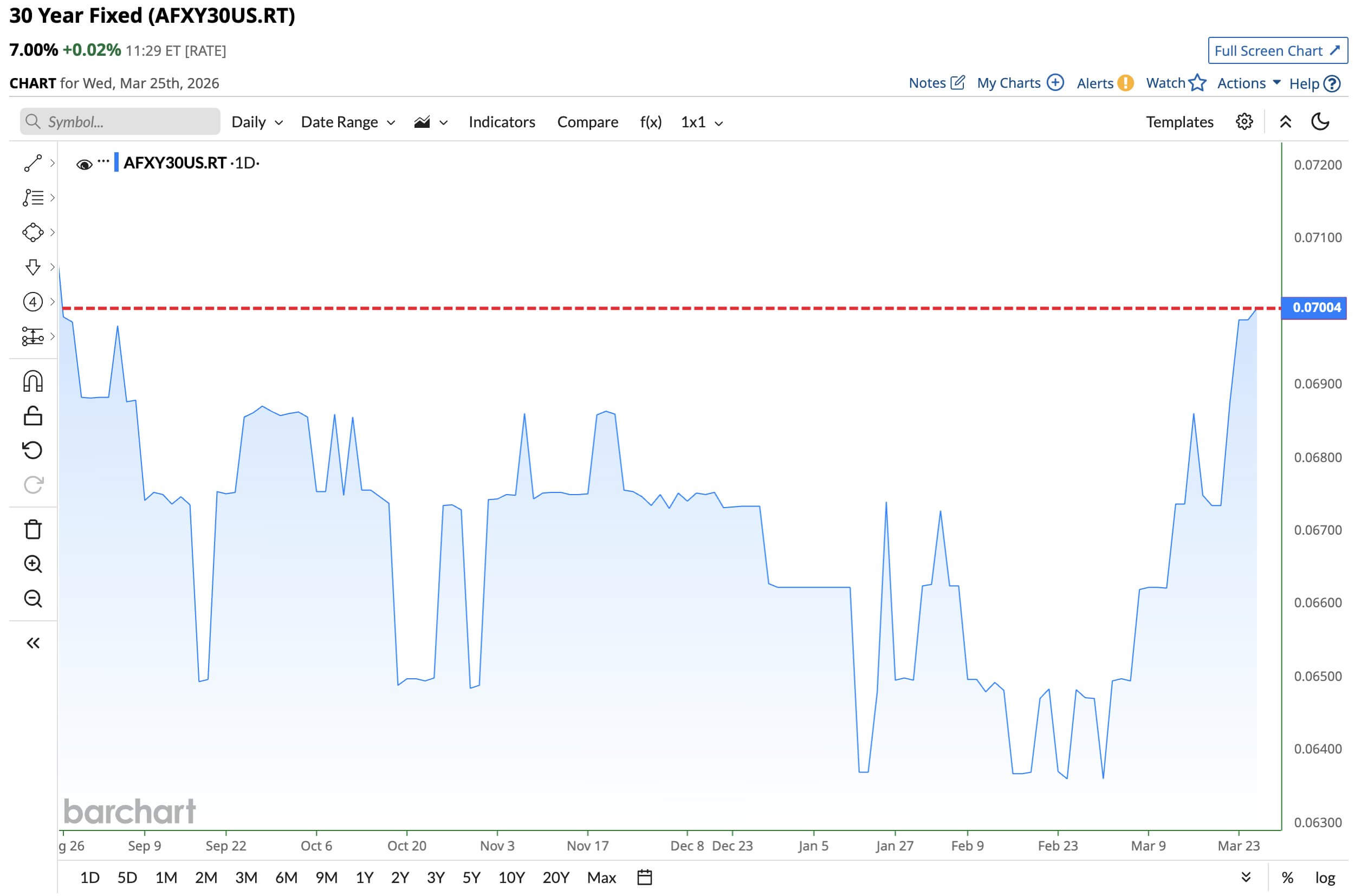
30-Year Mortgage Rate30-Year Mortgage Rate (Source: Barchart)

Against that backdrop, lenders and crypto firms are betting that a growing class of would-be buyers has wealth in digital assets but lacks the cash liquidity needed to clear one of the biggest barriers to homeownership.

A new route into the mortgage market

The Coinbase-backed product is aimed at borrowers who want to retain exposure to crypto markets instead of liquidating holdings to raise cash for a down payment.

Related Reading

You can now get a Bitcoin backed mortgage without a credit score

A Miami based lending firm is offering crypto backed mortgages if you have 100% of the value of the home in crypto.

Apr 29, 2022 · Liam 'Akiba' Wright

For many, that decision is about more than market timing. Selling crypto can also trigger a tax bill and force investors to reduce positions they view as long-term holdings.

Considering this, the structure is built around two loans at closing. The first is a standard mortgage on the property. The second is a privately financed loan secured by pledged crypto and used to fund the cash down payment.

Better says the 15-year and 30-year fixed mortgage options will be available, subject to credit approval, and that the loans are designed in accordance with Fannie Mae guidelines so that the mortgage remains a conforming loan.

That distinction is important. The product does not replace the traditional mortgage with a crypto loan. Instead, it wraps a crypto-secured financing layer around the down payment while leaving the main mortgage in a conventional format.

For borrowers using Bitcoin, the initial collateral value must be at least 250% of the loan amount in fiat. For borrowers using USDC, the initial collateral value must be at least 125%.

In practical terms, a borrower could pledge $250,000 in Bitcoin to unlock a $100,000 cash-down-payment loan, or $125,000 in USDC for the same result.

The companies are promoting the arrangement as a way to preserve ownership of digital assets while gaining access to the housing market. Better says both loans can share the same interest rate and amortization term, creating a single combined monthly payment.

Housing strain creates an opening

The product's appeal is tied directly to a housing market that has become harder to enter, especially for younger buyers.

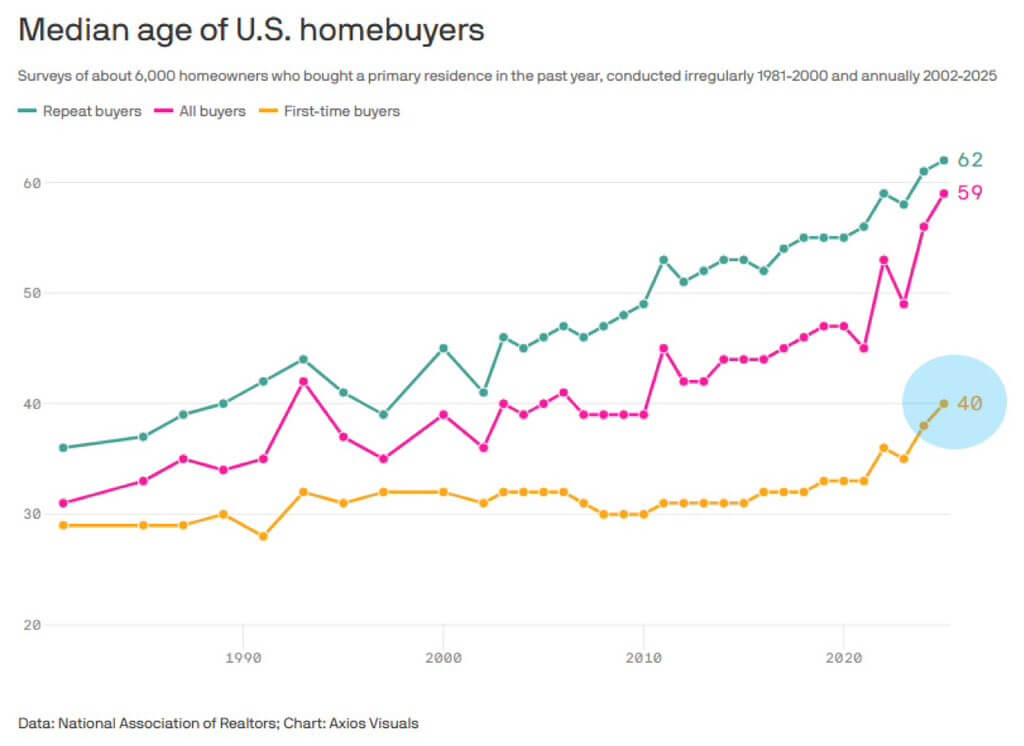
The median age of a first-time homebuyer reached 40 in 2025, according to the National Association of Realtors, reflecting the combined effect of high mortgage rates, elevated home prices, and limited inventory.
Related Reading

Why rising mortgage rates and gas prices are suddenly impacting Bitcoin holders directly

Consumer sentiment is tanking and its not helping Bitcoin as it struggles to hold $70,000.

Mar 20, 2026 · Liam 'Akiba' Wright
Median Age of Home BuyersMedian Age of US Home Buyers

The pressure is even more severe for households lower on the income scale. The NAHB/Wells Fargo Cost of Housing Index for the second quarter of 2025 showed that a typical family needed 36% of its income for a mortgage payment on a median new home. For lower-income households, that share rose above 71%.

Those figures help explain why companies see an opportunity in linking digital assets to housing finance. Traditional underwriting relies heavily on documented income, credit history, and cash reserves.

That framework tends to favor households that have already built wealth through home equity, rising incomes, or long-established financial assets.

At the same time, millions of Americans have built positions in crypto. For context, around 20% of US adults, equivalent to 52 million people, hold some form of crypto asset, and the majority of them are young.

The NCA 2025 State of Crypto Holders report confirmed that 67% of token holders are 45 or younger, and 26% earn less than $75,000 a year.

That gives the product a clear target market: younger buyers with meaningful crypto exposure but limited willingness, or ability, to convert those holdings into cash at the point of purchase.

How the crypto pledge works

The companies have tried to structure the product to look less like a volatile crypto loan and more like a mortgage-compatible financing tool.

Borrowers who pledge Bitcoin or USDC are not subject to margin calls or top-up requirements if the market value of their collateral falls.

Better says market movements alone do not trigger liquidation. Instead, the pledged assets are only at risk if a borrower becomes 60 days delinquent on payments, a threshold the companies say mirrors the treatment of payment stress in conforming mortgages.

The crypto is held in custody for the life of the down payment loan and returned once that obligation is repaid. Borrowers cannot trade the pledged assets while they are locked up, which preserves ownership but restricts flexibility.

For USDC borrowers, the stablecoin can continue to earn rewards, which could help offset mortgage servicing costs and reduce the borrower’s net effective financing burden.

Meanwhile, the broader ambition goes beyond one mortgage product. Better and Coinbase say they intend, over time, to expand the range of eligible digital assets to include tokenized equities, fixed income, and other tokenized real estate assets.

This represents a sign that they see the mortgage offering as an early step in bringing on-chain wealth into mainstream consumer finance.

Policy support and political resistance

Meanwhile, this launch is arriving in a political climate that has become more receptive to crypto, but not without resistance.

Fannie Mae’s role, along with oversight from the Federal Housing Finance Agency, could help make such products more mainstream than earlier crypto-linked mortgage offerings.

Last year, FHFA Director Bill Pulte directed Fannie Mae and Freddie Mac to prepare to count crypto as an asset on mortgage applications, reflecting broader support for the digital-asset industry from the Trump administration.

That policy opening created room for commercial products built around crypto wealth, but it also drew criticism from lawmakers who view the idea as a new source of risk for housing finance.

Democratic senators, led by Elizabeth Warren, objected to the proposal, arguing that the current policy does not permit federally backed mortgage channels to consider cryptocurrency unless it has first been converted into US dollars and properly documented.

They warned that expanding underwriting criteria to include unconverted crypto could introduce fresh risks to both the housing market and the broader financial system.

That criticism goes to the heart of the debate around products like Better’s.

Supporters see them as a way to translate digital wealth into real-world access without forcing borrowers to sell assets and leave the market. Critics see a danger in bringing a volatile and still-developing asset class closer to the foundations of US home lending.

So, the final outcome may depend on whether crypto-backed mortgages remain a niche tool for affluent digital-asset holders or evolve into a broader financing channel for buyers shut out by the traditional down payment hurdle.

The post Homebuyers can now borrow against Bitcoin to get a mortgage without selling or liquidation risk appeared first on CryptoSlate.

Market Opportunity
USDCoin Logo
USDCoin Price(USDC)
$1.0006
$1.0006$1.0006
+0.01%
USD
USDCoin (USDC) Live Price Chart
Disclaimer: The articles reposted on this site are sourced from public platforms and are provided for informational purposes only. They do not necessarily reflect the views of MEXC. All rights remain with the original authors. If you believe any content infringes on third-party rights, please contact crypto.news@mexc.com for removal. MEXC makes no guarantees regarding the accuracy, completeness, or timeliness of the content and is not responsible for any actions taken based on the information provided. The content does not constitute financial, legal, or other professional advice, nor should it be considered a recommendation or endorsement by MEXC.

You May Also Like

Crypto Real Estate Hedge: Eric Trump Unlocks a Revolutionary Strategy

Crypto Real Estate Hedge: Eric Trump Unlocks a Revolutionary Strategy

BitcoinWorld Crypto Real Estate Hedge: Eric Trump Unlocks a Revolutionary Strategy In the dynamic world of finance, investors constantly seek innovative ways to safeguard and grow their wealth. Recently, Eric Trump, a prominent figure in real estate and business, made a notable statement that has captured significant attention: he believes a crypto real estate hedge is the perfect solution for protecting property assets. This perspective opens up a fascinating discussion about the evolving relationship between traditional investments and the burgeoning digital asset space. What Exactly is a Crypto Real Estate Hedge? When we talk about a crypto real estate hedge, we are referring to the strategy of using cryptocurrency investments to offset potential risks or volatility in a real estate portfolio. Think of it as diversifying your financial safety net. Historically, investors have used various assets like gold, bonds, or different market sectors to hedge against downturns in other areas. Cryptocurrency, with its unique characteristics, presents a fresh option for this strategy. Its often uncorrelated price movements relative to traditional markets can provide a valuable counterweight during economic shifts. This approach isn’t about replacing real estate, but rather enhancing its resilience through strategic digital asset allocation. Why Consider Crypto for Your Property Portfolio? The idea of integrating cryptocurrency into a real estate strategy might seem unconventional at first, but several compelling reasons support it: Diversification: Cryptocurrencies often operate independently of traditional financial markets. This lack of correlation can reduce overall portfolio risk, making it a strong diversification tool. Inflation Protection: Some cryptocurrencies, particularly Bitcoin, are seen by many as a hedge against inflation due to their finite supply. As fiat currencies lose purchasing power, a strong digital asset might retain or even increase in value. Liquidity: While real estate is a long-term, illiquid asset, cryptocurrencies offer high liquidity. You can convert them to cash relatively quickly, providing access to funds when needed. Accessibility: Digital assets are globally accessible, allowing investors to participate in a market that transcends geographical boundaries and traditional banking hours. Eric Trump’s endorsement underscores a growing recognition of these benefits among seasoned investors. He sees it as a forward-thinking move to secure wealth in an unpredictable economic climate. Navigating the Challenges of a Crypto Real Estate Hedge While the potential benefits are clear, adopting a crypto real estate hedge strategy is not without its challenges. The cryptocurrency market is known for its volatility, with prices often experiencing dramatic swings. This inherent risk requires a cautious and informed approach. Moreover, the regulatory landscape for cryptocurrencies is still evolving. Different countries and jurisdictions have varying rules, which can impact how digital assets are taxed and managed. Investors must also contend with the technical aspects of securely storing and managing their crypto holdings. Understanding wallet security, exchange reliability, and potential cyber threats is paramount. Therefore, thorough research and a clear understanding of your risk tolerance are essential before integrating crypto into your investment strategy. Actionable Insights for Property Investors For real estate investors considering a crypto real estate hedge, here are some actionable steps: Start Small: Begin with a modest allocation to cryptocurrencies that aligns with your overall investment goals and risk profile. You do not need to commit a large portion of your assets initially. Educate Yourself: Learn about different cryptocurrencies, blockchain technology, and market dynamics. Understanding the fundamentals is key to making informed decisions. Choose Wisely: Focus on established cryptocurrencies with strong fundamentals and a proven track record, such as Bitcoin or Ethereum, rather than highly speculative altcoins. Prioritize Security: Use reputable exchanges and secure storage solutions (like hardware wallets) for your digital assets. Two-factor authentication is a must. Consult Experts: Speak with financial advisors who understand both real estate and cryptocurrency markets. They can help tailor a strategy that suits your individual needs. This strategic integration can provide a robust layer of protection, especially during periods of economic uncertainty. It represents a modern approach to asset management, blending traditional stability with digital innovation. The Future of Asset Protection: A Compelling Summary Eric Trump’s statement about cryptocurrency being a perfect hedge for real estate assets highlights a significant shift in investment thinking. The concept of a crypto real estate hedge is gaining traction as investors seek resilient strategies in an increasingly interconnected and volatile global economy. While challenges exist, the potential for diversification, inflation protection, and enhanced liquidity makes cryptocurrency a compelling consideration for safeguarding and growing wealth. As the digital asset landscape matures, its role in traditional investment portfolios is likely to expand, offering innovative solutions for asset protection and growth. Embracing this forward-thinking approach could be a key differentiator for investors looking to future-proof their wealth. Frequently Asked Questions (FAQs) 1. What does ‘hedge’ mean in the context of a crypto real estate hedge? A hedge is an investment made to reduce the risk of adverse price movements in an asset. In this case, a crypto real estate hedge uses cryptocurrency to protect against potential declines or volatility in real estate values. 2. Is cryptocurrency a stable investment for hedging? Cryptocurrency is known for its volatility. However, its often uncorrelated price movements with traditional assets like real estate can make it an effective hedge, providing diversification even with its inherent risks. The key is strategic allocation and understanding. 3. Which cryptocurrencies are best for a real estate hedge? While any cryptocurrency could theoretically be used, investors typically consider larger, more established assets like Bitcoin (BTC) or Ethereum (ETH) due to their higher liquidity and broader adoption. These are generally considered less volatile than newer, smaller altcoins. 4. How much crypto should I allocate for a real estate hedge? The ideal allocation depends on your individual risk tolerance, overall portfolio size, and financial goals. Many financial advisors suggest starting with a small percentage, perhaps 1-5% of your total portfolio, and adjusting as you gain more understanding and comfort with the asset class. 5. What are the tax implications of using crypto as a hedge? Tax implications for cryptocurrency vary significantly by jurisdiction. Generally, capital gains from selling crypto are taxable, and some countries also tax crypto income or even certain transactions. It is crucial to consult with a tax professional familiar with cryptocurrency regulations in your region. Did you find this article insightful? Share it with your network and spark a conversation about the future of investment strategies! To learn more about the latest crypto market trends, explore our article on key developments shaping Bitcoin institutional adoption. This post Crypto Real Estate Hedge: Eric Trump Unlocks a Revolutionary Strategy first appeared on BitcoinWorld.
Share
Coinstats2025/09/18 01:30
Stablecoin Sector Smashes Past the $290 Billion Milestone

Stablecoin Sector Smashes Past the $290 Billion Milestone

On Wednesday, the stablecoin market cracked into uncharted territory, vaulting past the $290 billion mark for the first time ever after padding its coffers with more than $4 billion in fresh capital over the past week. From USDT to RLUSD, Every Fiat-Pegged Token Joins the $290B Stablecoin Party Stablecoins are stealing the spotlight, complete with […]
Share
Coinstats2025/09/18 01:30
Coinbase Joins Ethereum Foundation to Back Open Intents Framework

Coinbase Joins Ethereum Foundation to Back Open Intents Framework

Coinbase Payments has joined the Open Intents Framework as a core contributor, working alongside Ethereum Foundation and other major players. The initiative aims to simplify complex multi-chain interactions through automated solver technology. The post Coinbase Joins Ethereum Foundation to Back Open Intents Framework appeared first on Coinspeaker.
Share
Coinspeaker2025/09/18 02:43