Dogecoin (DOGE) is trying to base on higher timeframes as Cantonese Cat points to a potential inverse head-and-shoulders on the daily, with price compressing justDogecoin (DOGE) is trying to base on higher timeframes as Cantonese Cat points to a potential inverse head-and-shoulders on the daily, with price compressing just

Dogecoin Flirts With An Inverse Head And Shoulders: $0.15 Break Is The Trigger

2026/01/16 20:30

Dogecoin (DOGE) is trying to base on higher timeframes as Cantonese Cat points to a potential inverse head-and-shoulders on the daily, with price compressing just beneath a defined resistance shelf while holding a nearby demand zone.

Dogecoin Breakout Could Target $0.19

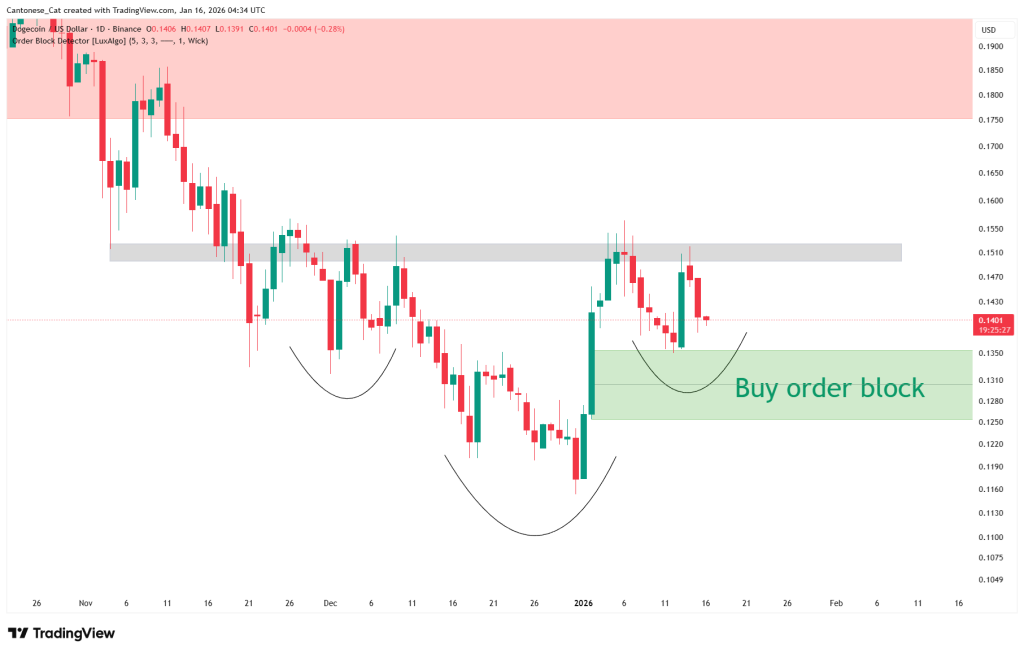
In a daily chart (DOGE/USD, Binance) shared via X on Jan. 16, Cantonese Cat overlays an inverse head-and-shoulders schematic: a left shoulder in early December, a deeper “head” into late December near the mid-$0.11s, and a developing right shoulder as price rotates lower after the early-January spike.
Dogecoin daily chart

The key feature on that daily view is a highlighted “Buy order block” spanning roughly $0.1250 to $0.1350. Price is shown pulling back toward the top of that block after failing to hold the most recent push higher, which places the current trade location in a classic “right shoulder” area if the pattern is going to remain constructive.

Above the current spot price, the chart marks a horizontal grey resistance (“the shoulder”) band at roughly $0.149–$0.152. This is the area DOGE needs to reclaim for the inverse H&S thesis to transition from “forming” to “triggering,” because it has acted as supply on recent tests.

Using Cantonese Cat’s daily inverse head-and-shoulders chart, the measured move is the neckline minus the head low, projected upward from the neckline: the neckline is the grey supply band centered near $0.151 (label on the axis), while the head prints at roughly $0.116. That gives a height of about $0.035, implying a pattern target near $0.186.

Notably, that objective runs directly into the chart’s overhead red supply zone, which begins around $0.175 and extends up toward $0.19, making that area the first obvious region where a confirmed breakout would be expected to meet meaningful resistance.

DOGE 2-Day Bollinger Bands Signal Momentum

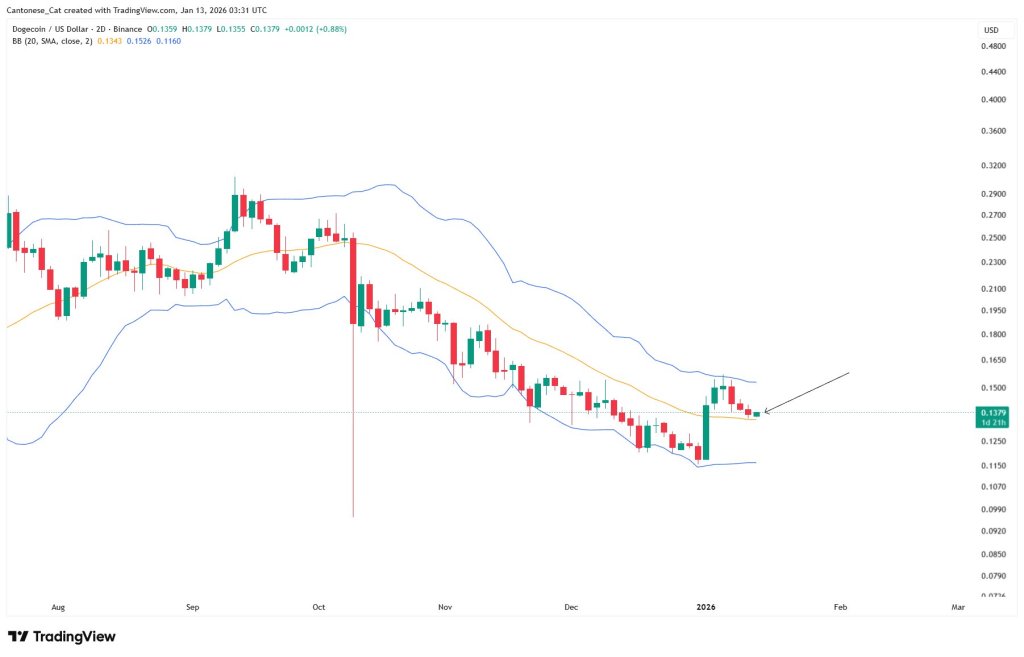
Notably, the Bollinger Bands on the 2-day chart support the mid-term bullish thesis. On Tuesday, Cantonese Cat highlighted that DOGE is trading above the Bollinger basis around $0.1343, while the upper band is near $0.1526 and the lower band near $0.1160.
Dogecoin 2-day chart

Cantonese Cat summarized the idea succinctly: “Price wanting to hang out at the top part of the Bollinger band? We have a chance here?” In practice, the “top part” framing matters because it’s a momentum tell. After an extended decline, sustained closes above the basis and into the upper half of the bands can signal that sellers are no longer controlling the volatility profile, even before price clears the obvious horizontal resistance.

That said, the 2D view also makes the immediate problem clear: the upper band sits close to the same zone highlighted on the daily as resistance. In other words, the bullish thesis is not just “hold support,” but “prove it” with acceptance above the $0.15–$0.152 region.

If DOGE continues to defend the $0.1250–$0.1350 buy-side block and reclaims the $0.149–$0.152 supply band, the inverse head-and-shoulders thesis gains credibility. The next areas the chart itself flags are the higher supply zones around $0.175 and the upper-$0.18s region, where prior selling pressure was visible.

If price loses the buy order block, the pattern read weakens materially. In that case, the Bollinger structure on the 2D chart points attention back toward the lower band region near $0.1160 and the late-December lows.

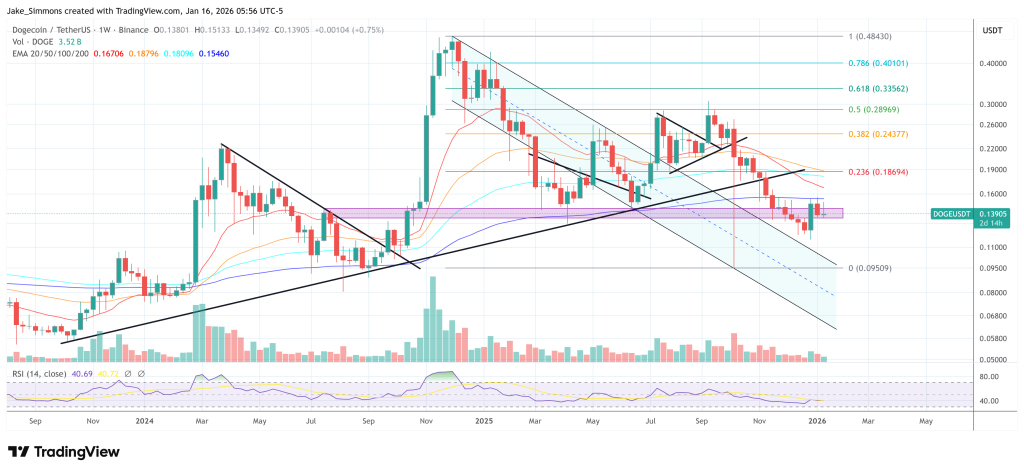
At press time, DOGE traded at $0.139.
Dogecoin price chart
Market Opportunity
DOGE Logo
DOGE Price(DOGE)
$0.11438
$0.11438$0.11438
-1.53%
USD
DOGE (DOGE) Live Price Chart
Disclaimer: The articles reposted on this site are sourced from public platforms and are provided for informational purposes only. They do not necessarily reflect the views of MEXC. All rights remain with the original authors. If you believe any content infringes on third-party rights, please contact service@support.mexc.com for removal. MEXC makes no guarantees regarding the accuracy, completeness, or timeliness of the content and is not responsible for any actions taken based on the information provided. The content does not constitute financial, legal, or other professional advice, nor should it be considered a recommendation or endorsement by MEXC.

You May Also Like

Republic Europe Offers Indirect Kraken Stake via SPV

Republic Europe Offers Indirect Kraken Stake via SPV

Republic Europe launches SPV for European retail access to Kraken equity pre-IPO.
Share
bitcoininfonews2026/01/30 13:32
cpwrt Limited Positions Customer Support as a Strategic Growth Function

cpwrt Limited Positions Customer Support as a Strategic Growth Function

For many growing businesses, customer support is often viewed as a cost center rather than a strategic function. cpwrt limited challenges this perception by providing
Share
Techbullion2026/01/30 13:07
How is the xStocks tokenized stock market developing?

How is the xStocks tokenized stock market developing?

Author: Heechang Compiled by: TechFlow xStocks offers a tokenized stock service, allowing investors to trade tokenized versions of popular US stocks like Tesla in real time. While still in its early stages, it’s already showing some interesting signs of growth. Observation 1: Trading is concentrated in Tesla (TSLA) As in many emerging markets, trading activity has quickly concentrated on a handful of stocks. Data shows a high concentration of trading volume in the most well-known and volatile stocks, with Tesla being the most prominent example. This concentration is not surprising: liquidity tends to accumulate in assets that retail investors already favor, and early adopters often use familiar high-beta stocks to test new infrastructure. Observation 2: Liquidity decreases on weekends Data shows that on-chain equity trading volume drops to 30% or less of weekday levels over the weekend. Unlike crypto-native assets, which trade seamlessly around the clock, tokenized stocks still inherit the behavioral inertia of traditional market trading hours. Traders appear less willing to trade when reference markets (such as Nasdaq and the New York Stock Exchange) are closed, likely due to concerns about arbitrage, price gaps, and the inability to hedge positions off-chain. Observation 3: Prices move in line with the Nasdaq Another key signal comes from pricing behavior during the initial launch period. Initially, xStocks tokens traded at a significant premium to their Nasdaq counterparts, reflecting market enthusiasm and potential friction in bridging fiat liquidity. However, these premiums gradually diminished over time. Current trading patterns show that the token price is at the upper limit of Tesla's intraday price range and is highly consistent with the Nasdaq reference price. Arbitrageurs appear to be maintaining this price discipline, but there are still small deviations from the intraday highs, indicating some market inefficiencies that may present opportunities and risks for active traders. New opportunities for Korean stock investors? South Korean investors currently hold over $100 billion in US stocks, with trading volume increasing 17-fold since January 2020. Existing infrastructure for South Korean investors to trade US stocks is limited by high fees, long settlement times, and slow cash-out processes, creating opportunities for tokenized or on-chain mirror stocks. As the infrastructure and platforms supporting on-chain US stock markets continue to improve, a new group of South Korean traders will enter the crypto market, which is undoubtedly a huge opportunity.
Share
PANews2025/09/18 08:00