OKX CEO Blasts Binance Over Oct. 10 Crypto Crash, Cites ‘Lasting Damage’
OKX founder and CEO Star Xu took aim at a rival “industry-leading company” over the market dislocation tied to Oct. 10, arguing the episode did more than trigger a brief liquidation cascade — it inflicted “real and lasting damage” on crypto’s credibility with users and regulators.
OKX CEO Slams Binance As Crypto Still Digests Oct. 10
In a post on X, Xu said the industry has “underestimated the impact of 10/10,” framing the event as a trust shock rather than a routine volatility episode. While he did not name Binance or its founder Changpeng Zhao (CZ) directly, the timing and context of the remarks and subsequent discussion on X tying Oct. 10 to a Binance-related incident made the target clear to many readers.
Xu’s central claim was that leading platforms should prioritize resilience and legitimacy, especially when scrutiny from regulators and mainstream institutions is rising. “An industry-leading company should focus on strengthening core infrastructure, building trust with global users and regulators, and protecting the long-term interests of the majority of crypto users, setting an example for others to follow,” Xu wrote.
“Instead, some chose to pursue short-term gains—repeatedly launching Ponzi-like schemes, amplifying a handful of ‘get-rich-quick’ narratives, and directly or indirectly manipulating the prices of low-quality tokens, drawing millions of users into assets closely tied to them.”
That critique broadens the Oct. 10 incident from a single failure event into a pattern: attention capture through high-risk token promotion and narratives, rather than a steady focus on market integrity. Xu argued that this approach turns exchanges into traffic machines optimized for “shortcuts,” at the expense of durable confidence.
This approach does not build an industry,” he added. “It erodes trust—and ultimately, everyone pays the price.” The post landed as parts of crypto Twitter were already revisiting Oct. 10 as a possible inflection point for recent market lull.
X account CryptosRus cited a Cathie Wood’s interview where she described the last “2–3 months” as an “aftershock” from an Oct. 10 “flash crash” tied to “a Binance software glitch” that “forced ~$28B of deleveraging across crypto.” In that framing, bitcoin absorbed the brunt “because it’s the most liquid asset,” and the forced selling is “mostly done,” shifting the market’s focus back to cycle positioning.
Some industry figures responded by framing the dispute as another round in centralized exchange rivalry. Moonrock Capital founder Simon Dedic wrote: “OKX attacking Binance. One shady CEX attacking the other shady CEX for extracting even more value than they do. As long as this fight costs at least one of them market share, that’s a net positive for the industry.”
Others used the moment to contrast opaque venues with on-chain alternatives. The Rollup’s CEO Andy C said “Binance is crooked and opaque,” arguing that “Hyperliquid is open, permissionless finance for all.” Flood, CEO of Fullstrack.trade, went further, writing that crypto “will never have a truly great era and reach mainstream adoption as long as Binance is the dominant exchange.”
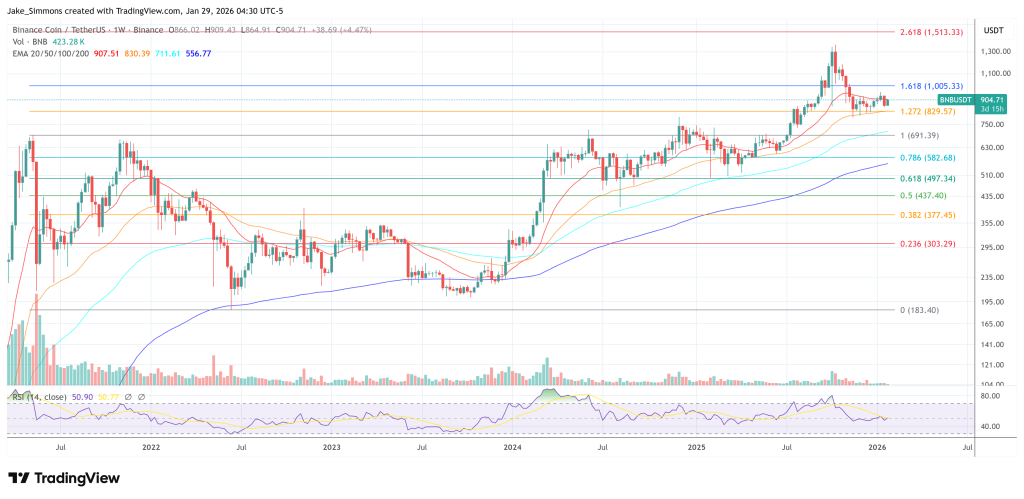
At press time, CZ had not publicly responded to the allegations, while BNB showed no immediate market reaction.
You May Also Like

‘Minimum $15 Price Surge Target’ Predicted For Ripple’s XRP as Sentiment Bottoms

Why Even Great Restaurants Are Closing In 2026