The United Arab Emirates (UAE) has announced that it will roll out an automatic crypto tax reporting system by 2027 and has launched an industry consultation to finalize implementation details before official rollout. In an official government release, the UAE Ministry of Finance revealed that it has signed the Multilateral Competent Authority Agreement on the Automatic Exchange of Information under the Crypto-Asset Reporting Framework (CARF), following its announcement last November of its intention to implement the framework. CARF implementation in the UAE is now scheduled to go live in 2027, with the first tax information reporting expected in 2028.Source: UAE Ministry of Finance “The framework establishes a mechanism for the automatic exchange of tax-related information on crypto-asset activities, ensuring that the UAE provides certainty and clarity to the crypto-asset sector while upholding the principles of global tax transparency,” the Ministry said. The move builds on the UAE’s efforts to attract crypto businesses after exempting crypto transactions from VAT in 2024 and Dubai setting regulatory guidelines for digital asset companies. The Ministry is now seeking industry feedback before implementing the rules. All participants in the crypto sector, including exchanges, custodians, traders, and advisors, are invited to join the public consultation to share their concerns about potential impacts. The consultation has already opened on September 15 and is expected to close on November 8, 2025. For Crypto Investors: What Does the UAE Crypto Tax Reporting Agreement Means The UAE will begin automatically sharing information on crypto transactions and holdings with tax authorities in other countries starting in 2028. This means that crypto will no longer be treated as an opaque asset class for offshore investors. Investors who rely on the UAE as a low-tax or no-tax hub will need to ensure they report their crypto holdings correctly in their home jurisdictions. Authorities can cross-check disclosures with the data exchanged under CARF, making tax evasion much harder. UAE-based exchanges, custodians, and wallet providers will be required to collect and report customer data, similar to how banks and brokers report under FATCA/CRS. Crypto investors should expect stricter KYC and AML processes, as platforms prepare to comply with international reporting standards. Institutional investors may view this as a positive development, as it reduces reputational risk and regulatory uncertainty. However, privacy-focused investors who rely on crypto for tax avoidance or secrecy may feel uneasy as cross-border reporting reduces anonymity. There could be higher compliance costs, especially for traders using multiple wallets, custodians, or offshore entities. Non-compliant investors might face penalties, back taxes, or investigations in their home countries as the tax avoidance window closes by 2027–2028. UAE’s Local Tax Position Remains Unchanged It’s worth noting that the UAE’s signing the CARF does not mean it will start taxing crypto gains locally. What it does mean is that if you are a foreigner living in the UAE but remain tax-resident elsewhere, your home country can now receive details of your UAE crypto activity and tax you according to its laws. For UAE nationals and residents who are only tax-resident in the UAE, crypto will still be exempt from income tax, unless a new domestic law is introduced later. Currently in the UAE, there’s no personal income tax on individuals, whether from salary, business profits, or crypto gains. Similarly, the 5% VAT in the country only applies to goods and services, but not to investment gains (like profits from selling crypto). So until now, crypto trading by individuals has not been taxed in the UAE. However, a corporate tax of 9% was introduced in June 2023, but it mainly applies to companies with profits exceeding AED 375,000. Individuals trading crypto on their own are not subject to corporate tax. Who Should Worry Most About the Crypto Tax Reporting System? The first category includes expats in the UAE who are still tax residents in their home countries. Also, investors who have been under-reporting or not reporting crypto gains back home and high-net-worth individuals who moved assets into UAE exchanges for “privacy.” This means if you’re from the US, EU, UK, Canada, Australia, Japan, South Korea, or India, the new CARF agreement means your home tax authority will soon have a clear view of your UAE crypto accounts. But suppose you’re from countries like Saudi Arabia, Qatar, Singapore, or Switzerland, or you’re a UAE national/resident who is only tied to the UAE. In that case, there’s little change since your jurisdiction doesn’t currently tax crypto gainsThe United Arab Emirates (UAE) has announced that it will roll out an automatic crypto tax reporting system by 2027 and has launched an industry consultation to finalize implementation details before official rollout. In an official government release, the UAE Ministry of Finance revealed that it has signed the Multilateral Competent Authority Agreement on the Automatic Exchange of Information under the Crypto-Asset Reporting Framework (CARF), following its announcement last November of its intention to implement the framework. CARF implementation in the UAE is now scheduled to go live in 2027, with the first tax information reporting expected in 2028.Source: UAE Ministry of Finance “The framework establishes a mechanism for the automatic exchange of tax-related information on crypto-asset activities, ensuring that the UAE provides certainty and clarity to the crypto-asset sector while upholding the principles of global tax transparency,” the Ministry said. The move builds on the UAE’s efforts to attract crypto businesses after exempting crypto transactions from VAT in 2024 and Dubai setting regulatory guidelines for digital asset companies. The Ministry is now seeking industry feedback before implementing the rules. All participants in the crypto sector, including exchanges, custodians, traders, and advisors, are invited to join the public consultation to share their concerns about potential impacts. The consultation has already opened on September 15 and is expected to close on November 8, 2025. For Crypto Investors: What Does the UAE Crypto Tax Reporting Agreement Means The UAE will begin automatically sharing information on crypto transactions and holdings with tax authorities in other countries starting in 2028. This means that crypto will no longer be treated as an opaque asset class for offshore investors. Investors who rely on the UAE as a low-tax or no-tax hub will need to ensure they report their crypto holdings correctly in their home jurisdictions. Authorities can cross-check disclosures with the data exchanged under CARF, making tax evasion much harder. UAE-based exchanges, custodians, and wallet providers will be required to collect and report customer data, similar to how banks and brokers report under FATCA/CRS. Crypto investors should expect stricter KYC and AML processes, as platforms prepare to comply with international reporting standards. Institutional investors may view this as a positive development, as it reduces reputational risk and regulatory uncertainty. However, privacy-focused investors who rely on crypto for tax avoidance or secrecy may feel uneasy as cross-border reporting reduces anonymity. There could be higher compliance costs, especially for traders using multiple wallets, custodians, or offshore entities. Non-compliant investors might face penalties, back taxes, or investigations in their home countries as the tax avoidance window closes by 2027–2028. UAE’s Local Tax Position Remains Unchanged It’s worth noting that the UAE’s signing the CARF does not mean it will start taxing crypto gains locally. What it does mean is that if you are a foreigner living in the UAE but remain tax-resident elsewhere, your home country can now receive details of your UAE crypto activity and tax you according to its laws. For UAE nationals and residents who are only tax-resident in the UAE, crypto will still be exempt from income tax, unless a new domestic law is introduced later. Currently in the UAE, there’s no personal income tax on individuals, whether from salary, business profits, or crypto gains. Similarly, the 5% VAT in the country only applies to goods and services, but not to investment gains (like profits from selling crypto). So until now, crypto trading by individuals has not been taxed in the UAE. However, a corporate tax of 9% was introduced in June 2023, but it mainly applies to companies with profits exceeding AED 375,000. Individuals trading crypto on their own are not subject to corporate tax. Who Should Worry Most About the Crypto Tax Reporting System? The first category includes expats in the UAE who are still tax residents in their home countries. Also, investors who have been under-reporting or not reporting crypto gains back home and high-net-worth individuals who moved assets into UAE exchanges for “privacy.” This means if you’re from the US, EU, UK, Canada, Australia, Japan, South Korea, or India, the new CARF agreement means your home tax authority will soon have a clear view of your UAE crypto accounts. But suppose you’re from countries like Saudi Arabia, Qatar, Singapore, or Switzerland, or you’re a UAE national/resident who is only tied to the UAE. In that case, there’s little change since your jurisdiction doesn’t currently tax crypto gains

UAE Announces 2027 Rollout of Automatic Crypto Tax Reporting System – What Does it Mean for Investors?

2025/09/22 21:59
4분 읽기
이 콘텐츠에 대한 의견이나 우려 사항이 있으시면 crypto.news@mexc.com으로 연락주시기 바랍니다

The United Arab Emirates (UAE) has announced that it will roll out an automatic crypto tax reporting system by 2027 and has launched an industry consultation to finalize implementation details before official rollout.

In an official government release, the UAE Ministry of Finance revealed that it has signed the Multilateral Competent Authority Agreement on the Automatic Exchange of Information under the Crypto-Asset Reporting Framework (CARF), following its announcement last November of its intention to implement the framework.

CARF implementation in the UAE is now scheduled to go live in 2027, with the first tax information reporting expected in 2028.
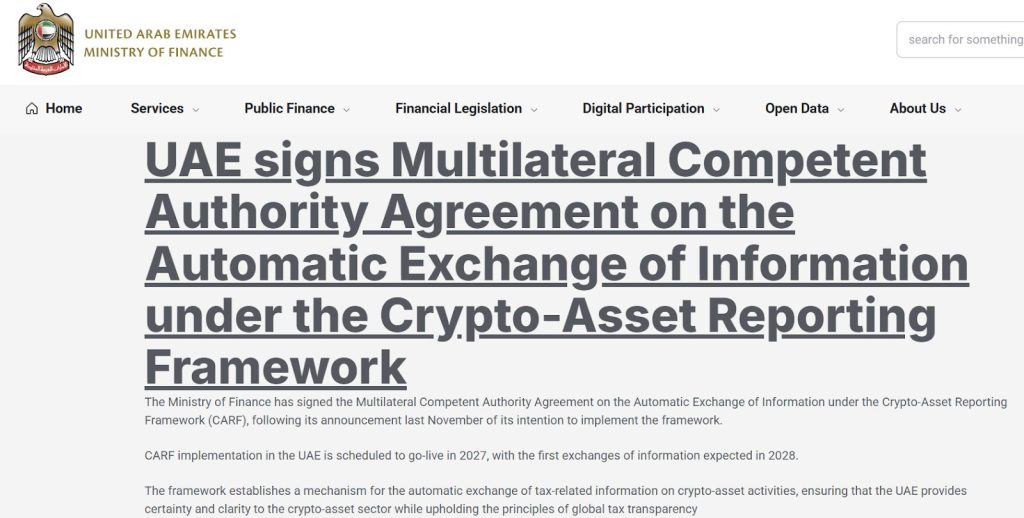
UAE Announces 2027 Rollout of Automatic Crypto Tax Reporting System – What Does it Mean for Investors?Source: UAE Ministry of Finance

The framework establishes a mechanism for the automatic exchange of tax-related information on crypto-asset activities, ensuring that the UAE provides certainty and clarity to the crypto-asset sector while upholding the principles of global tax transparency,” the Ministry said.

The move builds on the UAE’s efforts to attract crypto businesses after exempting crypto transactions from VAT in 2024 and Dubai setting regulatory guidelines for digital asset companies.

The Ministry is now seeking industry feedback before implementing the rules.

All participants in the crypto sector, including exchanges, custodians, traders, and advisors, are invited to join the public consultation to share their concerns about potential impacts.

The consultation has already opened on September 15 and is expected to close on November 8, 2025.

For Crypto Investors: What Does the UAE Crypto Tax Reporting Agreement Means

The UAE will begin automatically sharing information on crypto transactions and holdings with tax authorities in other countries starting in 2028.

This means that crypto will no longer be treated as an opaque asset class for offshore investors.

Investors who rely on the UAE as a low-tax or no-tax hub will need to ensure they report their crypto holdings correctly in their home jurisdictions.

Authorities can cross-check disclosures with the data exchanged under CARF, making tax evasion much harder.

UAE-based exchanges, custodians, and wallet providers will be required to collect and report customer data, similar to how banks and brokers report under FATCA/CRS.

Crypto investors should expect stricter KYC and AML processes, as platforms prepare to comply with international reporting standards.

Institutional investors may view this as a positive development, as it reduces reputational risk and regulatory uncertainty.

However, privacy-focused investors who rely on crypto for tax avoidance or secrecy may feel uneasy as cross-border reporting reduces anonymity.

There could be higher compliance costs, especially for traders using multiple wallets, custodians, or offshore entities.

Non-compliant investors might face penalties, back taxes, or investigations in their home countries as the tax avoidance window closes by 2027–2028.

UAE’s Local Tax Position Remains Unchanged

It’s worth noting that the UAE’s signing the CARF does not mean it will start taxing crypto gains locally.

What it does mean is that if you are a foreigner living in the UAE but remain tax-resident elsewhere, your home country can now receive details of your UAE crypto activity and tax you according to its laws.

For UAE nationals and residents who are only tax-resident in the UAE, crypto will still be exempt from income tax, unless a new domestic law is introduced later.

Currently in the UAE, there’s no personal income tax on individuals, whether from salary, business profits, or crypto gains.

Similarly, the 5% VAT in the country only applies to goods and services, but not to investment gains (like profits from selling crypto).

So until now, crypto trading by individuals has not been taxed in the UAE.

However, a corporate tax of 9% was introduced in June 2023, but it mainly applies to companies with profits exceeding AED 375,000. Individuals trading crypto on their own are not subject to corporate tax.

Who Should Worry Most About the Crypto Tax Reporting System?

The first category includes expats in the UAE who are still tax residents in their home countries.

Also, investors who have been under-reporting or not reporting crypto gains back home and high-net-worth individuals who moved assets into UAE exchanges for “privacy.”

This means if you’re from the US, EU, UK, Canada, Australia, Japan, South Korea, or India, the new CARF agreement means your home tax authority will soon have a clear view of your UAE crypto accounts.

But suppose you’re from countries like Saudi Arabia, Qatar, Singapore, or Switzerland, or you’re a UAE national/resident who is only tied to the UAE. In that case, there’s little change since your jurisdiction doesn’t currently tax crypto gains.


면책 조항: 본 사이트에 재게시된 글들은 공개 플랫폼에서 가져온 것으로 정보 제공 목적으로만 제공됩니다. 이는 반드시 MEXC의 견해를 반영하는 것은 아닙니다. 모든 권리는 원저자에게 있습니다. 제3자의 권리를 침해하는 콘텐츠가 있다고 판단될 경우, crypto.news@mexc.com으로 연락하여 삭제 요청을 해주시기 바랍니다. MEXC는 콘텐츠의 정확성, 완전성 또는 시의적절성에 대해 어떠한 보증도 하지 않으며, 제공된 정보에 기반하여 취해진 어떠한 조치에 대해서도 책임을 지지 않습니다. 본 콘텐츠는 금융, 법률 또는 기타 전문적인 조언을 구성하지 않으며, MEXC의 추천이나 보증으로 간주되어서는 안 됩니다.

$30,000 in PRL + 15,000 USDT

$30,000 in PRL + 15,000 USDT$30,000 in PRL + 15,000 USDT

Deposit & trade PRL to boost your rewards!