Exploring how biases in the peer-review system impact researchers' choices, showing how principles of fairness relate to the production of scientific knowledge based on topic importance and hardness.Exploring how biases in the peer-review system impact researchers' choices, showing how principles of fairness relate to the production of scientific knowledge based on topic importance and hardness.

Academic Publishing and Fairness: A Game-Theoretic Model of Peer-Review Bias

2025/09/17 23:15

Abstract and 1. Introduction

  1. A free and fair economy: definition, existence and uniqueness

    2.1 A free economy

    2.2 A free and fair economy

  2. Equilibrium existence in a free and fair economy

    3.1 A free and fair economy as a strategic form game

    3.2 Existence of an equilibrium

  3. Equilibrium efficiency in a free and fair economy

  4. A free economy with social justice and inclusion

    5.1 Equilibrium existence and efficiency in a free economy with social justice

    5.2 Choosing a reference point to achieve equilibrium efficiency

  5. Some applications

    6.1 Teamwork: surplus distribution in a firm

    6.2 Contagion and self-enforcing lockdown in a networked economy

    6.3 Bias in academic publishing

    6.4 Exchange economies

  6. Contributions to the closely related literature

  7. Conclusion and References

Appendix

6.3 Bias in academic publishing

\
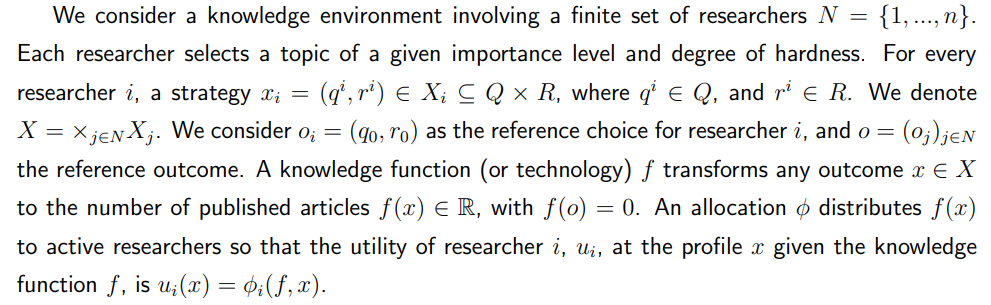
\
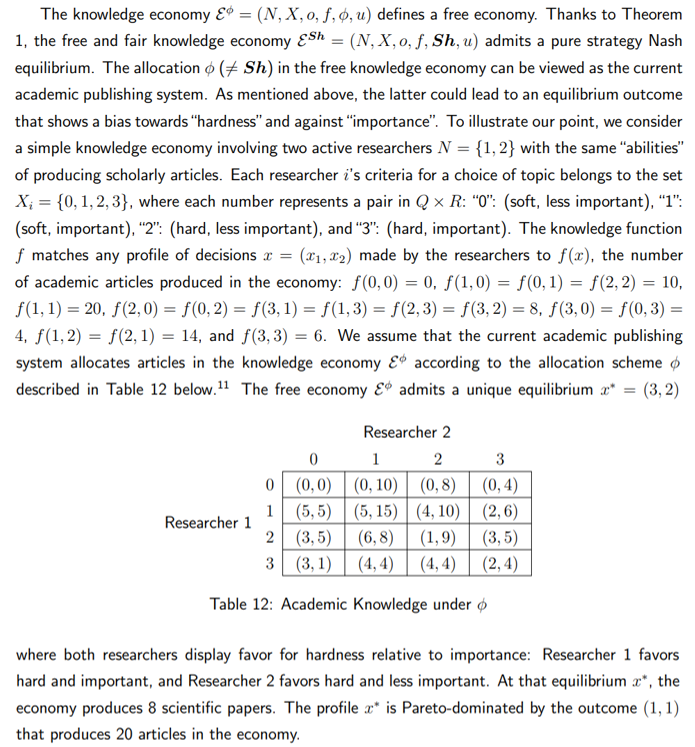
\
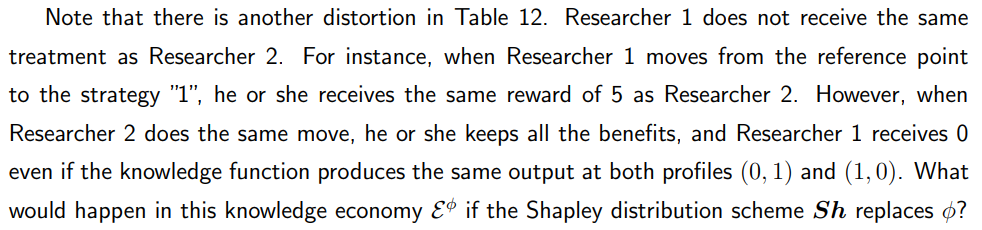
\ Well, it is straightforward to show that the researchers are symmetric under the knowledge function f. Using Anonymity and the other principles of merit-based justice, Table 13 below describes the allocation of academic articles under the allocation Sh.

\
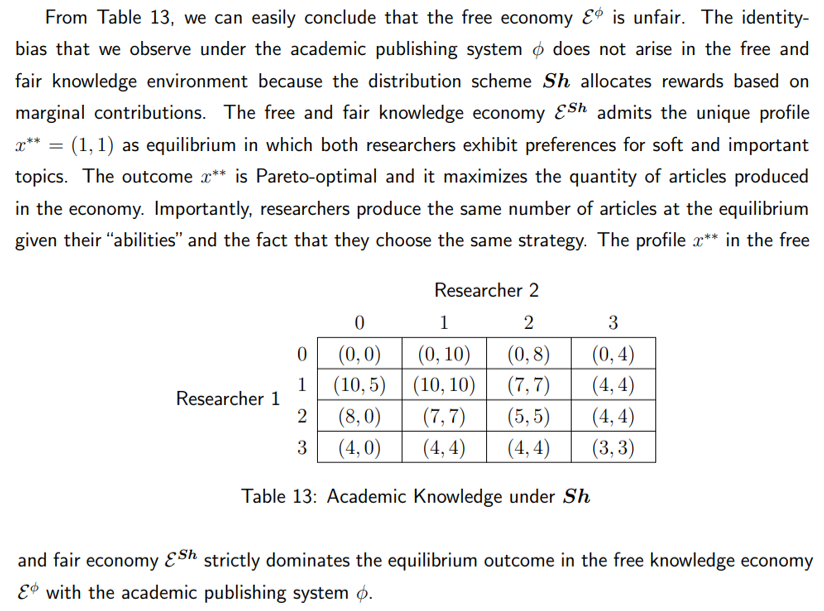
\

:::info Authors:

(1) Ghislain H. Demeze-Jouatsa, Center for Mathematical Economics, University of Bielefeld (demeze jouatsa@uni-bielefeld.de);

(2) Roland Pongou, Department of Economics, University of Ottawa (rpongou@uottawa.ca);

(3) Jean-Baptiste Tondji, Department of Economics and Finance, The University of Texas Rio Grande Valley (jeanbaptiste.tondji@utrgv.edu).

:::


:::info This paper is available on arxiv under CC BY 4.0 DEED license.

:::

[10] Tough the trade-off between the two quality dimensions can be viewed as a rational decision, the consequences can be detrimental to economics, as a discipline and profession. For instance, some general interest journals suffer from the “incest factor” [Heckman et al., 2017], and Akerlof [2020] shows that the tendency of rewarding “hard” topics versus“ soft ”topics in economics results in “sins of omissions” where issues that are relevant to the literature and can not be approached in a “hard” way are ignored.

\

Disclaimer: The articles reposted on this site are sourced from public platforms and are provided for informational purposes only. They do not necessarily reflect the views of MEXC. All rights remain with the original authors. If you believe any content infringes on third-party rights, please contact service@support.mexc.com for removal. MEXC makes no guarantees regarding the accuracy, completeness, or timeliness of the content and is not responsible for any actions taken based on the information provided. The content does not constitute financial, legal, or other professional advice, nor should it be considered a recommendation or endorsement by MEXC.

You May Also Like

Oracle cloud revenue uptick disappoints, investors question AI‑infrastructure gamble

Oracle cloud revenue uptick disappoints, investors question AI‑infrastructure gamble

The post Oracle cloud revenue uptick disappoints, investors question AI‑infrastructure gamble appeared on BitcoinEthereumNews.com. Oracle reported a cloud revenue result that landed below expectations, leaving investors uneasy about how long its massive AI booking wave will take to turn into steady cash. Fiscal second-quarter cloud sales climbed 34 percent to $7.98 billion, but the figure missed analyst forecasts. The slower payoff timing now sits at the center of market debate. This report marked the first major cloud test for the new leadership team running the company after a high-profile executive shift. Revenue from the infrastructure unit jumped 68 percent to $4.08 billion in the same period, yet that number also came in just under projections. Oracle said the remaining performance obligation reached $523 billion for the quarter that ended November 30. Analysts on the Wall Street trading floor had expected about $519 billion, showing demand stayed strong even as near-term revenue lagged today. Oracle’s bookings figure showed future work piling up, but the timing of when that money hits income remains uncertain. Investors question spending as data center build speeds up Oracle built its cloud push on its old database base and then chased bigger names in modern computing. The current expansion is tied tightly to a large data center build meant to support AI workloads for OpenAI. Major platform clients also include TikTok under ByteDance and Meta Platforms. These customers help explain the surge in infrastructure demand even as questions grow about the cost of keeping those sites running nonstop. Spending pressure showed up clearly in the quarter. Capital expenditures reached about $13 billion, up from $8.5 billion in the prior period. Back in September, the company projected full-year capital spending of $35 billion. Analysts had modeled only $8.25 billion for the latest quarter, which widened the gap between expectations and what was actually spent. The higher outlay reflects land, power, hardware, and…
Share
BitcoinEthereumNews2025/12/11 06:04