When people hear “Zero-Knowledge Proof”, the first reaction is almost always the same: it protects my privacy on-chain. ZK is everywhere in Web3, powering privacy chains, identity systems, and even Layer2 scaling. Too often, it’s treated as a silver bullet for anonymity. But anonymity is not the same as privacy protection. The gap lies in how proofs are designed: they hide some facts, but leave others visible. So, before we ask whether ZK protects privacy, we need to ask what it actually secures. What ZK Actually Is Zero-Knowledge Proofs (ZKPs) are not born from Web3. They come from decades of cryptography research, first proposed in the 1980s as a way for one party (the prover) to convince another (the verifier) that a statement is true, without revealing the underlying information. At its core, ZK is about selective disclosure. It doesn’t make all your data invisible. Instead, it lets you prove just enough to satisfy a condition: “I’m over 18” without exposing my exact birthday. “This account has at least 1 ETH” without showing the balance. “This address provided liquidity for N days” without disclosing all transactions. The original purpose was simple but powerful: enable trust between parties who don’t fully trust each other, while minimizing unnecessary data exposure. “Proving the required condition while concealing personal details”, the logic makes ZK capable of enabling anonymity and shielding sensitive information that does not need to be exposed. With this logic in mind, it becomes clearer why Web3 has embraced ZK, and how it’s applying it today. Why Web3 Embraces ZK Web3 has always been built on open ledgers, where every transaction, balance, and contract state is transparent by default. This transparency is powerful for auditability, but it also creates tension: some users and projects want verifiability without overexposure. Zero-Knowledge Proofs step into that gap. They allow protocols to preserve the credibility of on-chain data while reducing the amount of raw information revealed. In practice, this logic has shaped three main areas of adoption: Privacy-Preserving Protocols Networks such as Zcash or Aztec use ZK to hide transaction details while still keeping the chain valid. The proof confirms that “the math checks out” without exposing sender, receiver, or exact amounts. Identity and Access Projects build ZK-based credentials that let users prove traits without revealing identities. For example, demonstrating membership in a DAO, residency in a country, or eligibility for airdrops — all without handing over personal documents. Scaling and Efficiency Rollups like zkSync and StarkNet rely on ZK proofs to compress hundreds of off-chain transactions into a single validity proof. This keeps Ethereum scalable without sacrificing security or trust. Across these fronts, ZK is not just a niche cryptographic trick. It has become a core enabler of Web3’s ambition: open systems that are secure, verifiable, and less invasive. But here lies the common misconception: adopting ZK doesn’t automatically mean privacy protection. Misconceptions of ZK The rise of Zero-Knowledge Proofs in Web3 has fueled a common narrative: ZK protects privacy. But this assumption blurs the line between what ZK actually protects and what remains exposed. Proofs are powerful, yet selective. They let you prove a condition without revealing the exact detail. For example, you can use ZK to show that your wallet added more than 1,000 USDT into a liquidity pool, without disclosing the precise amount. But here is the problem — the wallet address itself still lives on-chain. Once linked, its broader transaction history, balances, and interactions remain traceable. This same logic applies to DataFi. ZK has an essential role: it allows users to share proofs instead of raw data, ensuring brands can verify “the condition is met” without accessing personal details. For example, a campaign can check that a user purchased from a certain category, or engaged with a protocol for N days, without ever seeing the underlying receipts or wallet logs. But ZK is not a blanket shield. If users rely on a single wallet address to join campaigns or share data, the proof may stay private, yet the address itself continues to leak behavioral patterns — participation frequency, overlaps across different campaigns, or even financial activity. Of course, DataFi isn’t limited to on-chain data. Off-chain records, such as shopping receipts, loyalty memberships, browsing histories, can also be turned into proofs, secured by a combination of ZK, MPC, and TEE. This multi-layer protection ensures raw data never leaves the user’s control. Yet even here, wallet addresses are still the weak point. Proofs don’t reveal their contents, but the act of using a proof does — it shows that an address interacted with certain campaigns or contracts. Over time, these repeated appearances link together into behavioral patterns, allowing others to infer far more than any single proof discloses. Beyond ZK ZK does solve part of the privacy problem. It lets users prove conditions without revealing raw details. But on-chain transparency means a single wallet address can still collapse multiple proofs into a visible behavioral pattern. So, at DataDanceChain, we see wallet addresses as the real bottleneck for privacy. To solve that, we integrate sub-addresses — a design that lets each proof, each interaction, live under its own isolated address. For users, this means campaigns and data shares don’t collapse into a single behavioral profile. With sub-addresses, ZK’s selective disclosure is no longer undermined by address linkage, and it achieves its full privacy-preserving power. DataDance is a consumer chain built for personal data assets. It enables AI to utilize user data while ensuring the privacy of that data. DataDance caters to both individual users and commercial organizations (brands). Through the DataDance Key Derivation Protocol, the network’s nodes achieve multi-layered privacy protection while being EVM-compatible. This ensures absolute data privacy while enabling rights management, data exchange, asset airdrops, and claims. Website: https://datadance.ai/ X (Twitter): https://x.com/DataDanceChain Telegram: https://t.me/datadancechain GitHub: https://github.com/DataDanceChain GitBook: https://datadance.gitbook.io/ddc DataFi 101: How Does ZK Actually Protect Data? was originally published in Coinmonks on Medium, where people are continuing the conversation by highlighting and responding to this storyWhen people hear “Zero-Knowledge Proof”, the first reaction is almost always the same: it protects my privacy on-chain. ZK is everywhere in Web3, powering privacy chains, identity systems, and even Layer2 scaling. Too often, it’s treated as a silver bullet for anonymity. But anonymity is not the same as privacy protection. The gap lies in how proofs are designed: they hide some facts, but leave others visible. So, before we ask whether ZK protects privacy, we need to ask what it actually secures. What ZK Actually Is Zero-Knowledge Proofs (ZKPs) are not born from Web3. They come from decades of cryptography research, first proposed in the 1980s as a way for one party (the prover) to convince another (the verifier) that a statement is true, without revealing the underlying information. At its core, ZK is about selective disclosure. It doesn’t make all your data invisible. Instead, it lets you prove just enough to satisfy a condition: “I’m over 18” without exposing my exact birthday. “This account has at least 1 ETH” without showing the balance. “This address provided liquidity for N days” without disclosing all transactions. The original purpose was simple but powerful: enable trust between parties who don’t fully trust each other, while minimizing unnecessary data exposure. “Proving the required condition while concealing personal details”, the logic makes ZK capable of enabling anonymity and shielding sensitive information that does not need to be exposed. With this logic in mind, it becomes clearer why Web3 has embraced ZK, and how it’s applying it today. Why Web3 Embraces ZK Web3 has always been built on open ledgers, where every transaction, balance, and contract state is transparent by default. This transparency is powerful for auditability, but it also creates tension: some users and projects want verifiability without overexposure. Zero-Knowledge Proofs step into that gap. They allow protocols to preserve the credibility of on-chain data while reducing the amount of raw information revealed. In practice, this logic has shaped three main areas of adoption: Privacy-Preserving Protocols Networks such as Zcash or Aztec use ZK to hide transaction details while still keeping the chain valid. The proof confirms that “the math checks out” without exposing sender, receiver, or exact amounts. Identity and Access Projects build ZK-based credentials that let users prove traits without revealing identities. For example, demonstrating membership in a DAO, residency in a country, or eligibility for airdrops — all without handing over personal documents. Scaling and Efficiency Rollups like zkSync and StarkNet rely on ZK proofs to compress hundreds of off-chain transactions into a single validity proof. This keeps Ethereum scalable without sacrificing security or trust. Across these fronts, ZK is not just a niche cryptographic trick. It has become a core enabler of Web3’s ambition: open systems that are secure, verifiable, and less invasive. But here lies the common misconception: adopting ZK doesn’t automatically mean privacy protection. Misconceptions of ZK The rise of Zero-Knowledge Proofs in Web3 has fueled a common narrative: ZK protects privacy. But this assumption blurs the line between what ZK actually protects and what remains exposed. Proofs are powerful, yet selective. They let you prove a condition without revealing the exact detail. For example, you can use ZK to show that your wallet added more than 1,000 USDT into a liquidity pool, without disclosing the precise amount. But here is the problem — the wallet address itself still lives on-chain. Once linked, its broader transaction history, balances, and interactions remain traceable. This same logic applies to DataFi. ZK has an essential role: it allows users to share proofs instead of raw data, ensuring brands can verify “the condition is met” without accessing personal details. For example, a campaign can check that a user purchased from a certain category, or engaged with a protocol for N days, without ever seeing the underlying receipts or wallet logs. But ZK is not a blanket shield. If users rely on a single wallet address to join campaigns or share data, the proof may stay private, yet the address itself continues to leak behavioral patterns — participation frequency, overlaps across different campaigns, or even financial activity. Of course, DataFi isn’t limited to on-chain data. Off-chain records, such as shopping receipts, loyalty memberships, browsing histories, can also be turned into proofs, secured by a combination of ZK, MPC, and TEE. This multi-layer protection ensures raw data never leaves the user’s control. Yet even here, wallet addresses are still the weak point. Proofs don’t reveal their contents, but the act of using a proof does — it shows that an address interacted with certain campaigns or contracts. Over time, these repeated appearances link together into behavioral patterns, allowing others to infer far more than any single proof discloses. Beyond ZK ZK does solve part of the privacy problem. It lets users prove conditions without revealing raw details. But on-chain transparency means a single wallet address can still collapse multiple proofs into a visible behavioral pattern. So, at DataDanceChain, we see wallet addresses as the real bottleneck for privacy. To solve that, we integrate sub-addresses — a design that lets each proof, each interaction, live under its own isolated address. For users, this means campaigns and data shares don’t collapse into a single behavioral profile. With sub-addresses, ZK’s selective disclosure is no longer undermined by address linkage, and it achieves its full privacy-preserving power. DataDance is a consumer chain built for personal data assets. It enables AI to utilize user data while ensuring the privacy of that data. DataDance caters to both individual users and commercial organizations (brands). Through the DataDance Key Derivation Protocol, the network’s nodes achieve multi-layered privacy protection while being EVM-compatible. This ensures absolute data privacy while enabling rights management, data exchange, asset airdrops, and claims. Website: https://datadance.ai/ X (Twitter): https://x.com/DataDanceChain Telegram: https://t.me/datadancechain GitHub: https://github.com/DataDanceChain GitBook: https://datadance.gitbook.io/ddc DataFi 101: How Does ZK Actually Protect Data? was originally published in Coinmonks on Medium, where people are continuing the conversation by highlighting and responding to this story

DataFi 101: How Does ZK Actually Protect Data?

2025/09/24 15:44
5 min read

When people hear “Zero-Knowledge Proof”, the first reaction is almost always the same: it protects my privacy on-chain.

ZK is everywhere in Web3, powering privacy chains, identity systems, and even Layer2 scaling. Too often, it’s treated as a silver bullet for anonymity. But anonymity is not the same as privacy protection. The gap lies in how proofs are designed: they hide some facts, but leave others visible.

So, before we ask whether ZK protects privacy, we need to ask what it actually secures.

What ZK Actually Is

Zero-Knowledge Proofs (ZKPs) are not born from Web3.

They come from decades of cryptography research, first proposed in the 1980s as a way for one party (the prover) to convince another (the verifier) that a statement is true, without revealing the underlying information.

At its core, ZK is about selective disclosure. It doesn’t make all your data invisible. Instead, it lets you prove just enough to satisfy a condition:

  • “I’m over 18” without exposing my exact birthday.
  • “This account has at least 1 ETH” without showing the balance.
  • “This address provided liquidity for N days” without disclosing all transactions.

The original purpose was simple but powerful: enable trust between parties who don’t fully trust each other, while minimizing unnecessary data exposure. “Proving the required condition while concealing personal details”, the logic makes ZK capable of enabling anonymity and shielding sensitive information that does not need to be exposed.

With this logic in mind, it becomes clearer why Web3 has embraced ZK, and how it’s applying it today.

Why Web3 Embraces ZK

Web3 has always been built on open ledgers, where every transaction, balance, and contract state is transparent by default. This transparency is powerful for auditability, but it also creates tension: some users and projects want verifiability without overexposure. Zero-Knowledge Proofs step into that gap. They allow protocols to preserve the credibility of on-chain data while reducing the amount of raw information revealed.

In practice, this logic has shaped three main areas of adoption:

Privacy-Preserving Protocols

Networks such as Zcash or Aztec use ZK to hide transaction details while still keeping the chain valid. The proof confirms that “the math checks out” without exposing sender, receiver, or exact amounts.

Identity and Access

Projects build ZK-based credentials that let users prove traits without revealing identities. For example, demonstrating membership in a DAO, residency in a country, or eligibility for airdrops — all without handing over personal documents.

Scaling and Efficiency

Rollups like zkSync and StarkNet rely on ZK proofs to compress hundreds of off-chain transactions into a single validity proof. This keeps Ethereum scalable without sacrificing security or trust.

Across these fronts, ZK is not just a niche cryptographic trick. It has become a core enabler of Web3’s ambition: open systems that are secure, verifiable, and less invasive. But here lies the common misconception: adopting ZK doesn’t automatically mean privacy protection.

Misconceptions of ZK

The rise of Zero-Knowledge Proofs in Web3 has fueled a common narrative: ZK protects privacy. But this assumption blurs the line between what ZK actually protects and what remains exposed.

Proofs are powerful, yet selective. They let you prove a condition without revealing the exact detail. For example, you can use ZK to show that your wallet added more than 1,000 USDT into a liquidity pool, without disclosing the precise amount. But here is the problem — the wallet address itself still lives on-chain. Once linked, its broader transaction history, balances, and interactions remain traceable.

This same logic applies to DataFi. ZK has an essential role: it allows users to share proofs instead of raw data, ensuring brands can verify “the condition is met” without accessing personal details. For example, a campaign can check that a user purchased from a certain category, or engaged with a protocol for N days, without ever seeing the underlying receipts or wallet logs.

But ZK is not a blanket shield. If users rely on a single wallet address to join campaigns or share data, the proof may stay private, yet the address itself continues to leak behavioral patterns — participation frequency, overlaps across different campaigns, or even financial activity.

Of course, DataFi isn’t limited to on-chain data. Off-chain records, such as shopping receipts, loyalty memberships, browsing histories, can also be turned into proofs, secured by a combination of ZK, MPC, and TEE. This multi-layer protection ensures raw data never leaves the user’s control.

Yet even here, wallet addresses are still the weak point. Proofs don’t reveal their contents, but the act of using a proof does — it shows that an address interacted with certain campaigns or contracts. Over time, these repeated appearances link together into behavioral patterns, allowing others to infer far more than any single proof discloses.

Beyond ZK

ZK does solve part of the privacy problem. It lets users prove conditions without revealing raw details. But on-chain transparency means a single wallet address can still collapse multiple proofs into a visible behavioral pattern. So, at DataDanceChain, we see wallet addresses as the real bottleneck for privacy.

To solve that, we integrate sub-addresses — a design that lets each proof, each interaction, live under its own isolated address. For users, this means campaigns and data shares don’t collapse into a single behavioral profile.

With sub-addresses, ZK’s selective disclosure is no longer undermined by address linkage, and it achieves its full privacy-preserving power.

DataDance is a consumer chain built for personal data assets. It enables AI to utilize user data while ensuring the privacy of that data.

DataDance caters to both individual users and commercial organizations (brands). Through the DataDance Key Derivation Protocol, the network’s nodes achieve multi-layered privacy protection while being EVM-compatible. This ensures absolute data privacy while enabling rights management, data exchange, asset airdrops, and claims.

Website: https://datadance.ai/

X (Twitter): https://x.com/DataDanceChain

Telegram: https://t.me/datadancechain

GitHub: https://github.com/DataDanceChain

GitBook: https://datadance.gitbook.io/ddc


DataFi 101: How Does ZK Actually Protect Data? was originally published in Coinmonks on Medium, where people are continuing the conversation by highlighting and responding to this story.

Market Opportunity
ZKsync Logo
ZKsync Price(ZK)
$0.02363
$0.02363$0.02363
-0.08%
USD
ZKsync (ZK) Live Price Chart
Disclaimer: The articles reposted on this site are sourced from public platforms and are provided for informational purposes only. They do not necessarily reflect the views of MEXC. All rights remain with the original authors. If you believe any content infringes on third-party rights, please contact service@support.mexc.com for removal. MEXC makes no guarantees regarding the accuracy, completeness, or timeliness of the content and is not responsible for any actions taken based on the information provided. The content does not constitute financial, legal, or other professional advice, nor should it be considered a recommendation or endorsement by MEXC.

You May Also Like

Fed Decides On Interest Rates Today—Here’s What To Watch For

Fed Decides On Interest Rates Today—Here’s What To Watch For

The post Fed Decides On Interest Rates Today—Here’s What To Watch For appeared on BitcoinEthereumNews.com. Topline The Federal Reserve on Wednesday will conclude a two-day policymaking meeting and release a decision on whether to lower interest rates—following months of pressure and criticism from President Donald Trump—and potentially signal whether additional cuts are on the way. President Donald Trump has urged the central bank to “CUT INTEREST RATES, NOW, AND BIGGER” than they might plan to. Getty Images Key Facts The central bank is poised to cut interest rates by at least a quarter-point, down from the 4.25% to 4.5% range where they have been held since December to between 4% and 4.25%, as Wall Street has placed 100% odds of a rate cut, according to CME’s FedWatch, with higher odds (94%) on a quarter-point cut than a half-point (6%) reduction. Fed governors Christopher Waller and Michelle Bowman, both Trump appointees, voted in July for a quarter-point reduction to rates, and they may dissent again in favor of a large cut alongside Stephen Miran, Trump’s Council of Economic Advisers’ chair, who was sworn in at the meeting’s start on Tuesday. It’s unclear whether other policymakers, including Kansas City Fed President Jeffrey Schmid and St. Louis Fed President Alberto Musalem, will favor larger cuts or opt for no reduction. Fed Chair Jerome Powell said in his Jackson Hole, Wyoming, address last month the central bank would likely consider a looser monetary policy, noting the “shifting balance of risks” on the U.S. economy “may warrant adjusting our policy stance.” David Mericle, an economist for Goldman Sachs, wrote in a note the “key question” for the Fed’s meeting is whether policymakers signal “this is likely the first in a series of consecutive cuts” as the central bank is anticipated to “acknowledge the softening in the labor market,” though they may not “nod to an October cut.” Mericle said he…
Share
BitcoinEthereumNews2025/09/18 00:23
While Shiba Inu and Turbo Chase Price, 63% APY Staking Puts APEMARS at the Forefront of the Best Meme Coin Presale 2026 – Stage 6 Ends in 3 Days!
While Shiba Inu and Turbo Chase Price, 63% APY Staking Puts APEMARS at the Forefront of the Best Meme Coin Presale 2026 – Stage 6 Ends in 3 Days!

What if your meme coin investment could generate passive income without selling a single token? Shiba Inu climbed 4.97% as 207 billion tokens left exchanges. Turbo
Share
Coinstats2026/02/04 03:15
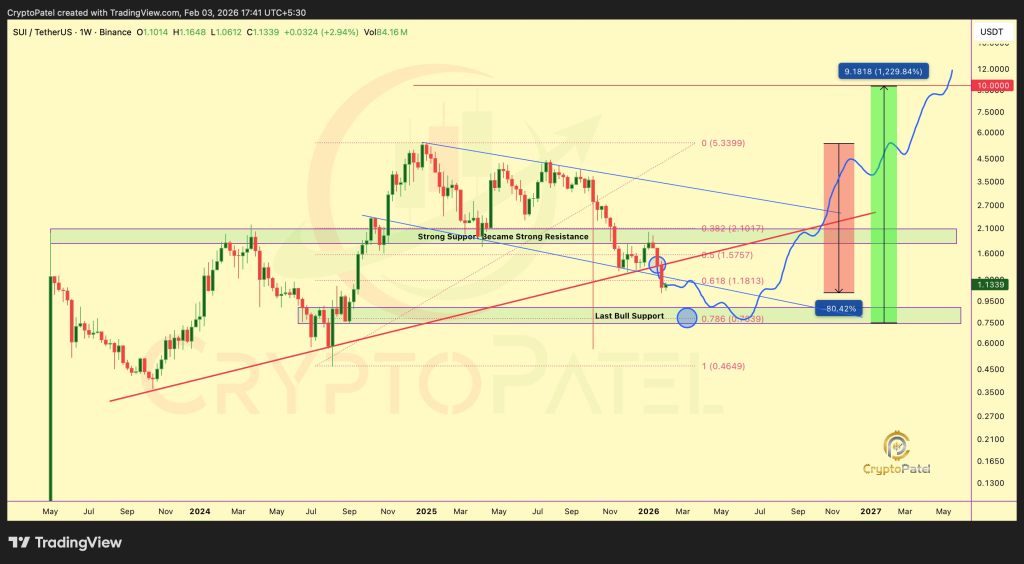
SUI Price Is Down 80%: Price Nears Level Bulls Cannot Afford to Lose

SUI Price Is Down 80%: Price Nears Level Bulls Cannot Afford to Lose

SUI price has quietly slipped into a zone that usually decides everything. Charts show an 80% drop from the peak, yet the market is no longer moving fast. This
Share
Captainaltcoin2026/02/04 03:00