Recently, AIOZ Network released AIOZ Stream, a protocol designed to make streaming as configurable as any modern software service. Instead of hard‑wired revenue shares and opaque delivery, teams get modular primitives: ingest, transcode, delivery, and payouts that can be tuned in code.Recently, AIOZ Network released AIOZ Stream, a protocol designed to make streaming as configurable as any modern software service. Instead of hard‑wired revenue shares and opaque delivery, teams get modular primitives: ingest, transcode, delivery, and payouts that can be tuned in code.

AIOZ Stream Delivers Peer-to-Peer On-Demand Video Powered by DePIN

4 min read

Recently, AIOZ Network released AIOZ Stream, a protocol designed to make streaming as configurable as any modern software service. Instead of hard‑wired revenue shares and opaque delivery, teams get modular primitives: ingest, transcode, delivery, and payouts that can be tuned in code.

The aim, as Founder & CEO Erman Tjiputra describes it, is alignment from source to screen: creators keep control, viewers can participate in value, developers build on open rails, and the community that supplies storage, bandwidth, AI, and compute through AIOZ DePIN is rewarded transparently.

Launch VOD Fast: Then Expand on Your Timeline

V1 focuses on video‑on‑demand so you can ship quickly, learn, and expand. Upload your content and AIOZ Stream handles adaptive transcoding. Playback is delivered through a customizable player that integrates seamlessly into existing apps.

SDKs and webhooks connect identity, analytics, and commerce. Crucially, wallets are optional: viewers can press play with familiar flows, while on‑chain proofs and token features are ready when you choose to expose them.

https://x.com/AIOZNetwork/status/1967604746505564199?ref_src=twsrc%5Etfw&embedable=true

\

AIOZ Stream powers Monetization into Code: SVOD/TVOD/AVOD, Tips & Micro‑Subs

AIOZ Stream reimagines monetization as programmable. Today, creators design their own economies with subscriptions (SVOD), pay-per-view (TVOD), tips, and micro-subscriptions. Ahead lies an even bigger frontier: ad-supported experiences (AVOD) and the AIOZ Ads Platform, unlocking limitless new revenue streams.”

A smart‑contract router settles subscription revenue into a Developer Pool, while a tip passthrough sends 100% of tips directly to creators. For ad‑supported models, an AIOZ‑denominated marketplace clears auctions in real time.

If you want to reward viewers, you can allocate a share to a configurable viewer rewards pool (Watch‑to‑Earn). With flows written directly on-chain, stakeholders in the ecosystem see splits in real time—no more month-end delays.

Deliver from the Network’s Edge, and Prove Every Session

Under the hood, delivery runs on AIOZ DePIN, a contributor‑powered fabric that supplies storage, bandwidth, and compute across a global footprint. Streams are sharded and redundantly distributed to neighboring nodes, then served peer‑to‑peer for resilience during spikes and reach in underserved regions.

Adaptive bitrate (ABR) logic is tuned for real‑world variability to preserve QoE. Beyond performance, playback integrity is verifiable, partners can produce on‑chain evidence that a stream was delivered, not just a log line.
Let Ads Learn While You Sleep

As part of the roadmap, the upcoming AIOZ Ads Platform will power AVOD models with real-time auctions denominated in AIOZ tokens. When this feature is live, it will apply bandit-style learning policies to continuously optimize yield per impression.

Optimization is continuous—testing placements and formats on the fly, then amplifying what works. With token-native settlement, publishers track value flows in near real time and can instantly reallocate incentives to creators, developers, or viewers, all without migrating platforms.

One Incentive Layer for Stream, Storage, Pin, and AI Powered By AIOZ DePIN

AIOZ Stream is one pillar of a unified stack built on the AIOZ DePIN incentive layer, where streaming runs alongside storage and AI compute. AIOZ Storage delivers S3-compatible object storage, powered by contributors and rewarded on-chain—ideal for catalogs and data-heavy workflows.

AIOZ Pin offers IPFS pinning for immutable artifacts like NFTs, contracts, and archives. AIOZ AI supplies decentralized CPU/GPU for model deployment, inference, and training. That combination enables edge‑AI services, speech‑to‑text, text‑to‑speech, tagging, and search, metered in tokens and callable from the same app that handles streaming.
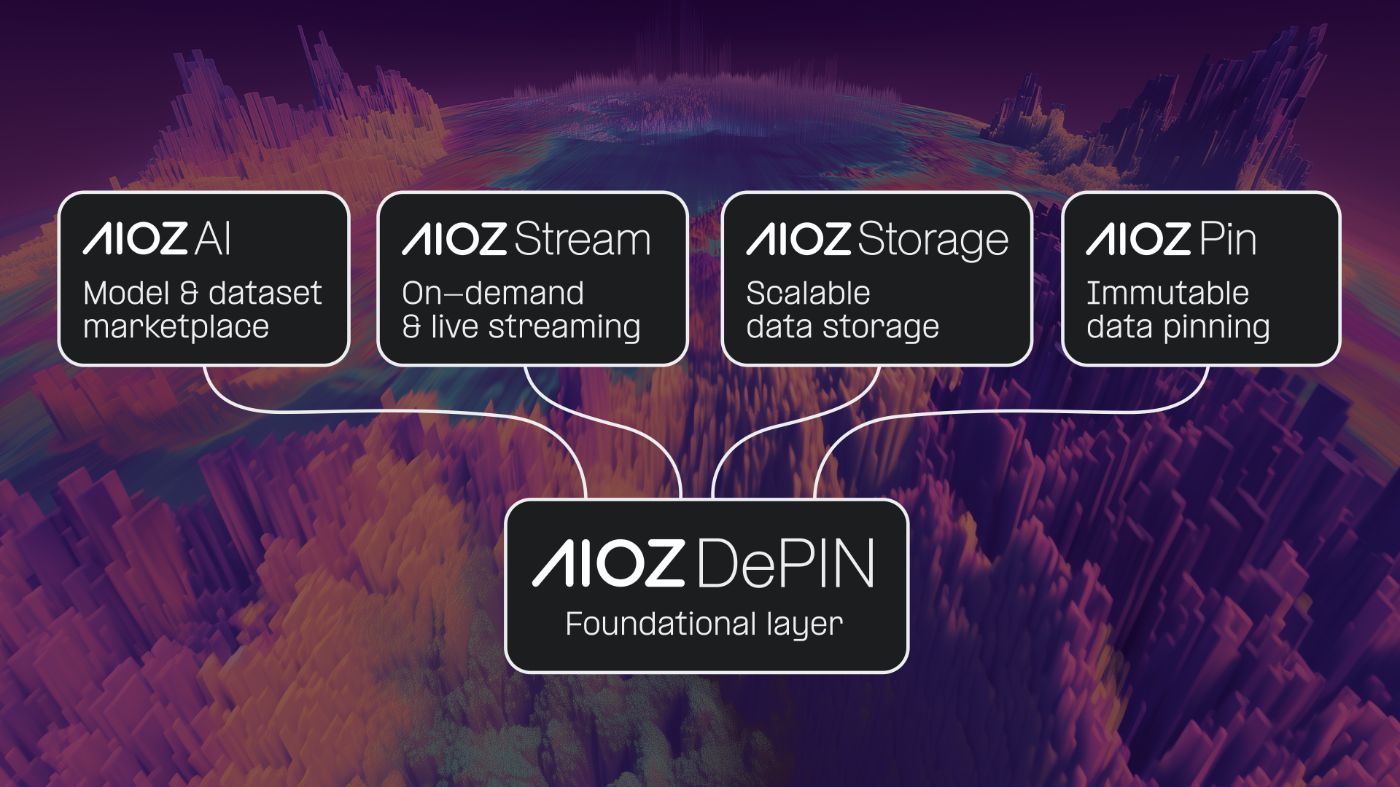
Because each component rides the same economic rails, architecture stays cohesive as you scale.

Keep Data Minimal, Control Maximal

AIOZ Stream is built on privacy-by-design: minimal data collection, encrypted delivery, and controls aligned with regulation. Creators keep ownership and rights, while content libraries stay portable across platforms and integrations.

On‑chain transparency complements privacy; it makes payouts auditable without turning user data into product.

Start Where You Are

AIOZ Stream unlocks the web3 future without a rebuild. Drop the player in your existing app, connect the SDKs, and choose which token‑native features to expose. Scale later with live, audio, and edge-AI as your product roadmap evolves.

At the core is the AIOZ DePIN backbone—a people-powered global network driving delivery, storage, and AI compute, with value flows kept transparent end to end

Launch. Build. Stream. → https://aiozstream.network

Market Opportunity
Streamflow Logo
Streamflow Price(STREAM)
$0,01513
$0,01513$0,01513
+0,66%
USD
Streamflow (STREAM) Live Price Chart
Disclaimer: The articles reposted on this site are sourced from public platforms and are provided for informational purposes only. They do not necessarily reflect the views of MEXC. All rights remain with the original authors. If you believe any content infringes on third-party rights, please contact service@support.mexc.com for removal. MEXC makes no guarantees regarding the accuracy, completeness, or timeliness of the content and is not responsible for any actions taken based on the information provided. The content does not constitute financial, legal, or other professional advice, nor should it be considered a recommendation or endorsement by MEXC.

You May Also Like

Unlocking Massive Value: Curve Finance Revenue Sharing Proposal for CRV Holders

Unlocking Massive Value: Curve Finance Revenue Sharing Proposal for CRV Holders

BitcoinWorld Unlocking Massive Value: Curve Finance Revenue Sharing Proposal for CRV Holders The dynamic world of decentralized finance (DeFi) is constantly evolving, bringing forth new opportunities and innovations. A significant development is currently unfolding at Curve Finance, a leading decentralized exchange (DEX). Its founder, Michael Egorov, has put forth an exciting proposal designed to offer a more direct path for token holders to earn revenue. This initiative, centered around a new Curve Finance revenue sharing model, aims to bolster the value for those actively participating in the protocol’s governance. What is the “Yield Basis” Proposal and How Does it Work? At the core of this forward-thinking initiative is a new protocol dubbed Yield Basis. Michael Egorov introduced this concept on the CurveDAO governance forum, outlining a mechanism to distribute sustainable profits directly to CRV holders. Specifically, it targets those who stake their CRV tokens to gain veCRV, which are essential for governance participation within the Curve ecosystem. Let’s break down the initial steps of this innovative proposal: crvUSD Issuance: Before the Yield Basis protocol goes live, $60 million in crvUSD will be issued. Strategic Fund Allocation: The funds generated from the sale of these crvUSD tokens will be strategically deployed into three distinct Bitcoin-based liquidity pools: WBTC, cbBTC, and tBTC. Pool Capping: To ensure balanced risk and diversified exposure, each of these pools will be capped at $10 million. This carefully designed structure aims to establish a robust and consistent income stream, forming the bedrock of a sustainable Curve Finance revenue sharing mechanism. Why is This Curve Finance Revenue Sharing Significant for CRV Holders? This proposal marks a pivotal moment for CRV holders, particularly those dedicated to the long-term health and governance of Curve Finance. Historically, generating revenue for token holders in the DeFi space can often be complex. The Yield Basis proposal simplifies this by offering a more direct and transparent pathway to earnings. By staking CRV for veCRV, holders are not merely engaging in governance; they are now directly positioned to benefit from the protocol’s overall success. The significance of this development is multifaceted: Direct Profit Distribution: veCRV holders are set to receive a substantial share of the profits generated by the Yield Basis protocol. Incentivized Governance: This direct financial incentive encourages more users to stake their CRV, which in turn strengthens the protocol’s decentralized governance structure. Enhanced Value Proposition: The promise of sustainable revenue sharing could significantly boost the inherent value of holding and staking CRV tokens. Ultimately, this move underscores Curve Finance’s dedication to rewarding its committed community and ensuring the long-term vitality of its ecosystem through effective Curve Finance revenue sharing. Understanding the Mechanics: Profit Distribution and Ecosystem Support The distribution model for Yield Basis has been thoughtfully crafted to strike a balance between rewarding veCRV holders and supporting the wider Curve ecosystem. Under the terms of the proposal, a substantial portion of the value generated by Yield Basis will flow back to those who contribute to the protocol’s governance. Returns for veCRV Holders: A significant share, specifically between 35% and 65% of the value generated by Yield Basis, will be distributed to veCRV holders. This flexible range allows for dynamic adjustments based on market conditions and the protocol’s performance. Ecosystem Reserve: Crucially, 25% of the Yield Basis tokens will be reserved exclusively for the Curve ecosystem. This allocation can be utilized for various strategic purposes, such as funding ongoing development, issuing grants, or further incentivizing liquidity providers. This ensures the continuous growth and innovation of the platform. The proposal is currently undergoing a democratic vote on the CurveDAO governance forum, giving the community a direct voice in shaping the future of Curve Finance revenue sharing. The voting period is scheduled to conclude on September 24th. What’s Next for Curve Finance and CRV Holders? The proposed Yield Basis protocol represents a pioneering approach to sustainable revenue generation and community incentivization within the DeFi landscape. If approved by the community, this Curve Finance revenue sharing model has the potential to establish a new benchmark for how decentralized exchanges reward their most dedicated participants. It aims to foster a more robust and engaged community by directly linking governance participation with tangible financial benefits. This strategic move by Michael Egorov and the Curve Finance team highlights a strong commitment to innovation and strengthening the decentralized nature of the protocol. For CRV holders, a thorough understanding of this proposal is crucial for making informed decisions regarding their staking strategies and overall engagement with one of DeFi’s foundational platforms. FAQs about Curve Finance Revenue Sharing Q1: What is the main goal of the Yield Basis proposal? A1: The primary goal is to establish a more direct and sustainable way for CRV token holders who stake their tokens (receiving veCRV) to earn revenue from the Curve Finance protocol. Q2: How will funds be generated for the Yield Basis protocol? A2: Initially, $60 million in crvUSD will be issued and sold. The funds from this sale will then be allocated to three Bitcoin-based pools (WBTC, cbBTC, and tBTC), with each pool capped at $10 million, to generate profits. Q3: Who benefits from the Yield Basis revenue sharing? A3: The proposal states that between 35% and 65% of the value generated by Yield Basis will be returned to veCRV holders, who are CRV stakers participating in governance. Q4: What is the purpose of the 25% reserve for the Curve ecosystem? A4: This 25% reserve of Yield Basis tokens is intended to support the broader Curve ecosystem, potentially funding development, grants, or other initiatives that contribute to the platform’s growth and sustainability. Q5: When is the vote on the Yield Basis proposal? A5: A vote on the proposal is currently underway on the CurveDAO governance forum and is scheduled to run until September 24th. If you found this article insightful and valuable, please consider sharing it with your friends, colleagues, and followers on social media! Your support helps us continue to deliver important DeFi insights and analysis to a wider audience. To learn more about the latest DeFi market trends, explore our article on key developments shaping decentralized finance institutional adoption. This post Unlocking Massive Value: Curve Finance Revenue Sharing Proposal for CRV Holders first appeared on BitcoinWorld.
Share
Coinstats2025/09/18 00:35
Best Crypto To Buy Now: Pepeto vs BlockDAG, Layer Brett, Remittix, Little Pepe, Compared

Best Crypto To Buy Now: Pepeto vs BlockDAG, Layer Brett, Remittix, Little Pepe, Compared

Today we compare Pepeto (PEPETO), BlockDAG, Layer Brett, Remittix, Little Pepe (and how they stack up today) by the main […] The post Best Crypto To Buy Now: Pepeto vs BlockDAG, Layer Brett, Remittix, Little Pepe, Compared appeared first on Coindoo.
Share
Coindoo2025/09/18 02:39
Solana Price Plummets: SOL Crashes Below $90 in Stunning Market Reversal

Solana Price Plummets: SOL Crashes Below $90 in Stunning Market Reversal

BitcoinWorld Solana Price Plummets: SOL Crashes Below $90 in Stunning Market Reversal In a dramatic shift for one of cryptocurrency’s leading networks, Solana (
Share
bitcoinworld2026/02/05 06:45