The post US court rules Bored Ape NFTs are not securities appeared on BitcoinEthereumNews.com. A California-based federal judge, Fernando M. Olguin, has reportedly dismissed a class-action lawsuit against Yuga Labs, the blockchain technology company that created the Bored Ape Yacht Club (BAYC) NFTs collection. The dismissal followed the judge’s ruling that these digital collectibles did not qualify as securities. According to him, the Bored Ape NFTs did not meet several requirements to determine whether financial transactions involving them are considered securities. Judge Olguin was appointed by former US President Barack Obama in 2013. Judge Olguin ruled that Bored Ape NFTs are not securities  In his Thursday, October 2 ruling, Olguin pointed out that Bored Ape NFTs differed from other NFT collections previously recognized as securities. Examples of these NFTs include Dapper Labs’ NBA Top Shot NFTs and DraftKings NFTs. He highlighted this difference mainly because investors prefer to purchase Bored Apes from third-party marketplaces, such as OpenSea and Coinbase, rather than acquiring them directly from the NFT issuer’s marketplace. The federal judge had also discovered that Bored Ape NFTs did not meet the necessary “common enterprise” aspect of the test used to establish an asset as a security.  He explained that the plaintiffs did not demonstrate any important relationship between the alleged securities and the proprietary ‘ecosystem’ that supported the case of Dapper Labs and DraftKings. This, therefore, led him to conclude that they had not clearly illustrated a horizontal connection.  Another thing that the judge uncovered was that Yuga Labs charges a royalty fee to creators on every sale of Bored Apes. This indicated a difference between the fortunes of the plaintiffs and those of the defendants. This meant that the defendants could still gain profit even if the plaintiffs sold their own NFTs at a loss. These royalties are one of the primary sources of income for NFT creators. To break this… The post US court rules Bored Ape NFTs are not securities appeared on BitcoinEthereumNews.com. A California-based federal judge, Fernando M. Olguin, has reportedly dismissed a class-action lawsuit against Yuga Labs, the blockchain technology company that created the Bored Ape Yacht Club (BAYC) NFTs collection. The dismissal followed the judge’s ruling that these digital collectibles did not qualify as securities. According to him, the Bored Ape NFTs did not meet several requirements to determine whether financial transactions involving them are considered securities. Judge Olguin was appointed by former US President Barack Obama in 2013. Judge Olguin ruled that Bored Ape NFTs are not securities  In his Thursday, October 2 ruling, Olguin pointed out that Bored Ape NFTs differed from other NFT collections previously recognized as securities. Examples of these NFTs include Dapper Labs’ NBA Top Shot NFTs and DraftKings NFTs. He highlighted this difference mainly because investors prefer to purchase Bored Apes from third-party marketplaces, such as OpenSea and Coinbase, rather than acquiring them directly from the NFT issuer’s marketplace. The federal judge had also discovered that Bored Ape NFTs did not meet the necessary “common enterprise” aspect of the test used to establish an asset as a security.  He explained that the plaintiffs did not demonstrate any important relationship between the alleged securities and the proprietary ‘ecosystem’ that supported the case of Dapper Labs and DraftKings. This, therefore, led him to conclude that they had not clearly illustrated a horizontal connection.  Another thing that the judge uncovered was that Yuga Labs charges a royalty fee to creators on every sale of Bored Apes. This indicated a difference between the fortunes of the plaintiffs and those of the defendants. This meant that the defendants could still gain profit even if the plaintiffs sold their own NFTs at a loss. These royalties are one of the primary sources of income for NFT creators. To break this…

US court rules Bored Ape NFTs are not securities

3 min read

A California-based federal judge, Fernando M. Olguin, has reportedly dismissed a class-action lawsuit against Yuga Labs, the blockchain technology company that created the Bored Ape Yacht Club (BAYC) NFTs collection. The dismissal followed the judge’s ruling that these digital collectibles did not qualify as securities.

According to him, the Bored Ape NFTs did not meet several requirements to determine whether financial transactions involving them are considered securities. Judge Olguin was appointed by former US President Barack Obama in 2013.

Judge Olguin ruled that Bored Ape NFTs are not securities 

In his Thursday, October 2 ruling, Olguin pointed out that Bored Ape NFTs differed from other NFT collections previously recognized as securities. Examples of these NFTs include Dapper Labs’ NBA Top Shot NFTs and DraftKings NFTs.

He highlighted this difference mainly because investors prefer to purchase Bored Apes from third-party marketplaces, such as OpenSea and Coinbase, rather than acquiring them directly from the NFT issuer’s marketplace.

The federal judge had also discovered that Bored Ape NFTs did not meet the necessary “common enterprise” aspect of the test used to establish an asset as a security. 

He explained that the plaintiffs did not demonstrate any important relationship between the alleged securities and the proprietary ‘ecosystem’ that supported the case of Dapper Labs and DraftKings. This, therefore, led him to conclude that they had not clearly illustrated a horizontal connection. 

Another thing that the judge uncovered was that Yuga Labs charges a royalty fee to creators on every sale of Bored Apes. This indicated a difference between the fortunes of the plaintiffs and those of the defendants.

This meant that the defendants could still gain profit even if the plaintiffs sold their own NFTs at a loss. These royalties are one of the primary sources of income for NFT creators. To break this down, they earn a built-in fee, mostly over 10%, each time their collectible tokens are sold or traded.

Notably, these arguments raised by the judge differ significantly from those employed by the SEC during the Biden administration. Based on those from the SEC, the creator royalties suggested that an asset is a security, as it was designed to be resold by its creators.

The SEC ends their lengthy investigation into the NFTs space amid Trump’s pro-crypto stance 

Yuga Labs has been fighting the federal government for several years about whether NFTs are securities, largely because it is one of the biggest players in this space. While Bored Ape NFTs have cooled off and depreciated in value and cultural significance, they have still racked up a remarkable $7.2 billion in trading volume since their launch in 2021. 

Concerning the situation, the company mentioned earlier this year that the SEC had concluded its long investigation into its operations as part of the Trump administration’s pro-crypto stance. The SEC also ended a similar investigation into NFT marketplace OpenSea.

It is one thing for the commission to opt not to pursue enforcement against certain NFT projects, but it is a different situation when a federal court issues a clear ruling, as it did in Yuga’s case this week.

Despite this significant ruling, Bored Ape NFTs look largely the same. The floor price for an NFT in the collection —the lowest price that NFTs sell for —dropped by 2% over the last 24 hours to $37,337. This represents a 90% decrease compared to the highest price of $369,900 reached in April 2022. 

Sharpen your strategy with mentorship + daily ideas – 30 days free access to our trading program

Source: https://www.cryptopolitan.com/court-says-bored-ape-nfts-not-securities/

Market Opportunity
ApeCoin Logo
ApeCoin Price(APE)
$0.1496
$0.1496$0.1496
+0.94%
USD
ApeCoin (APE) Live Price Chart
Disclaimer: The articles reposted on this site are sourced from public platforms and are provided for informational purposes only. They do not necessarily reflect the views of MEXC. All rights remain with the original authors. If you believe any content infringes on third-party rights, please contact service@support.mexc.com for removal. MEXC makes no guarantees regarding the accuracy, completeness, or timeliness of the content and is not responsible for any actions taken based on the information provided. The content does not constitute financial, legal, or other professional advice, nor should it be considered a recommendation or endorsement by MEXC.

You May Also Like

Fed Decides On Interest Rates Today—Here’s What To Watch For

Fed Decides On Interest Rates Today—Here’s What To Watch For

The post Fed Decides On Interest Rates Today—Here’s What To Watch For appeared on BitcoinEthereumNews.com. Topline The Federal Reserve on Wednesday will conclude a two-day policymaking meeting and release a decision on whether to lower interest rates—following months of pressure and criticism from President Donald Trump—and potentially signal whether additional cuts are on the way. President Donald Trump has urged the central bank to “CUT INTEREST RATES, NOW, AND BIGGER” than they might plan to. Getty Images Key Facts The central bank is poised to cut interest rates by at least a quarter-point, down from the 4.25% to 4.5% range where they have been held since December to between 4% and 4.25%, as Wall Street has placed 100% odds of a rate cut, according to CME’s FedWatch, with higher odds (94%) on a quarter-point cut than a half-point (6%) reduction. Fed governors Christopher Waller and Michelle Bowman, both Trump appointees, voted in July for a quarter-point reduction to rates, and they may dissent again in favor of a large cut alongside Stephen Miran, Trump’s Council of Economic Advisers’ chair, who was sworn in at the meeting’s start on Tuesday. It’s unclear whether other policymakers, including Kansas City Fed President Jeffrey Schmid and St. Louis Fed President Alberto Musalem, will favor larger cuts or opt for no reduction. Fed Chair Jerome Powell said in his Jackson Hole, Wyoming, address last month the central bank would likely consider a looser monetary policy, noting the “shifting balance of risks” on the U.S. economy “may warrant adjusting our policy stance.” David Mericle, an economist for Goldman Sachs, wrote in a note the “key question” for the Fed’s meeting is whether policymakers signal “this is likely the first in a series of consecutive cuts” as the central bank is anticipated to “acknowledge the softening in the labor market,” though they may not “nod to an October cut.” Mericle said he…
Share
BitcoinEthereumNews2025/09/18 00:23
While Shiba Inu and Turbo Chase Price, 63% APY Staking Puts APEMARS at the Forefront of the Best Meme Coin Presale 2026 – Stage 6 Ends in 3 Days!

While Shiba Inu and Turbo Chase Price, 63% APY Staking Puts APEMARS at the Forefront of the Best Meme Coin Presale 2026 – Stage 6 Ends in 3 Days!

What if your meme coin investment could generate passive income without selling a single token? Shiba Inu climbed 4.97% as 207 billion tokens left exchanges. Turbo
Share
Coinstats2026/02/04 03:15
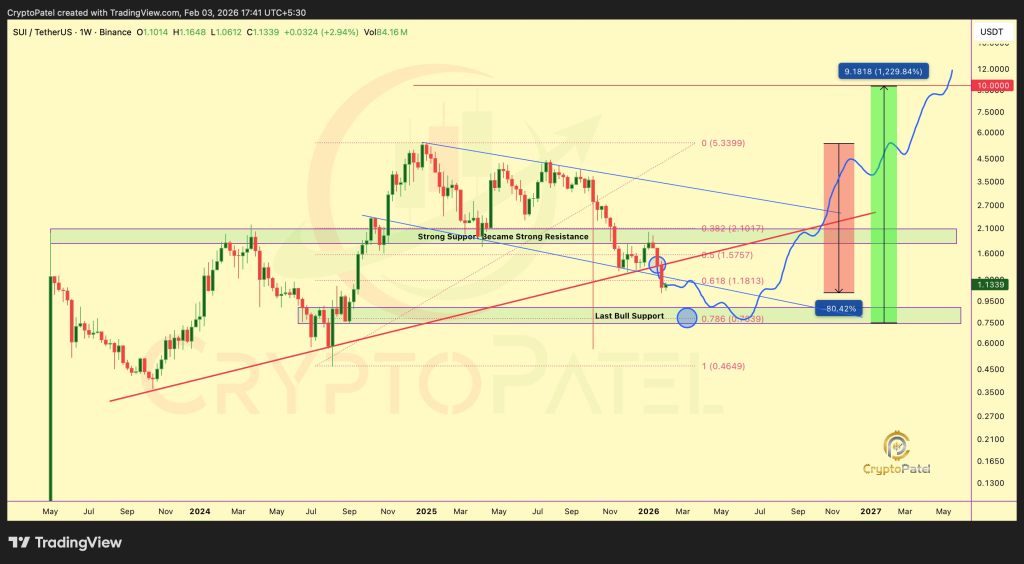
SUI Price Is Down 80%: Price Nears Level Bulls Cannot Afford to Lose

SUI Price Is Down 80%: Price Nears Level Bulls Cannot Afford to Lose

SUI price has quietly slipped into a zone that usually decides everything. Charts show an 80% drop from the peak, yet the market is no longer moving fast. This
Share
Captainaltcoin2026/02/04 03:00