The post Why Kalshi’s $5B valuation puts Polymarket on notice appeared on BitcoinEthereumNews.com. A high-stakes capital race has redefined the prediction market. Kalshi’s $300 million raise at a $5 billion valuation positioned it as the most valuable CFTC-regulated event-contract exchange in history. The firm’s expansion into 140 countries and growing list of macro and cultural markets seemed to cement its place as the global leader. Around the same time, Polymarket, Kalshi’s on-chain rival, secured $2 billion in backing from Intercontinental Exchange (ICE), the owner of the New York Stock Exchange, and announced plans to re-enter the US market through a newly licensed exchange framework. This marks the first true duel between regulated infrastructure and crypto-native liquidity in the prediction market. Polymarket goes institutional The ICE investment transformed Polymarket overnight from a scrappy decentralized platform into a heavyweight competitor with Wall Street credentials. ICE’s commitment gives the firm an implied valuation of $8 billion and makes it the first blockchain-based prediction market to gain backing from a Tier-1 financial operator. Beyond the capital, the partnership grants Polymarket access to ICE’s global distribution and data-feed infrastructure: channels that reach thousands of institutions already plugged into equities, commodities, and derivatives markets. Polymarket’s comeback also carries a regulatory twist. After years of operating offshore, the company has quietly built a compliant US pathway by acquiring QCX LLC, a CFTC-licensed exchange. Through QCX, Polymarket obtained a Designated Contract Market license and adopted a self-certification mechanism for event markets, allowing it to list new contracts without pre-approval unless the CFTC objects. That structure effectively mirrors Kalshi’s own legal model. A recent no-action letter cleared the way for Polymarket to resume operations in the United States, starting with contracts tied to sports outcomes and election probabilities. In parallel, Polymarket has timed its re-entry to coincide with the surge in political and sports-betting interest ahead of the 2026 election cycle. Its… The post Why Kalshi’s $5B valuation puts Polymarket on notice appeared on BitcoinEthereumNews.com. A high-stakes capital race has redefined the prediction market. Kalshi’s $300 million raise at a $5 billion valuation positioned it as the most valuable CFTC-regulated event-contract exchange in history. The firm’s expansion into 140 countries and growing list of macro and cultural markets seemed to cement its place as the global leader. Around the same time, Polymarket, Kalshi’s on-chain rival, secured $2 billion in backing from Intercontinental Exchange (ICE), the owner of the New York Stock Exchange, and announced plans to re-enter the US market through a newly licensed exchange framework. This marks the first true duel between regulated infrastructure and crypto-native liquidity in the prediction market. Polymarket goes institutional The ICE investment transformed Polymarket overnight from a scrappy decentralized platform into a heavyweight competitor with Wall Street credentials. ICE’s commitment gives the firm an implied valuation of $8 billion and makes it the first blockchain-based prediction market to gain backing from a Tier-1 financial operator. Beyond the capital, the partnership grants Polymarket access to ICE’s global distribution and data-feed infrastructure: channels that reach thousands of institutions already plugged into equities, commodities, and derivatives markets. Polymarket’s comeback also carries a regulatory twist. After years of operating offshore, the company has quietly built a compliant US pathway by acquiring QCX LLC, a CFTC-licensed exchange. Through QCX, Polymarket obtained a Designated Contract Market license and adopted a self-certification mechanism for event markets, allowing it to list new contracts without pre-approval unless the CFTC objects. That structure effectively mirrors Kalshi’s own legal model. A recent no-action letter cleared the way for Polymarket to resume operations in the United States, starting with contracts tied to sports outcomes and election probabilities. In parallel, Polymarket has timed its re-entry to coincide with the surge in political and sports-betting interest ahead of the 2026 election cycle. Its…

Why Kalshi’s $5B valuation puts Polymarket on notice

5 min read

A high-stakes capital race has redefined the prediction market. Kalshi’s $300 million raise at a $5 billion valuation positioned it as the most valuable CFTC-regulated event-contract exchange in history. The firm’s expansion into 140 countries and growing list of macro and cultural markets seemed to cement its place as the global leader.

Around the same time, Polymarket, Kalshi’s on-chain rival, secured $2 billion in backing from Intercontinental Exchange (ICE), the owner of the New York Stock Exchange, and announced plans to re-enter the US market through a newly licensed exchange framework.

This marks the first true duel between regulated infrastructure and crypto-native liquidity in the prediction market.

Polymarket goes institutional

The ICE investment transformed Polymarket overnight from a scrappy decentralized platform into a heavyweight competitor with Wall Street credentials. ICE’s commitment gives the firm an implied valuation of $8 billion and makes it the first blockchain-based prediction market to gain backing from a Tier-1 financial operator. Beyond the capital, the partnership grants Polymarket access to ICE’s global distribution and data-feed infrastructure: channels that reach thousands of institutions already plugged into equities, commodities, and derivatives markets.

Polymarket’s comeback also carries a regulatory twist. After years of operating offshore, the company has quietly built a compliant US pathway by acquiring QCX LLC, a CFTC-licensed exchange. Through QCX, Polymarket obtained a Designated Contract Market license and adopted a self-certification mechanism for event markets, allowing it to list new contracts without pre-approval unless the CFTC objects. That structure effectively mirrors Kalshi’s own legal model. A recent no-action letter cleared the way for Polymarket to resume operations in the United States, starting with contracts tied to sports outcomes and election probabilities.

In parallel, Polymarket has timed its re-entry to coincide with the surge in political and sports-betting interest ahead of the 2026 election cycle. Its first US product slate reportedly includes NFL-style moneyline and point-spread markets and macro-themed contracts on inflation, unemployment, and presidential odds. For Kalshi, which has been building its own regulated sports and entertainment categories, this represents direct overlap in nearly every growth vertical it identified for 2025.

Diverging philosophies

Kalshi’s strategy from day one has been to look and behave like a financial exchange, not a crypto startup. It operates under full CFTC oversight, clears trades in dollars, requires KYC verification, and positions its products as risk-management instruments rather than speculative wagers. The founders, Tarek Mansour and Luana Lopes Lara, often describe their goal as building a “futures exchange for everyday events”: a platform that allows traders to hedge exposure to inflation surprises, policy decisions, or even weather anomalies.

Polymarket’s trajectory could not have been more different. It rose during the DeFi boom as an open, tokenized platform where users could trade on virtually any topic using stablecoins. Its speed and openness made it popular among crypto natives and political bettors, but its regulatory exposure limited its access to mainstream capital. When US regulators fined Polymarket in 2022 and restricted its operations, it appeared to confirm Kalshi’s long-held thesis that compliance was the only path to scale. Yet the ICE partnership has flipped that narrative, demonstrating that a crypto-native model can coexist with regulatory legitimacy once a trusted intermediary bridges the gap.

Now, the contrast between the two platforms is less about legality and more about philosophy. Kalshi remains rooted in traditional market structure, emphasizing transparency and incremental growth. Polymarket has become the experimental frontier: a decentralized core reinforced by institutional scaffolding. The result is a convergence: Kalshi moving slightly toward innovation, and Polymarket edging toward regulation.

A narrowing gap

Kalshi’s compliance advantage once looked unassailable. However, if Polymarket can operate under a similar CFTC framework while leveraging ICE’s technology and data reach, the margin between the two will begin to disappear. Investors and liquidity providers who once preferred Kalshi’s regulatory certainty may now see equal safety with greater upside on Polymarket, especially if ICE integrates prediction-market data into its existing financial terminals.

This development also creates new pressure on Kalshi to accelerate its roadmap. Its international rollout, initially aimed at gradually onboarding retail and institutional users, now faces competition from a rival with a larger valuation and far deeper distribution. Polymarket’s data could soon appear on Bloomberg-style dashboards and risk-management systems, giving it visibility that Kalshi will struggle to match unless it secures similar partnerships.
The road ahead

Both companies now represent opposite poles of the same emerging industry. Kalshi embodies the institutionalization of prediction markets, proving they can exist inside the boundaries of US law. Polymarket, once an outsider, is now building a hybrid model where blockchain liquidity meets regulated infrastructure. Their competition could accelerate the normalization of event-based trading as a legitimate component of financial portfolios, bridging the gap between hedging instruments and public sentiment.

For Kalshi, the challenge is demonstrating that regulation remains a durable moat even when others gain it too. Its best defense may be execution: deeper liquidity, broader product coverage, and continued credibility with regulators wary of crypto experimentation. For Polymarket, the next phase is about proving that institutional capital can flow through decentralized systems without losing trust or transparency.

The race between them will define whether prediction markets evolve into a new class of financial derivatives or remain an experimental niche. Kalshi’s founders have long argued that the world’s most valuable commodity is information about the future. Polymarket’s comeback, backed by the owner of the NYSE, shows that Wall Street may have finally come to the same conclusion.

Mentioned in this article

Source: https://cryptoslate.com/why-kalshis-5b-valuation-puts-polymarket-on-notice/

Market Opportunity
GameGPT Logo
GameGPT Price(DUEL)
$0.000063
$0.000063$0.000063
-5.97%
USD
GameGPT (DUEL) Live Price Chart
Disclaimer: The articles reposted on this site are sourced from public platforms and are provided for informational purposes only. They do not necessarily reflect the views of MEXC. All rights remain with the original authors. If you believe any content infringes on third-party rights, please contact service@support.mexc.com for removal. MEXC makes no guarantees regarding the accuracy, completeness, or timeliness of the content and is not responsible for any actions taken based on the information provided. The content does not constitute financial, legal, or other professional advice, nor should it be considered a recommendation or endorsement by MEXC.

You May Also Like

Fed Decides On Interest Rates Today—Here’s What To Watch For

Fed Decides On Interest Rates Today—Here’s What To Watch For

The post Fed Decides On Interest Rates Today—Here’s What To Watch For appeared on BitcoinEthereumNews.com. Topline The Federal Reserve on Wednesday will conclude a two-day policymaking meeting and release a decision on whether to lower interest rates—following months of pressure and criticism from President Donald Trump—and potentially signal whether additional cuts are on the way. President Donald Trump has urged the central bank to “CUT INTEREST RATES, NOW, AND BIGGER” than they might plan to. Getty Images Key Facts The central bank is poised to cut interest rates by at least a quarter-point, down from the 4.25% to 4.5% range where they have been held since December to between 4% and 4.25%, as Wall Street has placed 100% odds of a rate cut, according to CME’s FedWatch, with higher odds (94%) on a quarter-point cut than a half-point (6%) reduction. Fed governors Christopher Waller and Michelle Bowman, both Trump appointees, voted in July for a quarter-point reduction to rates, and they may dissent again in favor of a large cut alongside Stephen Miran, Trump’s Council of Economic Advisers’ chair, who was sworn in at the meeting’s start on Tuesday. It’s unclear whether other policymakers, including Kansas City Fed President Jeffrey Schmid and St. Louis Fed President Alberto Musalem, will favor larger cuts or opt for no reduction. Fed Chair Jerome Powell said in his Jackson Hole, Wyoming, address last month the central bank would likely consider a looser monetary policy, noting the “shifting balance of risks” on the U.S. economy “may warrant adjusting our policy stance.” David Mericle, an economist for Goldman Sachs, wrote in a note the “key question” for the Fed’s meeting is whether policymakers signal “this is likely the first in a series of consecutive cuts” as the central bank is anticipated to “acknowledge the softening in the labor market,” though they may not “nod to an October cut.” Mericle said he…
Share
BitcoinEthereumNews2025/09/18 00:23
While Shiba Inu and Turbo Chase Price, 63% APY Staking Puts APEMARS at the Forefront of the Best Meme Coin Presale 2026 – Stage 6 Ends in 3 Days!

While Shiba Inu and Turbo Chase Price, 63% APY Staking Puts APEMARS at the Forefront of the Best Meme Coin Presale 2026 – Stage 6 Ends in 3 Days!

What if your meme coin investment could generate passive income without selling a single token? Shiba Inu climbed 4.97% as 207 billion tokens left exchanges. Turbo
Share
Coinstats2026/02/04 03:15
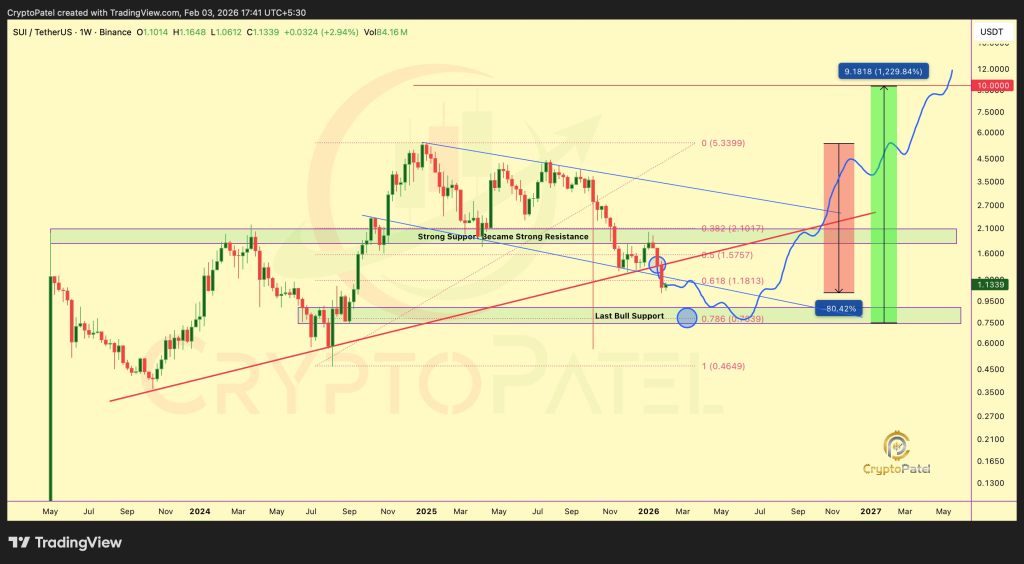
SUI Price Is Down 80%: Price Nears Level Bulls Cannot Afford to Lose

SUI Price Is Down 80%: Price Nears Level Bulls Cannot Afford to Lose

SUI price has quietly slipped into a zone that usually decides everything. Charts show an 80% drop from the peak, yet the market is no longer moving fast. This
Share
Captainaltcoin2026/02/04 03:00