The post Nobel Peace Prize Sparks Insider Trading Questions On Prediction Sites appeared on BitcoinEthereumNews.com. A sudden surge in Nobel Peace Prize odds hints that prediction markets may be less about wisdom and more about who knows first. (Photo Illustration by Thomas Fuller/SOPA Images/LightRocket via Getty Images) SOPA Images/LightRocket via Getty Images At 5 a.m. Eastern Time on Friday, the Norwegian Nobel Committee announced that this year’s Peace Prize would go to Venezuelan opposition leader María Corina Machado for her “tireless work promoting democratic rights for the people of Venezuela and for her struggle to achieve a just and peaceful transition from dictatorship to democracy.” It came as a surprise. On the two largest prediction markets, Polymarket and Kalshi, Machado had been running behind Yulia Navalnaya, the widow of Russian dissident Alexei Navalny, and President Donald Trump, whose brokering of a ceasefire between Hamas and Israel this week generated calls for him to get the award. But, something odd happened Thursday night. At 6:30 p.m. ET, Machado’s odds of winning sat at 3.6 percent. By 7:00, they jumped to 39 percent, then 65 percent by 7:30, topping out at 73 percent by 8:00. Less than ten hours later, the Nobel Committee made it official. Economist Jason Furman, a Harvard professor and former chair of President Obama’s Council of Economic Advisers, wrote on X that the sudden spike sure looked like insider trading. He’s not the only one thinking that. And there’s a certain irony to the Nobel Peace Prize having insiders willing to trade on what they know. The catch is, that isn’t necessarily against the rules. Prediction markets are mostly unregulated territory. As Molly White wrote in her Citation Needed newsletter on September 16, 2025, insider trading laws enforced by the SEC don’t apply. These aren’t securities, they’re contracts overseen, when at all, by the Commodity Futures Trading Commission (CFTC). That gap creates plenty… The post Nobel Peace Prize Sparks Insider Trading Questions On Prediction Sites appeared on BitcoinEthereumNews.com. A sudden surge in Nobel Peace Prize odds hints that prediction markets may be less about wisdom and more about who knows first. (Photo Illustration by Thomas Fuller/SOPA Images/LightRocket via Getty Images) SOPA Images/LightRocket via Getty Images At 5 a.m. Eastern Time on Friday, the Norwegian Nobel Committee announced that this year’s Peace Prize would go to Venezuelan opposition leader María Corina Machado for her “tireless work promoting democratic rights for the people of Venezuela and for her struggle to achieve a just and peaceful transition from dictatorship to democracy.” It came as a surprise. On the two largest prediction markets, Polymarket and Kalshi, Machado had been running behind Yulia Navalnaya, the widow of Russian dissident Alexei Navalny, and President Donald Trump, whose brokering of a ceasefire between Hamas and Israel this week generated calls for him to get the award. But, something odd happened Thursday night. At 6:30 p.m. ET, Machado’s odds of winning sat at 3.6 percent. By 7:00, they jumped to 39 percent, then 65 percent by 7:30, topping out at 73 percent by 8:00. Less than ten hours later, the Nobel Committee made it official. Economist Jason Furman, a Harvard professor and former chair of President Obama’s Council of Economic Advisers, wrote on X that the sudden spike sure looked like insider trading. He’s not the only one thinking that. And there’s a certain irony to the Nobel Peace Prize having insiders willing to trade on what they know. The catch is, that isn’t necessarily against the rules. Prediction markets are mostly unregulated territory. As Molly White wrote in her Citation Needed newsletter on September 16, 2025, insider trading laws enforced by the SEC don’t apply. These aren’t securities, they’re contracts overseen, when at all, by the Commodity Futures Trading Commission (CFTC). That gap creates plenty…

Nobel Peace Prize Sparks Insider Trading Questions On Prediction Sites

4 min read

A sudden surge in Nobel Peace Prize odds hints that prediction markets may be less about wisdom and more about who knows first. (Photo Illustration by Thomas Fuller/SOPA Images/LightRocket via Getty Images)

SOPA Images/LightRocket via Getty Images

At 5 a.m. Eastern Time on Friday, the Norwegian Nobel Committee announced that this year’s Peace Prize would go to Venezuelan opposition leader María Corina Machado for her “tireless work promoting democratic rights for the people of Venezuela and for her struggle to achieve a just and peaceful transition from dictatorship to democracy.”

It came as a surprise. On the two largest prediction markets, Polymarket and Kalshi, Machado had been running behind Yulia Navalnaya, the widow of Russian dissident Alexei Navalny, and President Donald Trump, whose brokering of a ceasefire between Hamas and Israel this week generated calls for him to get the award.

But, something odd happened Thursday night. At 6:30 p.m. ET, Machado’s odds of winning sat at 3.6 percent. By 7:00, they jumped to 39 percent, then 65 percent by 7:30, topping out at 73 percent by 8:00. Less than ten hours later, the Nobel Committee made it official.

Economist Jason Furman, a Harvard professor and former chair of President Obama’s Council of Economic Advisers, wrote on X that the sudden spike sure looked like insider trading.

He’s not the only one thinking that. And there’s a certain irony to the Nobel Peace Prize having insiders willing to trade on what they know.

The catch is, that isn’t necessarily against the rules.

Prediction markets are mostly unregulated territory. As Molly White wrote in her Citation Needed newsletter on September 16, 2025, insider trading laws enforced by the SEC don’t apply. These aren’t securities, they’re contracts overseen, when at all, by the Commodity Futures Trading Commission (CFTC).

That gap creates plenty of room to operate. Last month, billionaire Bill Ackman suggested on X that New York mayor Eric Adams could “place a large [Polymarket] bet on Andrew Cuomo and then announce [his] withdrawal” from this November’s race. “There is no insider trading on Polymarket,” Ackman wrote.

Polymarket received a $2 billion investment from New York Stock Exchange parent company Intercontinental Exchange this week valuing the company at $9 billion making its founder Shayne Coplan the world’s youngest billionaire. In 2022 Polymarket was fined for offering unregistered event-based contracts and now runs offshore, still handling billions in bets. Kalshi, its U.S.-regulated counterpart, has CFTC oversight but little enforcement and no clear ban on insiders using private information. Kalshi recently announced it had completed a $300 million funding round that values the company at $5 billion.

Some experts argue insider trading is an important feature of prediction markets. In the crypto publication Decrypt last October, Robin Hanson, an economist at George Mason University and one of the earliest advocates for prediction markets, said allowing insiders to trade makes the odds more accurate. “If the point of [prediction] markets is to get accurate information,” he said, “then you definitely want to allow insiders to trade.”

Others say that’s bad economics. Eric Zitzewitz, a Dartmouth economist, told Decrypt that insider trading discourages regular participants, which in turn hurts accuracy.

Either way, no one’s really policing it. Prediction markets exist somewhere between futures exchanges and gambling sites, and regulators treat them more like the latter. So, buyer beware. These markets can be fun and even useful, but sometimes the people placing the biggest bets already know the outcome.

More from Forbes

ForbesWith Billionaire Backers In Tow, Crypto’s Fastest-Growing Startup Mints The World’s Youngest Self-Made BillionaireForbesNew York Stock Exchange Owner Bets $2 Billion On Polymarket ComebackForbesWhy JPMorgan’s Rising Stock Defies Traditional Valuations And Jamie Dimon’s Own AdviceForbesSBA’s New Rule Makes It Easier To Expand Small Businesses

Source: https://www.forbes.com/sites/brandonkochkodin/2025/10/10/did-the-nobel-peace-prize-expose-insider-trading-on-prediction-market-polymarket/


Market Opportunity
Moonveil Logo
Moonveil Price(MORE)
$0.0007939
$0.0007939$0.0007939
-0.16%
USD
Moonveil (MORE) Live Price Chart
Disclaimer: The articles reposted on this site are sourced from public platforms and are provided for informational purposes only. They do not necessarily reflect the views of MEXC. All rights remain with the original authors. If you believe any content infringes on third-party rights, please contact service@support.mexc.com for removal. MEXC makes no guarantees regarding the accuracy, completeness, or timeliness of the content and is not responsible for any actions taken based on the information provided. The content does not constitute financial, legal, or other professional advice, nor should it be considered a recommendation or endorsement by MEXC.

You May Also Like

Fed Decides On Interest Rates Today—Here’s What To Watch For

Fed Decides On Interest Rates Today—Here’s What To Watch For

The post Fed Decides On Interest Rates Today—Here’s What To Watch For appeared on BitcoinEthereumNews.com. Topline The Federal Reserve on Wednesday will conclude a two-day policymaking meeting and release a decision on whether to lower interest rates—following months of pressure and criticism from President Donald Trump—and potentially signal whether additional cuts are on the way. President Donald Trump has urged the central bank to “CUT INTEREST RATES, NOW, AND BIGGER” than they might plan to. Getty Images Key Facts The central bank is poised to cut interest rates by at least a quarter-point, down from the 4.25% to 4.5% range where they have been held since December to between 4% and 4.25%, as Wall Street has placed 100% odds of a rate cut, according to CME’s FedWatch, with higher odds (94%) on a quarter-point cut than a half-point (6%) reduction. Fed governors Christopher Waller and Michelle Bowman, both Trump appointees, voted in July for a quarter-point reduction to rates, and they may dissent again in favor of a large cut alongside Stephen Miran, Trump’s Council of Economic Advisers’ chair, who was sworn in at the meeting’s start on Tuesday. It’s unclear whether other policymakers, including Kansas City Fed President Jeffrey Schmid and St. Louis Fed President Alberto Musalem, will favor larger cuts or opt for no reduction. Fed Chair Jerome Powell said in his Jackson Hole, Wyoming, address last month the central bank would likely consider a looser monetary policy, noting the “shifting balance of risks” on the U.S. economy “may warrant adjusting our policy stance.” David Mericle, an economist for Goldman Sachs, wrote in a note the “key question” for the Fed’s meeting is whether policymakers signal “this is likely the first in a series of consecutive cuts” as the central bank is anticipated to “acknowledge the softening in the labor market,” though they may not “nod to an October cut.” Mericle said he…
Share
BitcoinEthereumNews2025/09/18 00:23
While Shiba Inu and Turbo Chase Price, 63% APY Staking Puts APEMARS at the Forefront of the Best Meme Coin Presale 2026 – Stage 6 Ends in 3 Days!

While Shiba Inu and Turbo Chase Price, 63% APY Staking Puts APEMARS at the Forefront of the Best Meme Coin Presale 2026 – Stage 6 Ends in 3 Days!

What if your meme coin investment could generate passive income without selling a single token? Shiba Inu climbed 4.97% as 207 billion tokens left exchanges. Turbo
Share
Coinstats2026/02/04 03:15
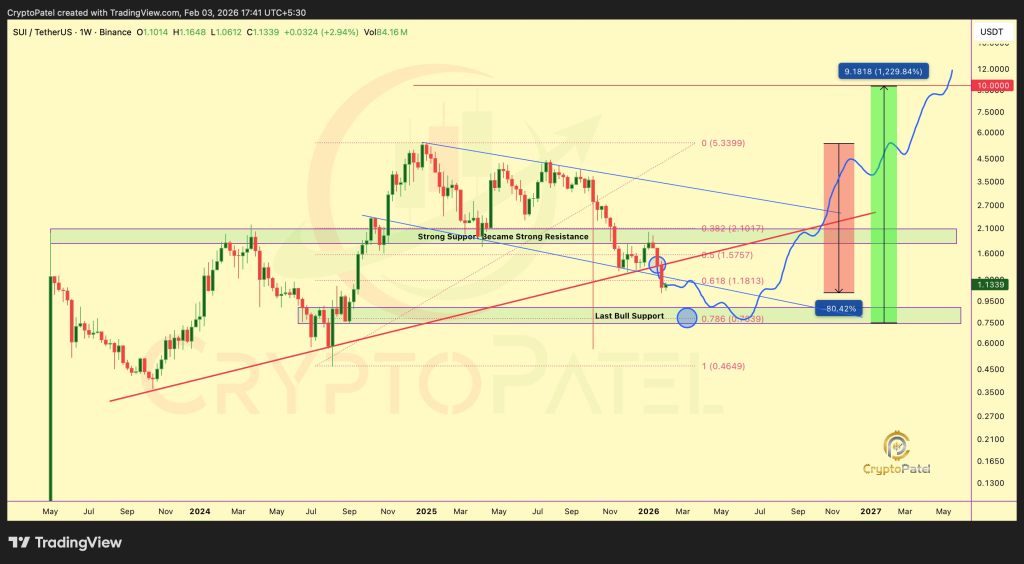
SUI Price Is Down 80%: Price Nears Level Bulls Cannot Afford to Lose

SUI Price Is Down 80%: Price Nears Level Bulls Cannot Afford to Lose

SUI price has quietly slipped into a zone that usually decides everything. Charts show an 80% drop from the peak, yet the market is no longer moving fast. This
Share
Captainaltcoin2026/02/04 03:00