The post Where do prediction markets stand legally? appeared on BitcoinEthereumNews.com. Prediction markets are moving from the fringe into the mainstream. They have been satirized on South Park, made founders wealthy through venture funding, and even triggered controversy after a Nobel Prize leak. The two leaders in the space are Kalshi, a regulated U.S. exchange that settles contracts in dollars, and Polymarket, a decentralized crypto-based platform built on Polygon. Together they saw record trading volume of $1.44 billion in September, with Kalshi pulling ahead at 60% share. As their visibility grows, the spotlight is turning to a key issue: are prediction markets legal, and where? To understand the legal debate, it’s worth first breaking down how prediction markets work. What are prediction markets? Simply put, a prediction market is a marketplace for bets on future events such as election outcomes, sports, weather patterns, or financial trends. People buy and sell contracts based on the outcome of real-world events. The prices shift dynamically with collective belief, and every trade is an incentive-driven bet on the future. For instance, take a market for “Will Team A win football match?” On the platform, each event works like a tug-of-war between two sides — YES and NO — whose combined value always equals $1. If you believe Team A will win, you buy the YES contract; if you believe the opposite, you pick NO. As traders react to new data, rumors, or intuition, the prices shift in real time. So, if a contract is trading at $0.80, it indicates that the market thinks the event has an 80% chance of occurring. You earn a $1 payout for your stake if your prediction comes true. Some prediction markets are off-chain, centralized, and regulated like Kalshi. Others are decentralized and run on blockchain, like Polymarket, giving them more flexibility but less regulatory control. So why do they matter?… The post Where do prediction markets stand legally? appeared on BitcoinEthereumNews.com. Prediction markets are moving from the fringe into the mainstream. They have been satirized on South Park, made founders wealthy through venture funding, and even triggered controversy after a Nobel Prize leak. The two leaders in the space are Kalshi, a regulated U.S. exchange that settles contracts in dollars, and Polymarket, a decentralized crypto-based platform built on Polygon. Together they saw record trading volume of $1.44 billion in September, with Kalshi pulling ahead at 60% share. As their visibility grows, the spotlight is turning to a key issue: are prediction markets legal, and where? To understand the legal debate, it’s worth first breaking down how prediction markets work. What are prediction markets? Simply put, a prediction market is a marketplace for bets on future events such as election outcomes, sports, weather patterns, or financial trends. People buy and sell contracts based on the outcome of real-world events. The prices shift dynamically with collective belief, and every trade is an incentive-driven bet on the future. For instance, take a market for “Will Team A win football match?” On the platform, each event works like a tug-of-war between two sides — YES and NO — whose combined value always equals $1. If you believe Team A will win, you buy the YES contract; if you believe the opposite, you pick NO. As traders react to new data, rumors, or intuition, the prices shift in real time. So, if a contract is trading at $0.80, it indicates that the market thinks the event has an 80% chance of occurring. You earn a $1 payout for your stake if your prediction comes true. Some prediction markets are off-chain, centralized, and regulated like Kalshi. Others are decentralized and run on blockchain, like Polymarket, giving them more flexibility but less regulatory control. So why do they matter?…

Where do prediction markets stand legally?

4 min read

Prediction markets are moving from the fringe into the mainstream. They have been satirized on South Park, made founders wealthy through venture funding, and even triggered controversy after a Nobel Prize leak.

The two leaders in the space are Kalshi, a regulated U.S. exchange that settles contracts in dollars, and Polymarket, a decentralized crypto-based platform built on Polygon. Together they saw record trading volume of $1.44 billion in September, with Kalshi pulling ahead at 60% share.

As their visibility grows, the spotlight is turning to a key issue: are prediction markets legal, and where? To understand the legal debate, it’s worth first breaking down how prediction markets work.

What are prediction markets?

Simply put, a prediction market is a marketplace for bets on future events such as election outcomes, sports, weather patterns, or financial trends. People buy and sell contracts based on the outcome of real-world events. The prices shift dynamically with collective belief, and every trade is an incentive-driven bet on the future.

For instance, take a market for “Will Team A win football match?” On the platform, each event works like a tug-of-war between two sides — YES and NO — whose combined value always equals $1. If you believe Team A will win, you buy the YES contract; if you believe the opposite, you pick NO. As traders react to new data, rumors, or intuition, the prices shift in real time. So, if a contract is trading at $0.80, it indicates that the market thinks the event has an 80% chance of occurring. You earn a $1 payout for your stake if your prediction comes true.

Some prediction markets are off-chain, centralized, and regulated like Kalshi. Others are decentralized and run on blockchain, like Polymarket, giving them more flexibility but less regulatory control.

So why do they matter? Because prediction markets aggregate new information, even outpacing traditional polls. With money on the line, guesses become predictions with more accurate insights. In many cases, these markets end up charting the future before anyone else can.

Yet their similarity to gambling or speculative betting has made regulation tricky across jurisdictions.

How different jurisdictions treat prediction markets

United States

The regulatory treatment of prediction markets in the U.S. depends on the platform’s operational model and compliance. Kalshi and Polymarket showcase how differently regulators treat these platforms.

Kalshi, fully regulated under the CFTC as a Designated Contract Market, is allowed to offer legal event contracts across various topics under federal oversight. Meanwhile, its decentralized rival Polymarket has a bitter history with the regulators. It was fined $1.4 million in 2022 for allegedly offering illicit binary options contracts, forcing it to withdraw from U.S. users. In 2025, it reentered the market after acquiring QCEX, a CFTC-licensed derivatives exchange.

The contrast between these rivals underscores the country’s regulatory stance: innovation is welcomed but only if it plays by the rules.

United Kingdom and European Union

Most EU countries treat prediction markets primarily as gambling grounds and have a fragmented regulatory approach. Meanwhile, the United Kingdom permits limited forms of prediction markets (Betfair-style betting exchanges) under the oversight of the UK Gambling Commission alongside stringent consumer protection rules. The legal grey zone, created by the regulatory ambiguity, limits institutional participation and the overall growth of these markets.

Consequently, the UK and other EU countries like Belgium, France, and Poland have restricted the operations of prediction markets such as Polymarket, Kalshi, and others, citing violations of gambling regulations and international sanctions.

APAC Countries

Asia-Pacific countries tend to take a restrictive stance on prediction markets, often classifying them as gambling platforms. Licensed operations are rare or nearly impossible, and jurisdictions such as Singapore, Taiwan, Thailand, and Australia have mulled a ban on betting platforms Polymarket and Kalshi.

Some experts argue that prediction markets should be seen as data infrastructures rather than merely speculative platforms. On the parallel side, regulation either forces platforms into centralized models or drives them completely offshore, limiting wider adoption.

The coming years, and how regulators choose to classify them, will decide whether prediction markets remain niche tools or evolve into mainstream financial infrastructure.

Source: https://finbold.com/where-do-prediction-markets-stand-legally/

Market Opportunity
Spacecoin Logo
Spacecoin Price(SPACE)
$0.00695
$0.00695$0.00695
+13.74%
USD
Spacecoin (SPACE) Live Price Chart
Disclaimer: The articles reposted on this site are sourced from public platforms and are provided for informational purposes only. They do not necessarily reflect the views of MEXC. All rights remain with the original authors. If you believe any content infringes on third-party rights, please contact service@support.mexc.com for removal. MEXC makes no guarantees regarding the accuracy, completeness, or timeliness of the content and is not responsible for any actions taken based on the information provided. The content does not constitute financial, legal, or other professional advice, nor should it be considered a recommendation or endorsement by MEXC.

You May Also Like

Fed Decides On Interest Rates Today—Here’s What To Watch For

Fed Decides On Interest Rates Today—Here’s What To Watch For

The post Fed Decides On Interest Rates Today—Here’s What To Watch For appeared on BitcoinEthereumNews.com. Topline The Federal Reserve on Wednesday will conclude a two-day policymaking meeting and release a decision on whether to lower interest rates—following months of pressure and criticism from President Donald Trump—and potentially signal whether additional cuts are on the way. President Donald Trump has urged the central bank to “CUT INTEREST RATES, NOW, AND BIGGER” than they might plan to. Getty Images Key Facts The central bank is poised to cut interest rates by at least a quarter-point, down from the 4.25% to 4.5% range where they have been held since December to between 4% and 4.25%, as Wall Street has placed 100% odds of a rate cut, according to CME’s FedWatch, with higher odds (94%) on a quarter-point cut than a half-point (6%) reduction. Fed governors Christopher Waller and Michelle Bowman, both Trump appointees, voted in July for a quarter-point reduction to rates, and they may dissent again in favor of a large cut alongside Stephen Miran, Trump’s Council of Economic Advisers’ chair, who was sworn in at the meeting’s start on Tuesday. It’s unclear whether other policymakers, including Kansas City Fed President Jeffrey Schmid and St. Louis Fed President Alberto Musalem, will favor larger cuts or opt for no reduction. Fed Chair Jerome Powell said in his Jackson Hole, Wyoming, address last month the central bank would likely consider a looser monetary policy, noting the “shifting balance of risks” on the U.S. economy “may warrant adjusting our policy stance.” David Mericle, an economist for Goldman Sachs, wrote in a note the “key question” for the Fed’s meeting is whether policymakers signal “this is likely the first in a series of consecutive cuts” as the central bank is anticipated to “acknowledge the softening in the labor market,” though they may not “nod to an October cut.” Mericle said he…
Share
BitcoinEthereumNews2025/09/18 00:23
While Shiba Inu and Turbo Chase Price, 63% APY Staking Puts APEMARS at the Forefront of the Best Meme Coin Presale 2026 – Stage 6 Ends in 3 Days!

While Shiba Inu and Turbo Chase Price, 63% APY Staking Puts APEMARS at the Forefront of the Best Meme Coin Presale 2026 – Stage 6 Ends in 3 Days!

What if your meme coin investment could generate passive income without selling a single token? Shiba Inu climbed 4.97% as 207 billion tokens left exchanges. Turbo
Share
Coinstats2026/02/04 03:15
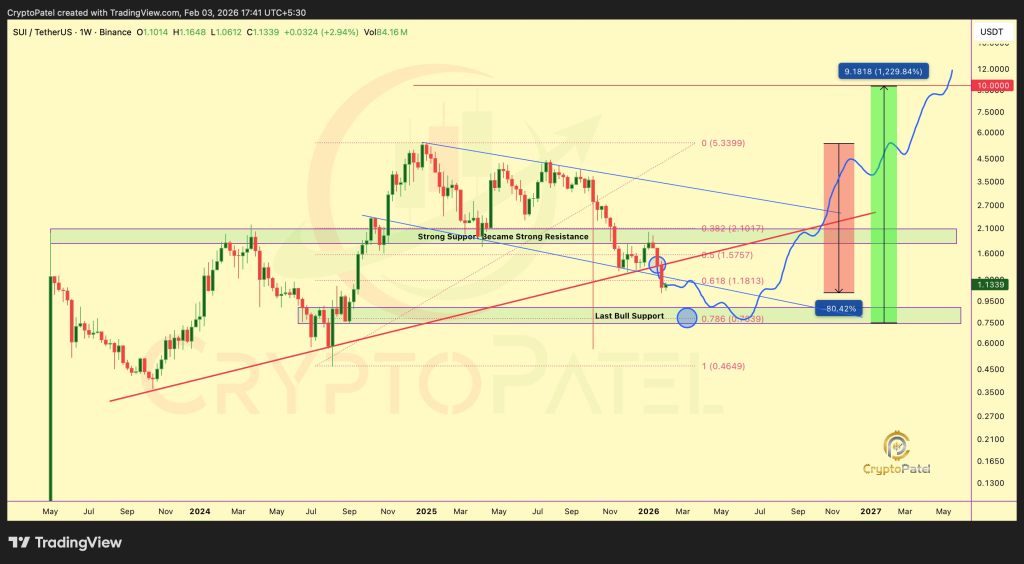
SUI Price Is Down 80%: Price Nears Level Bulls Cannot Afford to Lose

SUI Price Is Down 80%: Price Nears Level Bulls Cannot Afford to Lose

SUI price has quietly slipped into a zone that usually decides everything. Charts show an 80% drop from the peak, yet the market is no longer moving fast. This
Share
Captainaltcoin2026/02/04 03:00