Bipartisan talks on a long-awaited U.S. crypto market regulation package, the CLARITY Act, have resumed in the Senate, even as Washington remains paralyzed by a government shutdown now in its 31st day, one of the longest in U.S. history. Lawmakers from both parties are racing to finalize the market structure bill that could reshape oversight of digital assets before election politics stall progress. The negotiations, led by key Senate committees, have accelerated in recent weeks despite the broader gridlock. Can the CLARITY Act pass by Thanksgiving? According to the report, Senate Agriculture Committee Chair John Boozman (R-Ark.) said he and Sen. Cory Booker (D-N.J.) are working “daily” to complete their section of the legislation, which would establish a regulatory framework for digital assets treated as commodities. Boozman said he expects a committee vote “before Thanksgiving,” adding, “We’re going to get it done this year.” Booker echoed that sentiment, saying the goal was to “get the policy right” rather than rush the timeline. Their work represents one part of a broader bipartisan effort spanning multiple committees, including Banking and Finance, to define how digital assets fit within U.S. regulations and the tax code. Talks within the Senate Banking Committee have also gained momentum. Senators Cynthia Lummis (R-Wyo.), Ruben Gallego (D-Ariz.), and Angela Alsobrooks (D-Md.) said discussions had resumed after weeks of delay. Notably, Committee Chair Tim Scott (R-S.C.) said he was “encouraged” by the progress and looks forward to advancing “meaningful legislation.” Still, some members caution that the bill is not yet ready. Sen. John Kennedy (R-La.) said the legislation requires a public hearing and that many lawmakers still need to understand the issue. The push for progress comes amid warnings that time is running out. Sen. Thom Tillis (R-N.C.) said Congress must act by early 2026 or risk losing momentum as election politics take over. “I’m not optimistic about us moving much further on anything around digital assets, stablecoins, or crypto in this Congress,” he said on Monday. Longest Shutdown in History Looms — What’s Next for America? The shutdown, now stretching into its fifth week, has added further strain. The Senate adjourned Thursday without progress on a continuing resolution, guaranteeing the shutdown will last at least 34 days, tying the longest lapse in U.S. history. As of October 20, 25% of Polymarket bettors predict that the shutdown will last until at least November 16 and may drag on for almost another month to become the longest in American history. Funding for food assistance under the Supplemental Nutrition Assistance Program (SNAP) is set to expire Saturday, threatening benefits for 42 million Americans. The closure, triggered by disputes over healthcare subsidies, has left 1.4 million federal workers without pay, including air traffic controllers and employees at key agencies. Despite the stalemate, Senate Democrats and Republicans are expected to meet separately with industry executives next week to keep crypto talks alive. U.S. Lawmakers Renew Crypto Talks, but Prediction Markets Cut Odds of 2025 Passage to 25% On October 20, Sen. Kirsten Gillibrand (D-N.Y.) hosted a closed-door roundtable with major industry figures, including Galaxy’s Mike Novogratz, Coinbase CEO Brian Armstrong, and Chainlink’s Sergey Nazarov. Armstrong told CNBC that roughly 90% of the bill’s issues had already been resolved and that Thanksgiving had been floated as a possible target for completion. The House-passed Digital Asset Market Clarity Act, approved in July by a 294–137 vote, remains stalled due to the shutdown. The measure defines which digital assets fall under the jurisdiction of the Commodity Futures Trading Commission (CFTC) and which are overseen by the Securities and Exchange Commission (SEC). Together with the GENIUS Act, signed by President Donald Trump earlier this year, it forms the foundation of the emerging U.S. crypto regulatory framework. White House AI and Crypto Czar David Sacks said the administration remains optimistic that bipartisan support could still deliver progress by the end of 2025.Source: Polymarket But prediction markets paint a different picture, with data from Polymarket showing just a 25% chance the CLARITY Act becomes law this year, down from 87% in mid-JulyBipartisan talks on a long-awaited U.S. crypto market regulation package, the CLARITY Act, have resumed in the Senate, even as Washington remains paralyzed by a government shutdown now in its 31st day, one of the longest in U.S. history. Lawmakers from both parties are racing to finalize the market structure bill that could reshape oversight of digital assets before election politics stall progress. The negotiations, led by key Senate committees, have accelerated in recent weeks despite the broader gridlock. Can the CLARITY Act pass by Thanksgiving? According to the report, Senate Agriculture Committee Chair John Boozman (R-Ark.) said he and Sen. Cory Booker (D-N.J.) are working “daily” to complete their section of the legislation, which would establish a regulatory framework for digital assets treated as commodities. Boozman said he expects a committee vote “before Thanksgiving,” adding, “We’re going to get it done this year.” Booker echoed that sentiment, saying the goal was to “get the policy right” rather than rush the timeline. Their work represents one part of a broader bipartisan effort spanning multiple committees, including Banking and Finance, to define how digital assets fit within U.S. regulations and the tax code. Talks within the Senate Banking Committee have also gained momentum. Senators Cynthia Lummis (R-Wyo.), Ruben Gallego (D-Ariz.), and Angela Alsobrooks (D-Md.) said discussions had resumed after weeks of delay. Notably, Committee Chair Tim Scott (R-S.C.) said he was “encouraged” by the progress and looks forward to advancing “meaningful legislation.” Still, some members caution that the bill is not yet ready. Sen. John Kennedy (R-La.) said the legislation requires a public hearing and that many lawmakers still need to understand the issue. The push for progress comes amid warnings that time is running out. Sen. Thom Tillis (R-N.C.) said Congress must act by early 2026 or risk losing momentum as election politics take over. “I’m not optimistic about us moving much further on anything around digital assets, stablecoins, or crypto in this Congress,” he said on Monday. Longest Shutdown in History Looms — What’s Next for America? The shutdown, now stretching into its fifth week, has added further strain. The Senate adjourned Thursday without progress on a continuing resolution, guaranteeing the shutdown will last at least 34 days, tying the longest lapse in U.S. history. As of October 20, 25% of Polymarket bettors predict that the shutdown will last until at least November 16 and may drag on for almost another month to become the longest in American history. Funding for food assistance under the Supplemental Nutrition Assistance Program (SNAP) is set to expire Saturday, threatening benefits for 42 million Americans. The closure, triggered by disputes over healthcare subsidies, has left 1.4 million federal workers without pay, including air traffic controllers and employees at key agencies. Despite the stalemate, Senate Democrats and Republicans are expected to meet separately with industry executives next week to keep crypto talks alive. U.S. Lawmakers Renew Crypto Talks, but Prediction Markets Cut Odds of 2025 Passage to 25% On October 20, Sen. Kirsten Gillibrand (D-N.Y.) hosted a closed-door roundtable with major industry figures, including Galaxy’s Mike Novogratz, Coinbase CEO Brian Armstrong, and Chainlink’s Sergey Nazarov. Armstrong told CNBC that roughly 90% of the bill’s issues had already been resolved and that Thanksgiving had been floated as a possible target for completion. The House-passed Digital Asset Market Clarity Act, approved in July by a 294–137 vote, remains stalled due to the shutdown. The measure defines which digital assets fall under the jurisdiction of the Commodity Futures Trading Commission (CFTC) and which are overseen by the Securities and Exchange Commission (SEC). Together with the GENIUS Act, signed by President Donald Trump earlier this year, it forms the foundation of the emerging U.S. crypto regulatory framework. White House AI and Crypto Czar David Sacks said the administration remains optimistic that bipartisan support could still deliver progress by the end of 2025.Source: Polymarket But prediction markets paint a different picture, with data from Polymarket showing just a 25% chance the CLARITY Act becomes law this year, down from 87% in mid-July

US Senators Push to Finalize Crypto Market Bill as Shutdown Standoff Deepens: Report

4 min read

Bipartisan talks on a long-awaited U.S. crypto market regulation package, the CLARITY Act, have resumed in the Senate, even as Washington remains paralyzed by a government shutdown now in its 31st day, one of the longest in U.S. history.

Lawmakers from both parties are racing to finalize the market structure bill that could reshape oversight of digital assets before election politics stall progress.

The negotiations, led by key Senate committees, have accelerated in recent weeks despite the broader gridlock.

Can the CLARITY Act pass by Thanksgiving?

According to the report, Senate Agriculture Committee Chair John Boozman (R-Ark.) said he and Sen. Cory Booker (D-N.J.) are working “daily” to complete their section of the legislation, which would establish a regulatory framework for digital assets treated as commodities.

Boozman said he expects a committee vote “before Thanksgiving,” adding, “We’re going to get it done this year.”

Booker echoed that sentiment, saying the goal was to “get the policy right” rather than rush the timeline.

Their work represents one part of a broader bipartisan effort spanning multiple committees, including Banking and Finance, to define how digital assets fit within U.S. regulations and the tax code.

Talks within the Senate Banking Committee have also gained momentum. Senators Cynthia Lummis (R-Wyo.), Ruben Gallego (D-Ariz.), and Angela Alsobrooks (D-Md.) said discussions had resumed after weeks of delay.

Notably, Committee Chair Tim Scott (R-S.C.) said he was “encouraged” by the progress and looks forward to advancing “meaningful legislation.”

Still, some members caution that the bill is not yet ready. Sen. John Kennedy (R-La.) said the legislation requires a public hearing and that many lawmakers still need to understand the issue.

The push for progress comes amid warnings that time is running out. Sen. Thom Tillis (R-N.C.) said Congress must act by early 2026 or risk losing momentum as election politics take over.

“I’m not optimistic about us moving much further on anything around digital assets, stablecoins, or crypto in this Congress,” he said on Monday.

Longest Shutdown in History Looms — What’s Next for America?

The shutdown, now stretching into its fifth week, has added further strain. The Senate adjourned Thursday without progress on a continuing resolution, guaranteeing the shutdown will last at least 34 days, tying the longest lapse in U.S. history.

As of October 20, 25% of Polymarket bettors predict that the shutdown will last until at least November 16 and may drag on for almost another month to become the longest in American history.

Funding for food assistance under the Supplemental Nutrition Assistance Program (SNAP) is set to expire Saturday, threatening benefits for 42 million Americans.

The closure, triggered by disputes over healthcare subsidies, has left 1.4 million federal workers without pay, including air traffic controllers and employees at key agencies.

Despite the stalemate, Senate Democrats and Republicans are expected to meet separately with industry executives next week to keep crypto talks alive.

U.S. Lawmakers Renew Crypto Talks, but Prediction Markets Cut Odds of 2025 Passage to 25%

On October 20, Sen. Kirsten Gillibrand (D-N.Y.) hosted a closed-door roundtable with major industry figures, including Galaxy’s Mike Novogratz, Coinbase CEO Brian Armstrong, and Chainlink’s Sergey Nazarov.

Armstrong told CNBC that roughly 90% of the bill’s issues had already been resolved and that Thanksgiving had been floated as a possible target for completion.

The House-passed Digital Asset Market Clarity Act, approved in July by a 294–137 vote, remains stalled due to the shutdown.

The measure defines which digital assets fall under the jurisdiction of the Commodity Futures Trading Commission (CFTC) and which are overseen by the Securities and Exchange Commission (SEC).

Together with the GENIUS Act, signed by President Donald Trump earlier this year, it forms the foundation of the emerging U.S. crypto regulatory framework.

White House AI and Crypto Czar David Sacks said the administration remains optimistic that bipartisan support could still deliver progress by the end of 2025.
Source: Polymarket

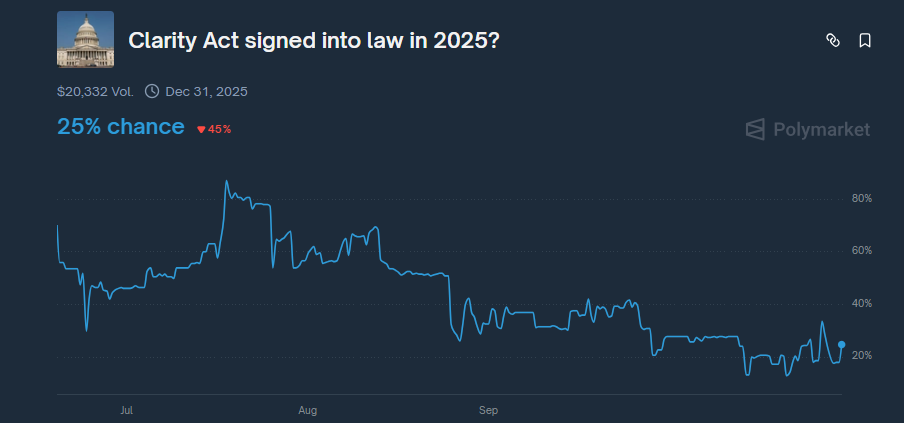
But prediction markets paint a different picture, with data from Polymarket showing just a 25% chance the CLARITY Act becomes law this year, down from 87% in mid-July

Market Opportunity
EPNS Logo
EPNS Price(PUSH)
$0.013759
$0.013759$0.013759
-0.47%
USD
EPNS (PUSH) Live Price Chart
Disclaimer: The articles reposted on this site are sourced from public platforms and are provided for informational purposes only. They do not necessarily reflect the views of MEXC. All rights remain with the original authors. If you believe any content infringes on third-party rights, please contact service@support.mexc.com for removal. MEXC makes no guarantees regarding the accuracy, completeness, or timeliness of the content and is not responsible for any actions taken based on the information provided. The content does not constitute financial, legal, or other professional advice, nor should it be considered a recommendation or endorsement by MEXC.

You May Also Like

Trump MAGA statue has strange crypto backstory

Trump MAGA statue has strange crypto backstory

The post Trump MAGA statue has strange crypto backstory appeared on BitcoinEthereumNews.com. A 15-foot-tall statue of former President Donald Trump, cast in bronze
Share
BitcoinEthereumNews2026/02/04 08:22
ABC Also Pulled Jimmy Kimmel’s Predecessor After Controversial Comments

ABC Also Pulled Jimmy Kimmel’s Predecessor After Controversial Comments

The post ABC Also Pulled Jimmy Kimmel’s Predecessor After Controversial Comments appeared on BitcoinEthereumNews.com. Jimmy Kimmel (Photo by Media Access Awards Presented By Easterseals/Getty Images for Easterseals) Getty Images for Easterseals The shock decision by ABC to pull Jimmy Kimmel Live! “indefinitely” after the late-night host’s remarks about the killing of Charlie Kirk has created a rare moment in modern TV media: A major show abruptly taken off the air, with its network forced into crisis-management mode. Rare, that is, but not unprecedented. What might go unnoticed by many people reacting to the news about Kimmel and his potential cancellation is that this is not the first time ABC has made such a move. In fact, a version of the same thing happened to Kimmel’s predecessor program — Bill Maher’s Politically Incorrect, which once had Kimmel’s slot and which ABC cancelled in the wake of a firestorm around comments Maher made in the immediate aftermath of the September 11 terrorist attacks. (Notice, by the way, that I said cancelled “in the wake of” and not “because of.” More on that in a moment.) Here’s what happened: Less than a week after 9/11, Maher and a panel were talking about then-President George W. Bush’s use of the word “cowards” to describe the hijackers. “We have been the cowards,” Maher interjected, referencing the practice of “lobbing cruise missiles from 2,000 miles away. That’s cowardly.” But Maher then went even farther over the line: Actually staying in an airplane as it hits a building? “Not cowardly.” You can read more about the ensuing uproar in this ABC news story from 2001, which includes a statement that Maher issued through his publicist: “In no way was I intending to say, nor have I ever thought, that the men and women who defend our nation in uniform are anything but courageous and valiant, and I offer my apologies to…
Share
BitcoinEthereumNews2025/09/18 11:02
The real-life inspiration for the protagonist of "The Big Short": Bitcoin crash may trigger a $1 billion gold and silver sell-off.

The real-life inspiration for the protagonist of "The Big Short": Bitcoin crash may trigger a $1 billion gold and silver sell-off.

PANews reported on February 4th that, according to CoinDesk, Michael Burry, the real-life inspiration for the character in "The Big Short" (and an investor who
Share
PANews2026/02/04 08:22