Only by constantly "doing things" can a project gain market recognition.Only by constantly "doing things" can a project gain market recognition.

"Living off the past" is not advisable. The crypto field cannot rely on network effects to build a holding moat

2025/04/01 17:22
7 min read

Author: Catrina , Crypto KOL

Compiled by: Felix, PANews

Revisiting Web2’s most popular Growth Hacking (PANews Note: Growth Hacking is the process of helping a company grow rapidly through certain means and strategies): Why network effects are no longer a lasting moat for Web3.

First, let’s understand the definition of network effects and why they are important in Web2. The following results are from ChatGPT:

Definition: A network effect occurs when a product or service gains additional value as more people use it. This means that each new user increases the overall value of the product or service to existing users.

Benefits of Network Effect (NE):

  • Strengthening competitive moat – More users make the product more valuable, thus keeping out competitors.
  • Lower user acquisition costs – existing users attract new users through word of mouth, integrations, or ecosystem effects.
  • Create higher switching costs and retention – As a network grows, users become more integrated into the ecosystem (e.g., social connections, data, integrations). This makes it costly or inconvenient for them to leave, thereby increasing retention and pricing power.

Some may raise objections here, but this article emphasizes that network effects are not a durable moat in the crypto space. Because cryptocurrencies have the following characteristics, they cannot enable crypto companies to have the same staying power and sustainable competitive advantage as Web2 companies.

Characteristic 1: Crypto users tend to be more profit-driven

Developers as users: Developers are users/purchasers of blockchains (L1, L2, other “layers”). Blockchains offer developers a similar product: block space in an on-chain immutable database that records transaction history. Developers generally have common criteria when choosing where to build:

  • Lowest transaction fees
  • Fastest transaction processing
  • Highest liquidity
  • Most ecosystem/community support, including grants
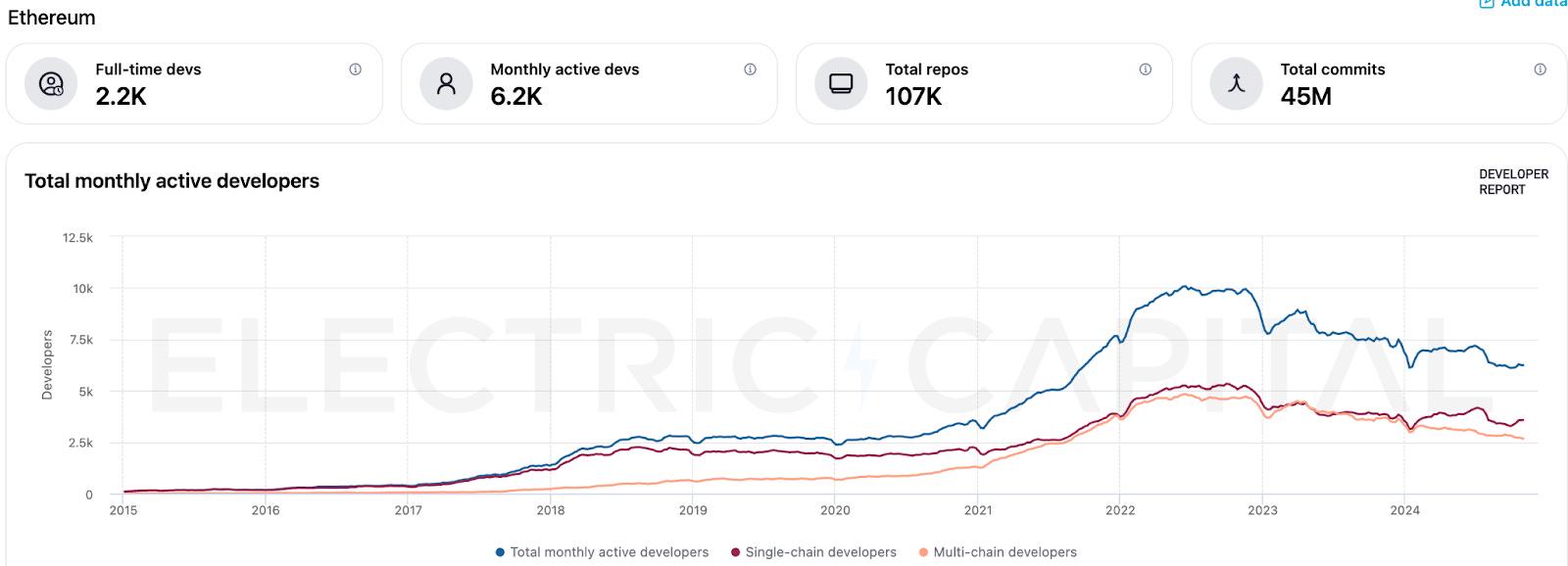
"Living off the past" is not advisable. The crypto field cannot rely on network effects to build a holding moat

As shown in the Electric Capital developer report above, Ethereum initially benefited from network effects, attracting most developers to build exclusively on Ethereum ("single-chain developers"). However, in the face of competitors such as Solana and Base, the network effect failed to save Ethereum from poor performance and fragmented liquidity. As a result, the ratio of "single-chain developers" / "total number of monthly active developers" has dropped significantly since 2022. This shift shows the profit-seeking nature of developers. They will flow to where their needs are met, rather than staying for loyalty.

Retail Investors as Users: As long as DeFi remains the primary use case for cryptocurrencies, liquidity providers and DeFi users will continue to seek:

  • Highest liquidity return
  • Minimum slippage in transactions
  • The most types of tokens
  • The most attractive mining rewards

This behavior is generally not related to user experience or platform preference.

In addition, the emergence of wallets makes switching between platforms such as Uniswap and Hyperliquid smooth and easy.

Validators as users: Validators naturally seek the highest notional value block rewards — either from their stake (in PoS networks) or from services provided (as DePIN providers).

The choice of continuing to use or supporting alt L1, L2, application chain or DePIN projects depends on a simple cost-benefit calculation. When making this choice, validators will evaluate the economic value and sustainability of block rewards.

Feature 2: Cryptocurrency is open source by default, greatly reducing the entry barrier for imitators

“Vampire Attack”: SushiSwap copied the Uniswap code and provided the exact same user experience, then designed a more profitable token incentive to siphon off Uniswap’s liquidity providers and users.

It would be much harder to pull off a similar attack in Web2. Someone would have to steal Facebook’s entire codebase, launch an identical or better product, and then offer money to all of Facebook’s users to entice them to use the new platform.

Feature 3: Cryptocurrencies are interoperable by default, minimizing switching costs for developers and retail investors

Take USDC, for example, which arguably has the highest network effect in the crypto space, comparing it to one of its Web2 peers, the Visa network. If USDC is not accepted, it doesn’t take much time to exchange it for USDT, USDe, or PYUSD on a DEX or CEX.

However, it is much more troublesome for users to switch their cards from the Visa network to MasterCard.

Now back to the main point of this article, why network effects don’t give crypto companies the same advantages as their Web2 counterparts:

Network effects do not increase competitive moats: Due to the forkability and open source nature of cryptocurrencies, coupled with Bertrand competition between undifferentiated products (yield, block space, liquidity) (PANews Note: that is, the products of different manufacturers are completely substitutable, so the oligopoly with the lower price will win the entire market, and the one with the higher price will not get any benefits at all), network effects do not necessarily make the first mover with more users more "competitive".

Network effects cannot reduce the cost of acquiring crypto users: Crypto users (whether retail or developers) are inherently more profit-driven than Web2 users. Retail investors prefer optimal trading returns and yields. Developers prefer the best performance and deepest liquidity. Regardless of whether there is a network effect, as long as the returns are profitable for LPs, liquidity will remain in the ecosystem.

Some even argue that cryptocurrencies have the opposite effect of network effects: the more LPs in a pool, the lower the returns; the more users on a chain, the higher the fees and the more congestion.

Network effects do not create higher switching costs and retention rates in crypto: Due to the default composability and interoperability of blockchains, switching costs in crypto are extremely low.

There is no data moat in the crypto space. No data on the chain can be considered "proprietary data", which is key for large technology companies to retain users.

Finally, let’s look at a case study on Ethereum, which is widely considered to be the epitome of network effects in the crypto space. Since Ethereum is regarded as the “world computer”, it combines blockchain innovation with programmable currency and benefits from early network effects:

  • Developer adoption: Ethereum attracted the largest blockchain developer community in its early days, primarily because its EVM became the industry standard for initial blockchain development.
  • Liquidity and DeFi Dominance: Ethereum hosted the majority of crypto liquidity via DeFi platforms — until recently surpassed by Solana. More liquidity attracts more users → easier and cheaper to trade/borrow → more liquidity.
  • Security: The increase in Ethereum usage has enhanced its security, attracting more projects and users.

However, this trend was broken this year. Ethereum played a good hand badly: delaying product improvements and over-fragmenting its ecosystem by supporting L2 that cannibalized its own liquidity. As a result:

  • A large outflow of developers: The number of monthly active developers decreased by 17% in 2024, while the number of new developers on Solana increased by about 83%.
  • Liquidity outflow: According to DeFiLlama data, DeFi’s dominance has dropped from 100% to 50%).

And Ethereum’s so-called network effects cannot reverse this trend.

In contrast, the Web2 giants (i.e. Meta and Twitter) have similarly slacked off on innovation and delivery, yet continue to easily dominate their respective markets. Why? Because the Web2 version of network effects really works and has staying power:

  • Competitors cannot fork their code and offer a similar product.
  • Twitter and Facebook data is truly proprietary and irreplaceable
  • Unable to interoperate with any project except within its own ecosystem.

Given this, traditional network effects that provide long-term moats for Web2 companies do not apply in crypto.

Related reading: Ethereum’s growing pains: From ETF “bleeding” to on-chain weakness, can ETF staking boost the market?

Market Opportunity
Notcoin Logo
Notcoin Price(NOT)
$0,0004517
$0,0004517$0,0004517
-0,44%
USD
Notcoin (NOT) Live Price Chart
Disclaimer: The articles reposted on this site are sourced from public platforms and are provided for informational purposes only. They do not necessarily reflect the views of MEXC. All rights remain with the original authors. If you believe any content infringes on third-party rights, please contact service@support.mexc.com for removal. MEXC makes no guarantees regarding the accuracy, completeness, or timeliness of the content and is not responsible for any actions taken based on the information provided. The content does not constitute financial, legal, or other professional advice, nor should it be considered a recommendation or endorsement by MEXC.

You May Also Like

SBI VC Trade Adds Litecoin to Japanese Lending Program

SBI VC Trade Adds Litecoin to Japanese Lending Program

The post SBI VC Trade Adds Litecoin to Japanese Lending Program appeared on BitcoinEthereumNews.com. SBI VC Trade added Litecoin to its regulated lending program
Share
BitcoinEthereumNews2026/02/03 19:53
Work Dogs TGE Is Running — Is WD About to Drop in Q2 After March 30?

Work Dogs TGE Is Running — Is WD About to Drop in Q2 After March 30?

Work Dogs Token Listing Date Expected in Q2 2026 as WD TGE Nears Completion The countdown to the Work Dogs (WD) token listing date has officially begun. Afte
Share
Hokanews2026/02/03 20:16
Bitcoin: Treasury Corporation’s Strategic OTCQX Listing Unlocks New Growth

Bitcoin: Treasury Corporation’s Strategic OTCQX Listing Unlocks New Growth

BitcoinWorld Bitcoin: Treasury Corporation’s Strategic OTCQX Listing Unlocks New Growth The world of cryptocurrency is constantly evolving, and a recent development has captured the attention of investors and enthusiasts alike. Bitcoin Treasury Corporation, a a company dedicated to accumulating digital assets, has made a significant move by listing on the U.S. OTCQX Best Market under the ticker BTCFF. This isn’t just another listing; it signals a growing trend of institutional confidence in digital assets and their long-term potential. What Does This Strategic OTCQX Listing Mean for Bitcoin Treasury Corporation? For those unfamiliar, the OTCQX Best Market is the highest tier of the three marketplaces for the over-the-counter (OTC) trading of stocks. It’s designed for established, investor-focused U.S. and international companies. Being listed here offers several distinct advantages for a company like Bitcoin Treasury Corporation. Enhanced Visibility: The listing provides a more transparent and regulated trading environment, making the company more attractive to a broader range of institutional and retail investors. Increased Liquidity: A higher-tier market often leads to greater trading volumes, which can improve the liquidity of the company’s shares. Credibility Boost: Operating on a recognized market lends significant credibility, especially for an entity deeply involved in the nascent crypto space. Bitcoin Treasury Corporation began its journey of accumulating BTC in June and has rapidly grown its holdings to over 700 BTC. This strategic accumulation underscores their belief in Bitcoin as a foundational asset for the future. Why Are More Companies Embracing Bitcoin for Their Treasuries? The move by Bitcoin Treasury Corporation isn’t an isolated incident. We’ve witnessed a remarkable shift in corporate finance over the past few years, with numerous companies integrating digital assets into their balance sheets. Why this sudden embrace of Bitcoin? Many view Bitcoin as a powerful hedge against inflation, especially in an era of quantitative easing and rising global debt. Its decentralized nature and finite supply of 21 million coins make it an appealing “digital gold” alternative to traditional fiat currencies. Companies like MicroStrategy have famously adopted Bitcoin as their primary treasury reserve asset, demonstrating a bold vision for corporate capital allocation. While the potential for significant gains is attractive, companies must also navigate the inherent volatility of the crypto market and evolving regulatory landscapes. Despite these challenges, the long-term strategic benefits often outweigh the risks for those with a strong conviction in this digital asset. How Does This Listing Impact the Broader Bitcoin Market? Each time a company like Bitcoin Treasury Corporation makes such a move, it sends a ripple through the entire crypto ecosystem. It serves as a strong validation of Bitcoin as a legitimate and valuable asset class, not just a speculative tool. This increased institutional involvement can lead to: Greater Stability: As more large entities hold Bitcoin for the long term, it could potentially reduce some of the extreme price swings often associated with the asset. Mainstream Acceptance: Corporate adoption paves the way for wider public acceptance and understanding of cryptocurrencies. Regulatory Clarity: With more traditional companies engaging, regulators may be compelled to provide clearer guidelines, fostering a more secure environment for everyone involved with digital currencies. For individual investors, this trend suggests a maturation of the market. It implies that fundamental analysis and long-term investment strategies are becoming increasingly relevant in the Bitcoin space. Navigating the Future of Corporate Bitcoin Holdings The listing of Bitcoin Treasury Corporation on the OTCQX Best Market marks a pivotal moment. It highlights a growing confidence among corporations in integrating digital assets into their financial strategies. As the digital economy continues to expand, we can expect more companies to explore similar avenues for their Bitcoin investments. However, it’s crucial for any company considering Bitcoin for its treasury to conduct thorough due diligence. Understanding market dynamics, regulatory compliance, and secure custody solutions are paramount. The journey into corporate crypto holdings is still relatively new, but pioneers like Bitcoin Treasury Corporation are charting a course for others to follow. In conclusion, Bitcoin Treasury Corporation’s OTCQX listing is more than just a procedural step; it’s a powerful testament to the enduring appeal and increasing institutional acceptance of Bitcoin. This move not only benefits the company but also reinforces the broader narrative of digital assets’ emergence as a crucial component of modern financial portfolios. It’s an exciting time to watch the intersection of traditional finance and digital assets evolve. Frequently Asked Questions About Bitcoin Treasury Corporation’s Listing Q1: What is the OTCQX Best Market? A1: The OTCQX Best Market is the highest tier for over-the-counter (OTC) stock trading in the U.S. It’s for established companies that meet stringent financial and disclosure requirements, offering enhanced transparency and credibility for investors. Q2: Why is Bitcoin Treasury Corporation’s listing significant for Bitcoin? A2: This listing signifies increasing institutional confidence in Bitcoin as a legitimate asset. It provides a regulated platform for a company focused on accumulating Bitcoin, potentially encouraging more traditional investors and corporations to consider digital assets. Q3: How much Bitcoin does Bitcoin Treasury Corporation hold? A3: As of their announcement, Bitcoin Treasury Corporation holds over 700 BTC, having begun its accumulation strategy in June. Q4: What are the benefits for Bitcoin Treasury Corporation by listing on OTCQX? A4: Benefits include enhanced visibility, increased liquidity for its shares, and a significant boost in credibility by operating on a recognized and regulated market, making it more attractive to a wider investor base. Q5: Does this mean Bitcoin is becoming more mainstream? A5: Yes, corporate actions like this listing contribute significantly to Bitcoin‘s mainstream acceptance. It helps validate digital assets as a serious component of financial portfolios, paving the way for wider public and institutional understanding. If you found this article insightful and believe in the growing importance of corporate Bitcoin adoption, please share it with your network! Your support helps us continue to provide valuable insights into the evolving world of cryptocurrency. To learn more about the latest Bitcoin trends, explore our article on key developments shaping Bitcoin institutional adoption. This post Bitcoin: Treasury Corporation’s Strategic OTCQX Listing Unlocks New Growth first appeared on BitcoinWorld.
Share
Coinstats2025/09/18 19:40