Virtual reality (VR) is a new way to create learning states that the brain treats as real. VR is the first medium that lets us engineer experiences, not just deliverVirtual reality (VR) is a new way to create learning states that the brain treats as real. VR is the first medium that lets us engineer experiences, not just deliver

Virtual Reality: A Bold New Era for Workforce Learning

\ Every generation thinks it has reinvented learning. Slides replaced chalkboards. E learning replaced slides. Then came microlearning, gamification, bite-sized content, and apps that flood employees with “nudges.”

\ Yet, ask any HR team a simple question.

\ Are employees actually learning faster today?

\ The honest answer is usually no.

\ Workforces are drowning in content but starved for environments that actually change how people think, feel, and act. The problem is not a lack of information. It is a lack of immersion, a lack of presence, and a lack of emotional engagement. Human beings do not learn through text alone. They learn through states of attention. They learn through experience.

\ This is where virtual reality quietly steps onto the stage. Not as entertainment, not as a toy, and not as a gimmick. As a fundamentally different way to create learning states that the brain treats as real.

\ VR is not the next version of e learning.

\ VR is the first medium that lets us engineer experiences, not just deliver content.

The Limits of Legacy Learning

Let us start by being blunt. Most workforce learning is built around the limitations of 20th-century classrooms. Linear, verbal, abstract, and detached from emotional consequence.

\ You can recognize the symptoms:

  • People click through modules while checking email \n \n
  • The brain treats the content as background noise \n \n
  • Retention drops within days \n \n
  • Real behavior at work barely changes \n \n

This is not a failure of motivation. It is a failure of design. The human nervous system simply does not treat passive content as signals worth updating. The amygdala, which filters for relevance and threat, sees no stakes. The hippocampus, which encodes memory, sees no novelty. The prefrontal cortex, which manages attention, is already tired from a full day of task switching.

\ Legacy learning is cognitively expensive and emotionally flat. Which means the brain invests little in it.

\ Workers are not disengaged from learning because they are lazy.

\ They are disengaged because their biology is boring.

VR Bypasses the Bottlenecks

Virtual reality breaks this pattern because it communicates with the brain on its own terms.

\ VR does three things that traditional learning cannot.

1. It captures full attention by design

In VR, you cannot multitask. The browser tabs vanish. Slack notifications vanish. Visual and auditory channels are controlled, which means attention is controlled. The brain cannot treat the environment as background. It becomes the foreground.

\ For HR and L and D teams, attention is the rarest currency. VR gives you the ability to buy it.

2. It creates emotional learning, not informational learning

People remember experiences, not lectures.

\ Fear, challenge, mastery, and empathy leave deep traces in memory.

\ VR can simulate:

  • A difficult conversation with a distressed patient \n \n
  • A high-pressure negotiation \n \n
  • A safety hazard unfolding in real time \n \n
  • A moment of leadership under conflict \n \n
  • A situation where emotional regulation determines the outcome \n \n

These are “hot cognition” experiences. They activate the emotional circuitry that makes memory sticky and behavior change possible.

\ Traditional learning asks the brain to imagine.

\ VR lets the brain experience.

3. It compresses time

A well-designed VR module accomplishes in ten minutes what a classroom session takes an hour to convey. Why? Because immersion removes the need for long explanations. The environment teaches.

\ People do not decode instructions.

\ They feel the consequences of their decisions.

\ The nervous system updates faster because it is operating inside a simulated feedback loop, not a hypothetical one.

The workplace version of a flight simulator.

Aviation figured this out long ago. No one teaches pilots by giving them a PDF and a quiz. They put them in simulators where mistakes do not kill anyone, but the brain treats them as real events.

\ Work has reached the same level of complexity.

\ Modern employees navigate:

  • AI-powered systems \n \n
  • Emotional labor \n \n
  • High-consequence decisions \n \n
  • Customer interactions with reputational risk \n \n
  • Safety protocols that cannot fail \n \n
  • Volatile team dynamics \n \n
  • Constant adaptation \n \n

Yet, we train them with slideshows.

\ VR offers the workplace equivalent of a flight simulator.

\ It lets organizations stress test skills without real-world cost.

\ Imagine if:

  • A new nurse could practice delivering bad news in a safe environment \n \n
  • A manager could rehearse conflict resolution before touching a real conflict \n \n
  • A field technician could make mistakes in a zero-risk simulation \n \n
  • A customer support employee could train for peak surge scenarios \n \n
  • A cybersecurity analyst could practice responding to a live attack simulation \n \n

This is training with stakes, and stakes are what make the brain care.

The Missing Link: Emotional and Cognitive Recovery

Most companies adopt VR for safety or technical skills.

\ The next frontier is emotional and cognitive performance.

\ In fast-changing environments, people do not fail because they lack knowledge. They fail because the nervous system becomes overwhelmed.

\ VR allows something unusual.

\ It can downregulate the nervous system in minutes.

\ Short reset environments calm the threat response, slow breathing, re-anchor attention, and restore cognitive capacity. This is not entertainment. It is the emotional version of clearing RAM so performance can continue.

\ Employees under pressure do not need more content.

\ They need the ability to reboot their internal operating system.

\ VR makes this possible at scale, inside the workday.

Why VR has finally crossed the threshold.

For years, VR was a promise waiting for hardware to catch up. Now, the pieces are aligned.

  • Lightweight headsets are affordable \n \n
  • Graphics are smooth enough for immersion \n \n
  • Organizations already invest in digital learning ecosystems \n \n
  • Hybrid and distributed work made experiential training necessary \n \n
  • AI can generate dynamic scenarios based on user behavior \n \n

The question is no longer “Will VR enter the workforce?” but “How fast will it become standard?”

\ If PowerPoint was the language of 2000, and e learning was the language of 2010, VR will be the language of 2030.

\ Because it is the only medium that mimics the features humans learn from best.

\ Experience.

A bold new era is starting.

The shift to VR is not a technological trend. It is a philosophical correction.

\ We are finally building learning systems that respect the realities of human biology and cognition. Systems where people do not passively consume content but live through simulations that matter.

\ In the next decade, workforce learning will not be judged by how much content you produce.

\ It will be judged by how effectively you engineer states of attention, emotion, and presence.

\ Those who adopt VR early will gain a workforce that learns faster, adapts faster, and recovers faster.

\ The organizations that cling to old formats will still be asking why their people “don’t retain anything.”

\ Because the truth is simple.

\ The human brain evolved for immersive experience.

\ VR is the first technology that finally gives it one.

Market Opportunity
Virtuals Protocol Logo
Virtuals Protocol Price(VIRTUAL)
$0.7254
$0.7254$0.7254
+0.09%
USD
Virtuals Protocol (VIRTUAL) Live Price Chart
Disclaimer: The articles reposted on this site are sourced from public platforms and are provided for informational purposes only. They do not necessarily reflect the views of MEXC. All rights remain with the original authors. If you believe any content infringes on third-party rights, please contact service@support.mexc.com for removal. MEXC makes no guarantees regarding the accuracy, completeness, or timeliness of the content and is not responsible for any actions taken based on the information provided. The content does not constitute financial, legal, or other professional advice, nor should it be considered a recommendation or endorsement by MEXC.

You May Also Like

Bitcoin ETF Investors React to Fed’s Decision

Bitcoin ETF Investors React to Fed’s Decision

The post Bitcoin ETF Investors React to Fed’s Decision appeared on BitcoinEthereumNews.com. In a surprise move, spot Bitcoin ETFs experienced their first significant daily outflows in over a week, following the Federal Reserve’s adjusted policy outlook. This shift reflects the market’s readiness to respond to any hint of change on the regulatory landscape, as well as its sensitivity to central bank cues. Continue Reading:Bitcoin ETF Investors React to Fed’s Decision Source: https://en.bitcoinhaber.net/bitcoin-etf-investors-react-to-feds-decision
Share
BitcoinEthereumNews2025/09/18 18:51
US Senators Introduce SAFE Crypto Act to Target Rising Crypto Scams
US Senators Introduce SAFE Crypto Act to Target Rising Crypto Scams

The post US Senators Introduce SAFE Crypto Act to Target Rising Crypto Scams appeared first on Coinpedia Fintech News Crypto scams are getting faster, smarter and
Share
CoinPedia2025/12/17 18:33
From Idea to App Store: The Complete Guide to Mobile App Development in Saudi Arabia

From Idea to App Store: The Complete Guide to Mobile App Development in Saudi Arabia

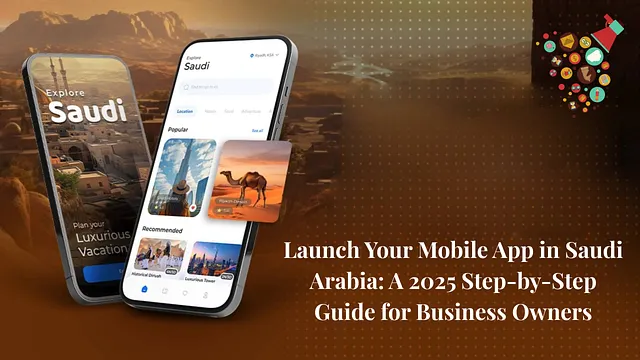
Saudi Arabia is at the forefront of digital transformation. With Vision 2030 driving innovation and a rapidly growing population of tech-savvy users, mobile apps have become a core driver of business growth in the Kingdom. From e-commerce and fintech to healthcare, logistics, and on-demand services, Saudi businesses are embracing mobile apps to connect with customers and scale faster. But how do you take a mobile app idea and turn it into a successful launch on the App Store or Google Play? This guide breaks down the complete mobile app development process in Saudi Arabia — step by step. Step 1: Validate Your App Idea for the Saudi Market Before you start building, ask: What problem does my app solve for Saudi users? Is there a cultural or market gap my app can fill? How do local competitors approach the same challenge? For example, apps related to digital payments, e-learning, delivery services, and healthcare are in high demand across Saudi Arabia. Conducting market research and aligning your app idea with local user behavior is critical. Step 2: Plan Features with Local Needs in Mind Your app should start with an MVP (Minimum Viable Product) — a core version that solves the main problem. Later, you can scale with advanced features. In Saudi Arabia, consider adding: Arabic language support (essential for user adoption) Integration with local payment gateways like STC Pay, Mada, or Apple Pay Regulatory compliance (especially for fintech and health apps) Localization for user preferences (Hijri calendar, cultural UI elements) Step 3: Select the Right Development Approach You can choose: Native Apps (Swift for iOS, Kotlin for Android) — Great for scalability and performance. Cross-Platform Apps (Flutter, React Native) — Cost-effective for startups targeting both iOS and Android simultaneously. Hybrid Apps — Suitable for simpler apps with limited features. For Saudi startups and enterprises, cross-platform development is often preferred to reach a wider audience quickly and efficiently. Step 4: Design With a Local Touch The design must balance global usability standards with local cultural relevance. UI (User Interface): Clean, modern visuals that align with Saudi branding. UX (User Experience): Simple navigation, clear Arabic text support, and intuitive flows. Wireframing & Prototyping: Test early with Saudi users to ensure adoption. A user-friendly design is one of the top reasons apps succeed in the Kingdom’s competitive market. Step 5: Develop Your Mobile App Once the design is ready, the coding begins. Saudi app development companies often follow Agile methodology, ensuring flexibility and faster delivery. Front-End Development: Interface and user interactions. Back-End Development: Databases, servers, and APIs. Integration: Secure connections between front-end and back-end. Strong collaboration between developers, designers, and business analysts ensures your app aligns with Saudi market needs. Step 6: Testing Across Devices and Networks Saudi users rely on different devices and network speeds. That’s why rigorous testing is critical: Functionality Testing: Features work as expected. Performance Testing: The app runs smoothly on both 4G and 5G networks. Localization Testing: Arabic text displays correctly, without alignment issues. Security Testing: Data protection compliance with Saudi cybersecurity standards. Step 7: App Store & Google Play Launch in Saudi Arabia To publish your app: Apple App Store (iOS): Requires an Apple Developer account and strict guideline compliance. Google Play Store (Android): Faster approval but still requires detailed app info. You’ll also need metadata in both English and Arabic — titles, descriptions, and screenshots — to maximize visibility among Saudi users. Step 8: Market Your App in Saudi Arabia Launching an app is only the beginning. You need a marketing strategy tailored to the Kingdom: App Store Optimization (ASO): Use Arabic and English keywords. Social Media Campaigns: Leverage platforms like Snapchat, Twitter (X), and Instagram, which are highly popular in Saudi Arabia. Influencer Marketing: Collaborate with Saudi influencers for early traction. Paid Ads: Google Ads and Saudi-focused Facebook/Instagram ads. Partnerships: Collaborate with local businesses to reach a wider audience. Step 9: Gather Feedback and Optimize Once your app is live, monitor: User reviews on app stores Analytics on engagement, retention, and churn rates Suggestions from Saudi users for culturally relevant features Continuous updates and improvements are vital to stay competitive. Step 10: Scale With Advanced Features Once your MVP gains traction, you can expand with advanced features such as: AI and machine learning for personalization Blockchain-based payments for fintech apps AR/VR features for retail and gaming apps IoT integration for smart home and mobility solutions Saudi Arabia’s digital ecosystem is growing rapidly — apps that adapt quickly will thrive. Conclusion Mobile app development in Saudi Arabia is not just about building an app — it’s about aligning with Vision 2030, cultural needs, and user expectations. By following a clear process — from idea validation to launch and beyond — you can transform your concept into a profitable digital product. Whether you’re a startup or an enterprise in Saudi Arabia, the opportunity is massive. With the right strategy, you can move from idea to App Store and create an app that truly resonates with Saudi users. From Idea to App Store: The Complete Guide to Mobile App Development in Saudi Arabia was originally published in Coinmonks on Medium, where people are continuing the conversation by highlighting and responding to this story
Share
Medium2025/09/18 14:46