Early investor opportunities rarely announce themselves loudly. They tend to surface when attention starts shifting, but before prices fully adjust. That momentEarly investor opportunities rarely announce themselves loudly. They tend to surface when attention starts shifting, but before prices fully adjust. That moment

Top 3 Crypto Gems for Early Investors: One Altcoin Nears 100% Allocation at $0.035

Early investor opportunities rarely announce themselves loudly. They tend to surface when attention starts shifting, but before prices fully adjust. That moment often comes when familiar names slow down and newer projects begin to show stronger signals beneath the surface. As the market looks toward the next crypto cycle, a small group of cryptocurrencies is being discussed more often, with one new altcoin drawing particular focus as its allocation window tightens.

Pepecoin (PEPE) 

Pepecoin remains one of the most recognizable meme coins in the market. Its early surge was dramatic, driven by viral attention and rapid community growth. That move pushed PEPE to a large market cap in a short time, rewarding early buyers who entered before mainstream exposure.

Today, PEPE faces a different reality. Its price behavior is heavily tied to sentiment rather than utility. Without a clear product or revenue model, demand depends on renewed hype cycles. Market commentators suggest that as meme-driven momentum fades, price recovery becomes harder to sustain. 

While PEPE can still move during strong market rallies, its long-term growth profile appears limited by the absence of fundamental drivers. This has led some early participants to reassess where new upside might come from, especially as capital becomes more selective.

Solana (SOL) 

Solana represents the opposite end of the spectrum. It is a high-utility blockchain with a large market cap and a strong history of adoption. Early SOL investors benefited from one of the fastest growth phases of the last cycle, as usage and developer activity expanded rapidly.

At current levels, SOL trades under a clear resistance zone around $150. Each attempt to push higher has struggled to hold. Analysts often point to scale as the main factor. With a large valuation already in place, Solana requires significant inflows to deliver another strong move.

For many holders, SOL is now viewed as a mature asset. It offers stability and continued development, but the explosive upside seen in its early days is harder to repeat. This has prompted some investors to look for projects that are earlier in execution but still grounded in real use cases.

Mutuum Finance (MUTM)

That search has brought Mutuum Finance (MUTM) into focus. Mutuum Finance is a DeFi crypto building a lending and borrowing protocol designed around practical financial activity. Instead of relying on narrative cycles, it aims to generate usage through supplying assets, borrowing against collateral, and earning yield.

Mutuum Finance is currently priced at $0.035 and is in Phase 6 of its presale, which is now over 99% allocated. The presale began in early 2025, and since then the token has climbed 250% from its initial phase. The project has raised over $19.4M and attracted more than 18,600 holders.

Rather than framing this as early speculation, many observers see MUTM as entering a transition phase. Development milestones are in place, participation is growing, and supply at the current price is becoming scarce.

Why Analysts See MUTM Differently

Analysts comparing these three assets often focus on structure rather than popularity. PEPE’s growth depends on renewed attention. SOL’s growth is constrained by size. MUTM sits in a different position.

First, Mutuum Finance has defined utility. Its lending protocol is designed to support ongoing borrowing and lending activity, which can generate repeat usage. Second, it is still early in its lifecycle, meaning price behavior is not yet limited by a large market cap. Third, its supply is still being distributed, which often precedes sharper price adjustments.

To illustrate the contrast, consider a simple example. A $600 position in PEPE today relies almost entirely on sentiment shifts. A $600 position in SOL depends on broader market expansion. A $600 position in MUTM is tied to an upcoming execution phase, where utility is expected to activate and participation may increase. This is not a guarantee of performance, but it highlights why some analysts believe the risk-reward profile differs.

V1 Launch and Security as Key Catalysts

Execution remains the main focus. According to official statements shared on Mutuum Finance’s X account, V1 of the lending and borrowing protocol is scheduled to launch on the Sepolia testnet in Q4 2025. Core features include liquidity pools, mtTokens, debt tokens, and liquidation tools, with ETH and USDT as initial supported assets.

Security has also been prioritized. Mutuum Finance completed a CertiK audit with a 90/100 token scan score. In addition, Halborn Security is conducting an independent review of the protocol’s lending and borrowing contracts. A $50k bug bounty is active to identify code vulnerabilities ahead of wider use.

For a developing DeFi crypto, these steps matter. Lending protocols depend on trust, accurate pricing, and robust safeguards. Many investors wait for this layer of validation before increasing exposure.

Why Early Investors Are Watching Closely

When comparing PEPE, SOL, and MUTM, the differences are clear. PEPE represents past momentum. SOL represents established infrastructure. MUTM represents a new crypto moving toward execution with defined utility and tightening supply.

For those tracking crypto prices today and asking what crypto to buy now, this explains why Mutuum Finance is increasingly mentioned among top crypto discussions. It is not about replacing large-cap assets, but about identifying where the next phase of growth might form.

As Phase 6 nears completion and V1 approaches, Mutuum Finance enters a stage where attention often accelerates. For early investors, that timing is what makes this new DeFi crypto stand out alongside more familiar names.

For more information about Mutuum Finance (MUTM) visit the links below:

Website: https://www.mutuum.com

Linktree: https://linktr.ee/mutuumfinance

Market Opportunity
TOP Network Logo
TOP Network Price(TOP)
$0.000096
$0.000096$0.000096
0.00%
USD
TOP Network (TOP) Live Price Chart
Disclaimer: The articles reposted on this site are sourced from public platforms and are provided for informational purposes only. They do not necessarily reflect the views of MEXC. All rights remain with the original authors. If you believe any content infringes on third-party rights, please contact service@support.mexc.com for removal. MEXC makes no guarantees regarding the accuracy, completeness, or timeliness of the content and is not responsible for any actions taken based on the information provided. The content does not constitute financial, legal, or other professional advice, nor should it be considered a recommendation or endorsement by MEXC.

You May Also Like

FBI says North Korea’s Kimsuky APT uses malicious QR codes to spearphish U.S. entities

FBI says North Korea’s Kimsuky APT uses malicious QR codes to spearphish U.S. entities

The post FBI says North Korea’s Kimsuky APT uses malicious QR codes to spearphish U.S. entities appeared on BitcoinEthereumNews.com. The FBI says Kimsuky APT, a
Share
BitcoinEthereumNews2026/01/10 02:55
a16z targets AI and crypto after $15B fundraising year in 2025
a16z targets AI and crypto after $15B fundraising year in 2025

The post a16z targets AI and crypto after $15B fundraising year in 2025 appeared on BitcoinEthereumNews.com. Andreessen Horowitz (a16z) secured over $15 billion
Share
BitcoinEthereumNews2026/01/10 03:13
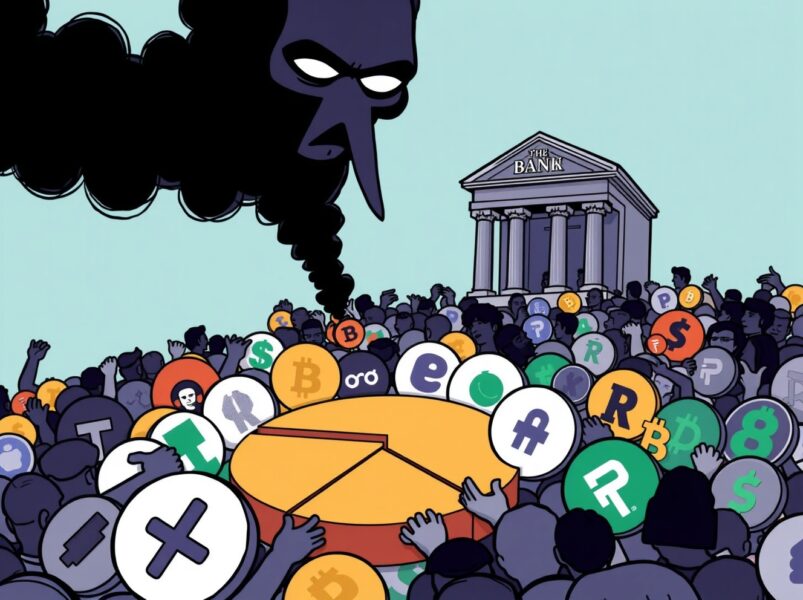
Stablecoin Market: Urgent Warning of a Zero-Sum Future

Stablecoin Market: Urgent Warning of a Zero-Sum Future

BitcoinWorld Stablecoin Market: Urgent Warning of a Zero-Sum Future A significant warning has emerged from financial giant JPMorgan, signaling a potentially challenging future for the stablecoin market. This isn’t just a minor blip; it’s a stark reminder that the booming world of digital assets faces a critical juncture, especially for those relying on the stability of stablecoins. JPMorgan’s recent research note suggests that unless the broader cryptocurrency market expands dramatically, stablecoin issuers are heading towards a fierce ‘zero-sum game’ scenario. The Alarming Truth About the Stablecoin Market What exactly does a ‘zero-sum game’ mean for the stablecoin market? Essentially, it implies that for one stablecoin to gain market share, another must lose it. This isn’t about overall growth where everyone benefits; it’s about a fixed pie where new entrants only succeed by taking a slice from existing players. JPMorgan analysts point to a rapidly increasing number of new stablecoin projects vying for attention. Tether recently announced its unregulated stablecoin, USAT. Hyperliquid plans to launch USDH, aiming to reduce its dependence on Circle’s USDC. Even traditional fintech powerhouses like Robinhood and Revolut are developing their own stablecoins. This surge of new issuers intensifies competition significantly. While the overall stablecoin market capitalization has reached an impressive $278 billion, its share of the total crypto market has remained stagnant, averaging below 8% since 2020. This stagnation, according to JPMorgan, is a key indicator of the brewing zero-sum challenge. Why is the Stablecoin Market Becoming So Crowded? The influx of new players into the stablecoin market isn’t accidental; it’s driven by various strategic motivations. Many projects aim to gain greater control over their financial infrastructure and reduce reliance on third-party stablecoins. For instance, Hyperliquid’s move to USDH is a clear example of a platform seeking self-sufficiency and potentially lower operational costs. Furthermore, established fintech firms like Robinhood and Revolut see stablecoins as a natural extension of their existing services. They can integrate these digital assets into their platforms, offering new functionalities and potentially attracting a broader user base. However, this expansion comes with a caveat: if the overall crypto market doesn’t grow proportionally, these new offerings will merely fragment the existing demand, making profitability and widespread adoption harder to achieve for all. The core challenge remains the limited expansion of the total crypto market relative to the growing supply of stablecoins. This dynamic creates an environment where innovation must go hand-in-hand with genuine market expansion, not just internal competition. Navigating the Competitive Stablecoin Market Landscape So, what does this intense competition mean for users and the broader crypto ecosystem? For one, it could lead to increased innovation as issuers strive to differentiate their offerings through better features, lower fees, or enhanced security. However, it also presents potential risks, particularly if some stablecoins fail to gain traction or face liquidity issues in a highly competitive environment. Users should exercise caution and conduct thorough due diligence when choosing stablecoins. For existing giants like USDC, the entry of new competitors means they must continue to innovate and maintain their market leadership. Regulatory clarity also plays a crucial role here. As more entities enter the space, the demand for clear, consistent regulations will only grow, potentially shaping the future landscape of the stablecoin market significantly. Ultimately, the long-term health of the stablecoin ecosystem hinges on the ability of the entire cryptocurrency market to attract new capital and users. Without this broader expansion, JPMorgan’s warning of a zero-sum game could become a stark reality. In conclusion, JPMorgan’s recent warning serves as a potent reminder of the escalating competition within the stablecoin market. While innovation and new entrants are exciting, the core challenge lies in the stagnant growth of the broader crypto market. For stablecoins to truly thrive beyond a zero-sum dynamic, a significant influx of new capital and users into the entire cryptocurrency ecosystem is paramount. The future success of these digital anchors depends on collective market expansion, not just internal rivalry. Frequently Asked Questions About the Stablecoin Market Q1: What is a ‘zero-sum game’ in the context of the stablecoin market? A1: A ‘zero-sum game’ means that for one stablecoin to gain market share, another stablecoin must lose an equivalent amount. It implies that the overall market size for stablecoins is not growing, forcing issuers to compete for a fixed pool of users and capital. Q2: Why is JPMorgan concerned about the stablecoin market? A2: JPMorgan is concerned because despite the stablecoin market’s growth in total value, its share of the overall crypto market capitalization has stagnated. With many new entrants, they believe competition will intensify, leading to a zero-sum dynamic unless the broader crypto market significantly expands. Q3: Which new stablecoin issuers are mentioned in the warning? A3: The warning highlights new entrants such as Tether’s unregulated stablecoin USAT, Hyperliquid’s planned USDH, and stablecoins being developed by fintech firms Robinhood and Revolut. Q4: What could be the implications for users of stablecoins? A4: For users, increased competition could lead to more innovative features, potentially lower fees, and better services. However, it also means a greater need for due diligence to assess the stability and reliability of various stablecoins, especially if some struggle in a crowded market. Q5: How can the stablecoin market avoid a zero-sum outcome? A5: According to JPMorgan, avoiding a zero-sum outcome requires significant expansion of the broader cryptocurrency market. This means attracting new capital and users into the entire crypto ecosystem, thereby growing the ‘pie’ rather than just re-dividing existing slices. Did JPMorgan’s warning about the stablecoin market catch your attention? Share this crucial insight with your network and join the conversation about the future of digital assets. Your thoughts and perspectives are invaluable! To learn more about the latest stablecoin market trends, explore our article on key developments shaping stablecoin market institutional adoption. This post Stablecoin Market: Urgent Warning of a Zero-Sum Future first appeared on BitcoinWorld.
Share
Coinstats2025/09/19 15:45