Ethereum co-founder Vitalik Buterin has once again stirred crypto markets after updating his profile photo on X to a Milady NFT helping push the collection’s floorEthereum co-founder Vitalik Buterin has once again stirred crypto markets after updating his profile photo on X to a Milady NFT helping push the collection’s floor

Vitalik Buterin’s Milady Profile Photo Sparks 30% Jump in NFT Floor Price

2026/01/02 19:11
3 min read

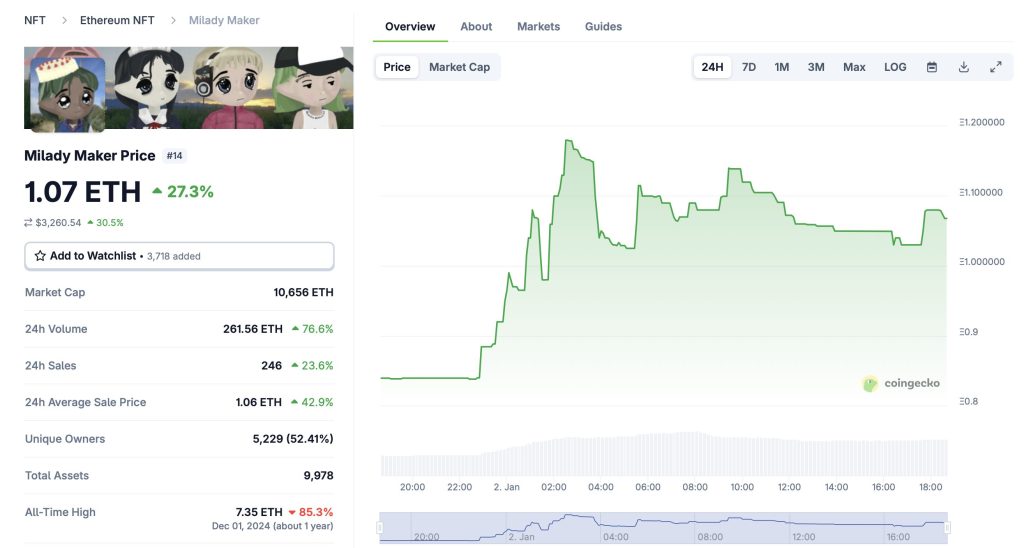
Ethereum co-founder Vitalik Buterin has once again stirred crypto markets after updating his profile photo on X to a Milady NFT helping push the collection’s floor price up nearly 30% within 24 hours.

Data from Coingecko NFT marketplaces show Milady Maker’s floor price climbing to around 1.07 ETH, with both trading volume and sales rising sharply following the profile change.
A New Year Message for Ethereum

The price move coincided with a New Year post from Buterin on X in which he reflected on Ethereum’s progress in 2025 and laid out his priorities for the year ahead.

“Welcome to 2026! Milady is back,” Buterin wrote, before pointing to a series of technical upgrades completed last year, including higher gas limits, expanded blob capacity, improvements in node software quality, and major advances in zkEVMs and PeerDAS.

He describes these milestones as some of Ethereum’s most important steps toward becoming a more powerful and scalable blockchain.

Beyond Hype: Ethereum’s Long-Term Mission

Buterin used the post to reiterate Ethereum’s broader mission, arguing that the network should not focus on short-term narratives or speculative trends, but instead serve as a foundational layer for a freer and more open internet.

He highlights the importance of decentralized applications that operate without fraud, censorship, or third-party interference, continue functioning even if their original developers disappear and protect user privacy. Such applications, he said, should remain stable regardless of political, corporate, or ideological shifts.

The Unusual Lore of Milady

The renewed attention has once again drawn focus to Milady’s unconventional history. Launched in August 2021, Milady Maker is a collection of 10,000 neochibi-style NFTs on Ethereum created by the Remilia Collective.

From the outset the project embraced irony, discomfort and intentionally broken aesthetics blending cute anime imagery with cryptic humor and insider references that many initially failed to understand.

Surviving Controversy and Volatility

Milady has weathered numerous controversies including public disputes involving its creators, legal battles between founders, allegations of misconduct and technical incidents that resulted in the loss of funds. Despite these challenges the collection has repeatedly rebounded.

In May 2023, a meme shared by Elon Musk triggered a surge in trading activity pushing Milady into the mainstream spotlight. Since then the ecosystem has continued to expand through new tokens, community initiatives and cultural events.

Culture Still Moves Markets

While the NFT market remains volatile, Milady’s latest rally underscores how cultural signals from influential figures can still move prices — particularly for projects rooted as much in internet subculture as financial speculation.

As members of the Milady community often note many NFT projects failed by trying too hard to explain themselves. Milady by contrast has survived by never doing so.

Market Opportunity
Seed.Photo Logo
Seed.Photo Price(PHOTO)
$0.2257
$0.2257$0.2257
+1.29%
USD
Seed.Photo (PHOTO) Live Price Chart
Disclaimer: The articles reposted on this site are sourced from public platforms and are provided for informational purposes only. They do not necessarily reflect the views of MEXC. All rights remain with the original authors. If you believe any content infringes on third-party rights, please contact service@support.mexc.com for removal. MEXC makes no guarantees regarding the accuracy, completeness, or timeliness of the content and is not responsible for any actions taken based on the information provided. The content does not constitute financial, legal, or other professional advice, nor should it be considered a recommendation or endorsement by MEXC.

You May Also Like

Cashing In On University Patents Means Giving Up On Our Innovation Future

Cashing In On University Patents Means Giving Up On Our Innovation Future

The post Cashing In On University Patents Means Giving Up On Our Innovation Future appeared on BitcoinEthereumNews.com. “It’s a raid on American innovation that would deliver pennies to the Treasury while kneecapping the very engine of our economic and medical progress,” writes Pipes. Getty Images Washington is addicted to taxing success. Now, Commerce Secretary Howard Lutnick is floating a plan to skim half the patent earnings from inventions developed at universities with federal funding. It’s being sold as a way to shore up programs like Social Security. In reality, it’s a raid on American innovation that would deliver pennies to the Treasury while kneecapping the very engine of our economic and medical progress. Yes, taxpayer dollars support early-stage research. But the real payoff comes later—in the jobs created, cures discovered, and industries launched when universities and private industry turn those discoveries into real products. By comparison, the sums at stake in patent licensing are trivial. Universities collectively earn only about $3.6 billion annually in patent income—less than the federal government spends on Social Security in a single day. Even confiscating half would barely register against a $6 trillion federal budget. And yet the damage from such a policy would be anything but trivial. The true return on taxpayer investment isn’t in licensing checks sent to Washington, but in the downstream economic activity that federally supported research unleashes. Thanks to the bipartisan Bayh-Dole Act of 1980, universities and private industry have powerful incentives to translate early-stage discoveries into real-world products. Before Bayh-Dole, the government hoarded patents from federally funded research, and fewer than 5% were ever licensed. Once universities could own and license their own inventions, innovation exploded. The result has been one of the best returns on investment in government history. Since 1996, university research has added nearly $2 trillion to U.S. industrial output, supported 6.5 million jobs, and launched more than 19,000 startups. Those companies pay…
Share
BitcoinEthereumNews2025/09/18 03:26
VIRTUAL Bearish Analysis Feb 10

VIRTUAL Bearish Analysis Feb 10

The post VIRTUAL Bearish Analysis Feb 10 appeared on BitcoinEthereumNews.com. VIRTUAL is approaching a critical support test at the 0.55$ level, with RSI at 33
Share
BitcoinEthereumNews2026/02/10 15:15
XRPL Developer Says 100% Taking Profits on XRP at $10, $27

XRPL Developer Says 100% Taking Profits on XRP at $10, $27

An XRPL developer has stirred discussion around profit-taking levels well above today’s price, prompting mixed reactions from XRP holders who favor a never-sell
Share
Coinstats2026/02/10 15:11