Infinex's token sale raised $700K in 48 hours, prompting major changes including removal of allocation caps and new distribution methods. The post Infinex AnnouncesInfinex's token sale raised $700K in 48 hours, prompting major changes including removal of allocation caps and new distribution methods. The post Infinex Announces

Infinex Announces Token Sales Changes in TGE Failure; Insider Trading Concerns

2026/01/06 01:23
3 min read

Infinex, a crypto wallet super app, started its long-awaited token sales on January 3, with a worse-than-expected first 24 hours. The team now announced some changes to the token generation event (TGE), listening to community feedback—which impacted prediction bets on Polymarket, raising insider trading concerns.

In a post that starts with “We got the sales wrong,” on January 5, the Infinex official account explained that seeking a balance between “existing Patron holders, new participants, and fair distribution” was a mistake that pleased nobody. “Retail hates the lock. Whales hate the cap. Everyone hates the complexity,” they concluded.

With less than five days left for the TGE end, set to January 10, the team announced three significant changes. First, the $2,500 individual allocation cap is now removed: “We’re done trying to guess the right number. The market will decide.”

Second, Infinex changed the random allocation mechanism to a “bottom-up fill (…), also known as water filling.” Everyone’s allocation rises equally until it is full or the supply runs out, and any excess contribution will later be refunded.

Nevertheless, the preference for “Patron holders” remains untouched, and they will still get allocation priority. The difference here is that details on this allocation preference will be defined only when token sales end, gathering demand information “instead of guessing,” in the team’s words.

Token Sales State and Insider Trading Concerns

Infinex aimed to raise $5 million by selling 5% of the token’s total supply at a $99.99 million fully diluted valuation, with a one-year lock-up period for all tokens generated in the TGE.

Reports show less than 10%, only $448,000, raised in the first 24 hours, with only 270 unique addresses participating. By the time of this writing, the token sales had raised less than $700,000 and sparked commentary of Infinex TGE being a failure, which explains the team’s decision.

On the other hand, the announced changes raised other concerns as analysts started sharing data from the leading prediction market, Polymarket, related to a bet around Infinex token sales. According to users on X, some recently created accounts started to massively purchase “yes” bets for $3 million and $5 million raised on TGE less than 15 hours before the reported announcement.

Users and commentators started to report insider trading suspicion as accounts frontran the announcement with significant bets on Polymarket, or some other sort of information leakage—whether desired or not—all things considered. The team has not commented on these rumors.

Infinex is a non-custodial, passkey-secured cryptocurrency superapp designed to deliver a centralized exchange-like experience directly on-chain, powered in part by NEAR Intents, a fast-growing chain abstraction protocol that runs on the NEAR blockchain.

Infinex combines a multi-chain wallet, unified portfolio tracker, and integrated trading terminal, supporting over 20 blockchains with features like gas abstraction, perpetual and spot trading, swapping, bridging, yield farming, NFT marketplaces, prediction markets, and airdrop claiming—all in one interface.

Recent announcements came at the same time as another Ledger wallet data breach happened and an Ethereum L2, Starknet, faced a major outage.

next

The post Infinex Announces Token Sales Changes in TGE Failure; Insider Trading Concerns appeared first on Coinspeaker.

Market Opportunity
TokenFi Logo
TokenFi Price(TOKEN)
$0.003335
$0.003335$0.003335
+2.55%
USD
TokenFi (TOKEN) Live Price Chart
Disclaimer: The articles reposted on this site are sourced from public platforms and are provided for informational purposes only. They do not necessarily reflect the views of MEXC. All rights remain with the original authors. If you believe any content infringes on third-party rights, please contact service@support.mexc.com for removal. MEXC makes no guarantees regarding the accuracy, completeness, or timeliness of the content and is not responsible for any actions taken based on the information provided. The content does not constitute financial, legal, or other professional advice, nor should it be considered a recommendation or endorsement by MEXC.

You May Also Like

Hadron Labs Launches Bitcoin Summer on Neutron, Offering 5–10% BTC Yield
Hadron Labs Launches Bitcoin Summer on Neutron, Offering 5–10% BTC Yield

Hadron Labs launches 'Bitcoin Summer' on Neutron, BTC vaults for WBTC, eBTC, solvBTC, uniBTC and USDC. Earn 5–10% BTC via maxBTC, with up to 10x looping.
Share
Blockchainreporter2025/09/18 02:00
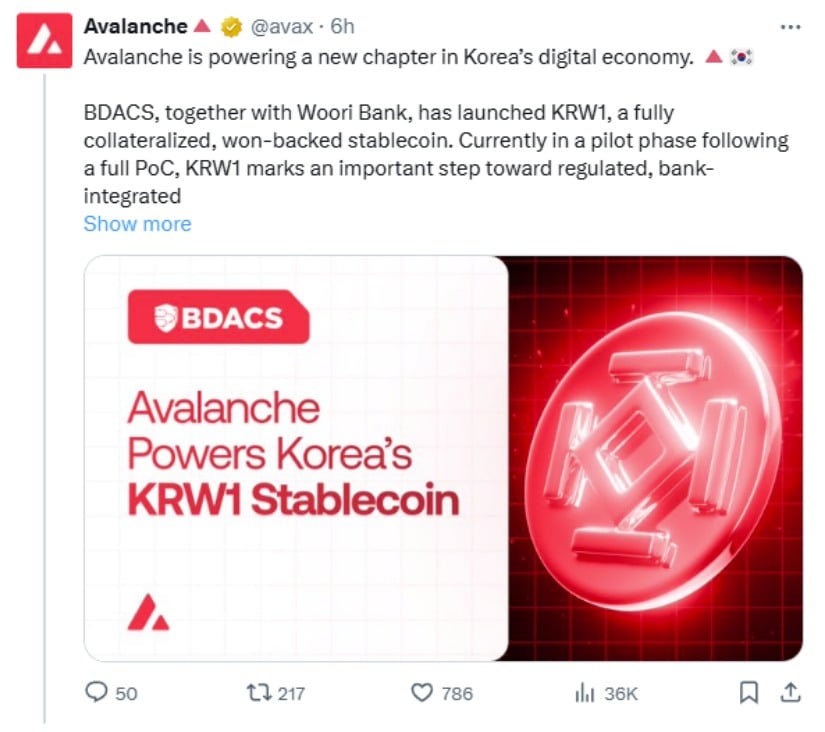
South Korea Launches First Won-Backed Stablecoin KRW1 on Avalanche

South Korea Launches First Won-Backed Stablecoin KRW1 on Avalanche

South Korea made history this week by launching its first Korean won-backed stablecoin.
Share
Brave Newcoin2025/09/19 03:15
Curve Finance votes on revenue-sharing model for CRV holders

Curve Finance votes on revenue-sharing model for CRV holders

The post Curve Finance votes on revenue-sharing model for CRV holders appeared on BitcoinEthereumNews.com. Curve Finance has proposed a new protocol called Yield Basis that would share revenue directly with CRV holders, marking a shift from one-off incentives to sustainable income. Summary Curve Finance has put forward a revenue-sharing protocol to give CRV holders sustainable income beyond emissions and fees. The plan would mint $60M in crvUSD to seed three Bitcoin liquidity pools (WBTC, cbBTC, tBTC), with 35–65% of revenue distributed to veCRV stakers. The DAO vote runs from up to Sept. 24, with the proposal seen as a major step to strengthen CRV tokenomics after past liquidity and governance challenges. Curve Finance founder Michael Egorov has introduced a proposal to give CRV token holders a more direct way to earn income, launching a system called Yield Basis that aims to turn the governance token into a sustainable, yield-bearing asset.  The proposal has been published on the Curve DAO (CRV) governance forum, with voting open until Sept. 24. A new model for CRV rewards Yield Basis is designed to distribute transparent and consistent returns to CRV holders who lock their tokens for veCRV governance rights. Unlike past incentive programs, which relied heavily on airdrops and emissions, the protocol channels income from Bitcoin-focused liquidity pools directly back to token holders. To start, Curve would mint $60 million worth of crvUSD, its over-collateralized stablecoin, with proceeds allocated across three pools — WBTC, cbBTC, and tBTC — each capped at $10 million. 25% of Yield Basis tokens would be reserved for the Curve ecosystem, and between 35% and 65% of Yield Basis’s revenue would be given to veCRV holders. By emphasizing Bitcoin (BTC) liquidity and offering yields without the short-term loss risks associated with automated market makers, the protocol hopes to draw in professional traders and institutions. Context and potential impact on Curve Finance The proposal comes as Curve continues to modify…
Share
BitcoinEthereumNews2025/09/18 14:37