USDT prices have reportedly risen in Argentina as demand for US dollars rises in the Latin American nation. Criptonoticias reported that the price of USDT rose above the 1,280 peso mark on July 8. At the time of writing, that would price USDT at USD 1.02, rather than USD 1.00. The news comes just three months after the Lemon Cash platform, one of the country’s most popular crypto exchanges, recorded an all-time high for stablecoin purchases. The firm said that between April 14, between 10 am and 11 am, stablecoin transactions grew by more than 350% hour-on-hour. The USDT market cap over the past 12 months. (Source: CoinMarketCap) USDT: Argentina Demand Growing? The same crypto exchange said that stablecoin buying is a growing trend in Argentina. It announced that, in February this year, combined USD-pegged coin trading volumes were 2.5 times higher than the monthly average for 2024. Experts and media analysts in the nation have credited much of the rise to the Argentine government’s announcement on April 13 that it would lift a much-maligned cap on USD buying. The foreign exchange restrictions were first imposed back in 2019, when Buenos Aires attempted to address ballooning inflation rates and falling domestic investment rates. However, the newspaper La Nacion claimed that other factors are also at play. Fears of a peso devaluation remain high. And while the government has seemingly emerged victorious in its battle with hyperinflation, trust in the peso remains low. Argentina inflation tumbles to five-year-low 1.5% in boost for Milei https://t.co/bFXBMAODWD https://t.co/bFXBMAODWD — Reuters Politics (@ReutersPolitics) June 13, 2025 Dollarization Plans Still in Play? Ahead of his election in 2023, President Javier Milei promised to scrap the Argentine peso and dollarize the country’s economy. Media outlets also pointed to growing “uncertainty” ahead of legislative elections slated for October 26. Criptonoticias wrote that “many savers are seeking refuge in dollar-denominated assets in the face of possible changes in the government’s economic direction.” However, experts also pointed to new Christmas bonus rules, which this year saw companies pay their employees bonuses in June. This has led many to invest surplus funds in assets they think can store value in the medium and long term. For many, this is the US dollar. But for others, it is Bitcoin (BTC) , which also remains popular in Argentina. Many traders use USDT and other USD-pegged coins to buy and sell BTC. USDT prices versus the Argentine Peso over the past month. (Source: Google Finance) However, others explained that FOMO (fear of missing out) may also be driving the dollar market. The concept of the “ dólar barato ” (literally: “cheap dollar”) appears to have taken root in the Argentinian markets. An acceleration of the agricultural sector’s liquidation process was cited as another factor. This refers to a recurring Argentine economic phenomenon whereby farmers and exporters convert their foreign currency earnings from agricultural exports into fiat pesos. The consulting firm Ecolatina explained to La Nation: “The acceleration of the agricultural sector’s liquidation is occurring amid two factors. First, increased seasonal demand from individuals during the Christmas bonus season. And second, a deterioration in expectations [as savers think about the] ‘day after the agricultural sector’s liquidation.’ This anticipates higher demand at a time when the dollar is perceived as cheap. And that, in turn, creates a self-fulfilling prophecy.” President Javier Milei is counting on a shale-oil boom in Argentina to cement his libertarian economic reforms https://t.co/djmmzH5npj — Bloomberg (@business) July 6, 2025 Black Market USD Prices Also Climbing Criptonoticias, meanwhile, explained that “dólar barato” sees savers “buy to protect themselves, which in turn increases demand and pushes the price up.” In other words, the outlet concluded, “the rise ultimately occurs because of the trading activity of people who anticipate” a rise in USD prices. La Nacion explained that black market dollar prices are also on the rise, climbing 3.25% from July 4 to July 7. The rate if MEP dollar, which is used to legally dollarize savings as an emergency measure, climbed 2.4% from ARS 29.52 to ARS 1,276.44 in the same period. Earlier this month, the USDT operator Tether announced it was exploring a joint Bitcoin mining project powered by Brazilian renewable energy sources .USDT prices have reportedly risen in Argentina as demand for US dollars rises in the Latin American nation. Criptonoticias reported that the price of USDT rose above the 1,280 peso mark on July 8. At the time of writing, that would price USDT at USD 1.02, rather than USD 1.00. The news comes just three months after the Lemon Cash platform, one of the country’s most popular crypto exchanges, recorded an all-time high for stablecoin purchases. The firm said that between April 14, between 10 am and 11 am, stablecoin transactions grew by more than 350% hour-on-hour. The USDT market cap over the past 12 months. (Source: CoinMarketCap) USDT: Argentina Demand Growing? The same crypto exchange said that stablecoin buying is a growing trend in Argentina. It announced that, in February this year, combined USD-pegged coin trading volumes were 2.5 times higher than the monthly average for 2024. Experts and media analysts in the nation have credited much of the rise to the Argentine government’s announcement on April 13 that it would lift a much-maligned cap on USD buying. The foreign exchange restrictions were first imposed back in 2019, when Buenos Aires attempted to address ballooning inflation rates and falling domestic investment rates. However, the newspaper La Nacion claimed that other factors are also at play. Fears of a peso devaluation remain high. And while the government has seemingly emerged victorious in its battle with hyperinflation, trust in the peso remains low. Argentina inflation tumbles to five-year-low 1.5% in boost for Milei https://t.co/bFXBMAODWD https://t.co/bFXBMAODWD — Reuters Politics (@ReutersPolitics) June 13, 2025 Dollarization Plans Still in Play? Ahead of his election in 2023, President Javier Milei promised to scrap the Argentine peso and dollarize the country’s economy. Media outlets also pointed to growing “uncertainty” ahead of legislative elections slated for October 26. Criptonoticias wrote that “many savers are seeking refuge in dollar-denominated assets in the face of possible changes in the government’s economic direction.” However, experts also pointed to new Christmas bonus rules, which this year saw companies pay their employees bonuses in June. This has led many to invest surplus funds in assets they think can store value in the medium and long term. For many, this is the US dollar. But for others, it is Bitcoin (BTC) , which also remains popular in Argentina. Many traders use USDT and other USD-pegged coins to buy and sell BTC. USDT prices versus the Argentine Peso over the past month. (Source: Google Finance) However, others explained that FOMO (fear of missing out) may also be driving the dollar market. The concept of the “ dólar barato ” (literally: “cheap dollar”) appears to have taken root in the Argentinian markets. An acceleration of the agricultural sector’s liquidation process was cited as another factor. This refers to a recurring Argentine economic phenomenon whereby farmers and exporters convert their foreign currency earnings from agricultural exports into fiat pesos. The consulting firm Ecolatina explained to La Nation: “The acceleration of the agricultural sector’s liquidation is occurring amid two factors. First, increased seasonal demand from individuals during the Christmas bonus season. And second, a deterioration in expectations [as savers think about the] ‘day after the agricultural sector’s liquidation.’ This anticipates higher demand at a time when the dollar is perceived as cheap. And that, in turn, creates a self-fulfilling prophecy.” President Javier Milei is counting on a shale-oil boom in Argentina to cement his libertarian economic reforms https://t.co/djmmzH5npj — Bloomberg (@business) July 6, 2025 Black Market USD Prices Also Climbing Criptonoticias, meanwhile, explained that “dólar barato” sees savers “buy to protect themselves, which in turn increases demand and pushes the price up.” In other words, the outlet concluded, “the rise ultimately occurs because of the trading activity of people who anticipate” a rise in USD prices. La Nacion explained that black market dollar prices are also on the rise, climbing 3.25% from July 4 to July 7. The rate if MEP dollar, which is used to legally dollarize savings as an emergency measure, climbed 2.4% from ARS 29.52 to ARS 1,276.44 in the same period. Earlier this month, the USDT operator Tether announced it was exploring a joint Bitcoin mining project powered by Brazilian renewable energy sources .

USDT Prices Surge in Argentina as Dollar Demand Spikes

3 min read

USDT prices have reportedly risen in Argentina as demand for US dollars rises in the Latin American nation.

Criptonoticias reported that the price of USDT rose above the 1,280 peso mark on July 8. At the time of writing, that would price USDT at USD 1.02, rather than USD 1.00.

The news comes just three months after the Lemon Cash platform, one of the country’s most popular crypto exchanges, recorded an all-time high for stablecoin purchases.

The firm said that between April 14, between 10 am and 11 am, stablecoin transactions grew by more than 350% hour-on-hour.
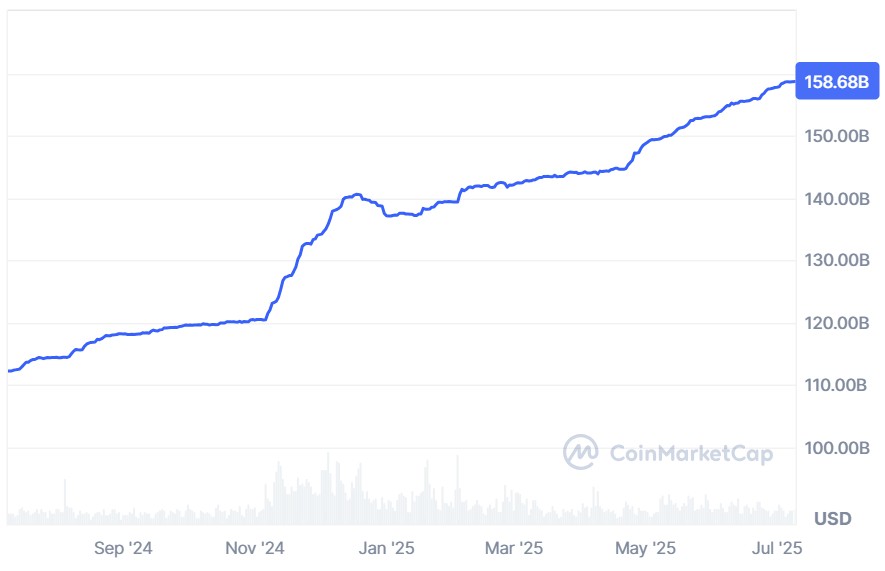
A graph showing the USDT market cap over the past 12 months.The USDT market cap over the past 12 months. (Source: CoinMarketCap)

USDT: Argentina Demand Growing?

The same crypto exchange said that stablecoin buying is a growing trend in Argentina. It announced that, in February this year, combined USD-pegged coin trading volumes were 2.5 times higher than the monthly average for 2024.

Experts and media analysts in the nation have credited much of the rise to the Argentine government’s announcement on April 13 that it would lift a much-maligned cap on USD buying.

The foreign exchange restrictions were first imposed back in 2019, when Buenos Aires attempted to address ballooning inflation rates and falling domestic investment rates.

However, the newspaper La Nacion claimed that other factors are also at play.

Fears of a peso devaluation remain high. And while the government has seemingly emerged victorious in its battle with hyperinflation, trust in the peso remains low.

Dollarization Plans Still in Play?

Ahead of his election in 2023, President Javier Milei promised to scrap the Argentine peso and dollarize the country’s economy.

Media outlets also pointed to growing “uncertainty” ahead of legislative elections slated for October 26.

Criptonoticias wrote that “many savers are seeking refuge in dollar-denominated assets in the face of possible changes in the government’s economic direction.”

However, experts also pointed to new Christmas bonus rules, which this year saw companies pay their employees bonuses in June.

This has led many to invest surplus funds in assets they think can store value in the medium and long term.

For many, this is the US dollar. But for others, it is Bitcoin (BTC), which also remains popular in Argentina.

Many traders use USDT and other USD-pegged coins to buy and sell BTC.

A graph showing USDT prices versus the Argentine Peso over the past month.USDT prices versus the Argentine Peso over the past month. (Source: Google Finance)

However, others explained that FOMO (fear of missing out) may also be driving the dollar market.

The concept of the “dólar barato” (literally: “cheap dollar”) appears to have taken root in the Argentinian markets.

An acceleration of the agricultural sector’s liquidation process was cited as another factor.

This refers to a recurring Argentine economic phenomenon whereby farmers and exporters convert their foreign currency earnings from agricultural exports into fiat pesos. The consulting firm Ecolatina explained to La Nation:

Black Market USD Prices Also Climbing

Criptonoticias, meanwhile, explained that “dólar barato” sees savers “buy to protect themselves, which in turn increases demand and pushes the price up.”

In other words, the outlet concluded, “the rise ultimately occurs because of the trading activity of people who anticipate” a rise in USD prices.

La Nacion explained that black market dollar prices are also on the rise, climbing 3.25% from July 4 to July 7.

The rate if MEP dollar, which is used to legally dollarize savings as an emergency measure, climbed 2.4% from ARS 29.52 to ARS 1,276.44 in the same period.

Earlier this month, the USDT operator Tether announced it was exploring a joint Bitcoin mining project powered by Brazilian renewable energy sources.

Market Opportunity
Threshold Logo
Threshold Price(T)
$0,008104
$0,008104$0,008104
-%0,36
USD
Threshold (T) Live Price Chart
Disclaimer: The articles reposted on this site are sourced from public platforms and are provided for informational purposes only. They do not necessarily reflect the views of MEXC. All rights remain with the original authors. If you believe any content infringes on third-party rights, please contact service@support.mexc.com for removal. MEXC makes no guarantees regarding the accuracy, completeness, or timeliness of the content and is not responsible for any actions taken based on the information provided. The content does not constitute financial, legal, or other professional advice, nor should it be considered a recommendation or endorsement by MEXC.

You May Also Like

Trump MAGA statue has strange crypto backstory

Trump MAGA statue has strange crypto backstory

The post Trump MAGA statue has strange crypto backstory appeared on BitcoinEthereumNews.com. A 15-foot-tall statue of former President Donald Trump, cast in bronze
Share
BitcoinEthereumNews2026/02/04 08:22
ABC Also Pulled Jimmy Kimmel’s Predecessor After Controversial Comments

ABC Also Pulled Jimmy Kimmel’s Predecessor After Controversial Comments

The post ABC Also Pulled Jimmy Kimmel’s Predecessor After Controversial Comments appeared on BitcoinEthereumNews.com. Jimmy Kimmel (Photo by Media Access Awards Presented By Easterseals/Getty Images for Easterseals) Getty Images for Easterseals The shock decision by ABC to pull Jimmy Kimmel Live! “indefinitely” after the late-night host’s remarks about the killing of Charlie Kirk has created a rare moment in modern TV media: A major show abruptly taken off the air, with its network forced into crisis-management mode. Rare, that is, but not unprecedented. What might go unnoticed by many people reacting to the news about Kimmel and his potential cancellation is that this is not the first time ABC has made such a move. In fact, a version of the same thing happened to Kimmel’s predecessor program — Bill Maher’s Politically Incorrect, which once had Kimmel’s slot and which ABC cancelled in the wake of a firestorm around comments Maher made in the immediate aftermath of the September 11 terrorist attacks. (Notice, by the way, that I said cancelled “in the wake of” and not “because of.” More on that in a moment.) Here’s what happened: Less than a week after 9/11, Maher and a panel were talking about then-President George W. Bush’s use of the word “cowards” to describe the hijackers. “We have been the cowards,” Maher interjected, referencing the practice of “lobbing cruise missiles from 2,000 miles away. That’s cowardly.” But Maher then went even farther over the line: Actually staying in an airplane as it hits a building? “Not cowardly.” You can read more about the ensuing uproar in this ABC news story from 2001, which includes a statement that Maher issued through his publicist: “In no way was I intending to say, nor have I ever thought, that the men and women who defend our nation in uniform are anything but courageous and valiant, and I offer my apologies to…
Share
BitcoinEthereumNews2025/09/18 11:02
The real-life inspiration for the protagonist of "The Big Short": Bitcoin crash may trigger a $1 billion gold and silver sell-off.

The real-life inspiration for the protagonist of "The Big Short": Bitcoin crash may trigger a $1 billion gold and silver sell-off.

PANews reported on February 4th that, according to CoinDesk, Michael Burry, the real-life inspiration for the character in "The Big Short" (and an investor who
Share
PANews2026/02/04 08:22