

Why A 24/7 Global Stock Market Is Impossible with Today’s Blockchain Technology
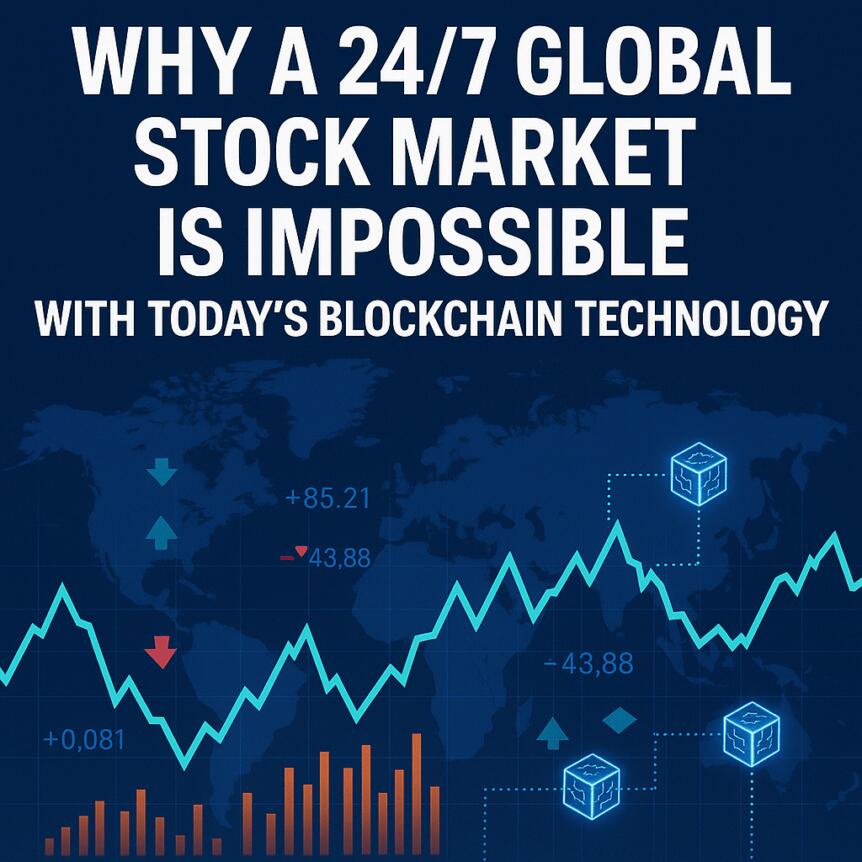
Revolutionizing Global Finance: The Critical Need for Blockchain Infrastructure Overhaul
The vision of a borderless, 24/7 financial market—where entities from Nebraska farmers to Tokyo pension funds trade seamlessly—remains a compelling future, yet it is hindered by current blockchain limitations. Despite rapid digitization of real-world assets, the infrastructure supporting these markets cannot sustain the scale, speed, and fairness necessary for institutional-grade trading. Addressing these issues is crucial for blockchain to fulfill its promise of transforming global finance.
Key Takeaways
- Current blockchain networks cannot handle the transaction volume required for real-world asset trading.
- Latency and unpredictable finality hinder efficient price discovery and high-frequency trading.
- Market manipulation through frontrunning and MEV erodes fairness for both institutions and retail traders.
- Building scalable, fair, and interoperable infrastructure is essential for mainstream adoption and confidence in tokenized assets.
Tickers mentioned: None
Sentiment: Cautiously optimistic
Price impact: Neutral. Industry skepticism persists due to technical limitations, despite growing interest.
Market context: Traditional finance is increasingly paying attention to tokenization but remains wary of blockchain’s current constraints.
The Blockchain Bottleneck
Although the digitization of real-world assets—such as stocks, bonds, and commodities—accelerates, fundamental issues plague blockchain infrastructure, impeding its adoption for high-stakes trading. Layer-1 blockchains like Bitcoin and Ethereum, while pioneering, struggle with capacity, latency, and vulnerability to market manipulation.
One primary obstacle is throughput: existing networks cannot process the millions of daily trades at the precision and speed demanded by institutional participants. When a popular asset launch causes hours of congestion, it exposes the inadequacy of current infrastructure. Latency issues further impair real-time trading, with slow block times and uncertain finality creating significant hurdles for high-frequency strategies and arbitrage opportunities.
Another critical concern is market fairness. The prevalence of Maximal Extractable Value (MEV)—a form of front-running—allows sophisticated bots to manipulate transaction ordering, undermining transparency and trust. This environment discourages institutional investment, as traders face unpredictable execution and potential exploitation.
Consequences and the Path Forward
For institutions, the current risks of transaction failure and manipulation are unacceptable. They require reliable execution and transparent protocols to consider deploying significant capital into blockchain-based assets. Retail traders face a similar predicament, with the deck increasingly stacked against fairness—recreating traditional financial inequalities and systemic biases.
While traditional finance begins to recognize the potential of tokenization, each failed trade or congestion event adds to skepticism. The industry needs a paradigm shift—an overhaul that prioritizes scalability and fairness. Building on high-throughput networks like Solana demonstrates the possibility, but what is needed is a new class of infrastructure capable of processing over 100,000 transactions per second with sub-second finality.
Fundamental redesign must focus on protocol-level fairness, ensuring first-come, first-served transaction ordering to eliminate malicious MEV. Seamless liquidity transfer across ecosystems is equally vital, enabling assets to move atomically without fragmentation. The existing technical architectures, including layered execution models compatible with ecosystems like the Solana Virtual Machine, provide a foundation for this transformation.
Incremental solutions will not suffice. A comprehensive rebirth of blockchain infrastructure is imperative to realize the full potential of tokenized assets. With the right foundation, a true 24/7 global market can become a reality, unlocking trillions in value and reshaping the future of finance.
Opinion by: Joshua Sum, head of product at Solayer Labs.
This article was originally published as Why A 24/7 Global Stock Market Is Impossible with Today’s Blockchain Technology on Crypto Breaking News – your trusted source for crypto news, Bitcoin news, and blockchain updates.
You May Also Like
Nasdaq and CME Launch New Nasdaq-CME Crypto Index—A Game-Changer in Digital Assets

CME to launch Solana and XRP futures options on October 13, 2025
