

NCAA Demands CFTC Halt $320M College Sports Betting Markets—Citing Student Safety
The National Collegiate Athletic Association has asked the US Commodity Futures Trading Commission to immediately suspend college sports prediction markets, warning that the fast-growing sector is exposing student-athletes to heightened risks and undermining the integrity of college competition.
The request targets an estimated $320 million in active college sports markets, a figure that reflects how quickly prediction platforms have expanded into territory long dominated by regulated sportsbooks.
As Prediction Markets Grow, NCAA Pushes for Safeguards
In a letter dated January 14, 2026, NCAA President Charlie Baker urged CFTC Chairman Michael Selig to halt collegiate sports prediction trading until stronger safeguards are put in place.
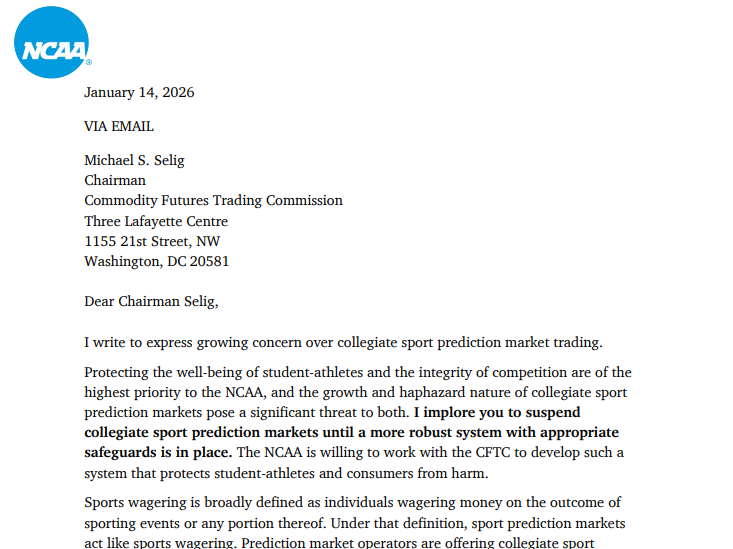 Source: NCAA
Baker argued that although prediction markets are often framed as financial products, many now function in practice like sports wagering.
NCAA noted that platforms are offering moneyline, spread, and total markets on college games that closely mirror traditional betting, while operating under a lighter regulatory framework.
The timing of the letter comes as prediction markets experience explosive growth. Total daily trading volume across major platforms reached a record $701.7 million on January 12, with sports accounting for a growing share of activity.
 Source: Dune analysis
Platforms such as Kalshi and Polymarket together processed tens of billions of dollars in trades during 2025, and sports markets now represent roughly three-quarters of Kalshi’s weekly volume and nearly 40% of Polymarket’s.
That scale has drawn institutional interest, but it has also raised alarms among regulators and sports bodies.
At the center of the NCAA’s concern is student safety. Baker warned that college prediction markets often allow participants as young as 18, compared with the 21-and-over requirement in most states for sports betting.
NCAA surveys show that 58 percent of individuals aged 18 to 22 have participated in sports betting, with a significant portion reporting academic, financial, and mental health consequences.
The letter also highlighted gaps in advertising rules. While sportsbooks face restrictions on marketing to college campuses, similar limits do not consistently apply to prediction markets.
The NCAA said some students may mistakenly view prediction trading as a form of investing rather than gambling, despite the inherent unpredictability of sports outcomes.
NCAA Cites Harassment and Integrity Gaps in College Prediction Platforms
That framing, Baker argued, increases the risk of excessive participation and financial harm.
Integrity monitoring was another key issue, as the NCAA monitors more than 23,000 contests annually for suspicious activity and relies on detailed data, including bettor geolocation, to investigate irregularities.
Baker said many prediction platforms lack this level of oversight and are not required to share integrity alerts with other operators or governing bodies.
He pointed to recent efforts by prediction platforms to seek approval for markets tied to the college transfer portal as an example of activity that could create severe risks for athletes if left unchecked.
The NCAA also raised concerns about harassment, as Baker said student-athletes frequently report abuse from bettors, including online harassment tied to game outcomes.
He argued that prediction markets should be required to enforce anti-harassment measures across platforms, including banning participants who target athletes.
Harm reduction resources were also cited as missing, with the NCAA noting that many states direct sportsbook revenue toward gambling education and treatment programs on campuses, a mechanism that prediction markets do not consistently provide.
The request places the CFTC in a difficult position, as prediction markets fall under federal commodities law rather than state gambling statutes, and the agency has previously approved certain sports-related contracts.
However, the rapid growth of college-focused markets and the entry of major sports betting and fantasy operators into the space have intensified scrutiny.
You May Also Like

Trump MAGA statue has strange crypto backstory

ABC Also Pulled Jimmy Kimmel’s Predecessor After Controversial Comments
