The post SEI Price Prediction 2026: Can the Token Reclaim $1? appeared first on Coinpedia Fintech News Amid the chaos and volatility of popular tokens like BitcoinThe post SEI Price Prediction 2026: Can the Token Reclaim $1? appeared first on Coinpedia Fintech News Amid the chaos and volatility of popular tokens like Bitcoin

SEI Price Prediction 2026: Can the Token Reclaim $1?
2026/01/24 13:09
4 min read
SEI Price Prediction 2025: Is SEI Crypto Ready for a Double-Bottom 400% Reversal?

The post SEI Price Prediction 2026: Can the Token Reclaim $1? appeared first on Coinpedia Fintech News

Amid the chaos and volatility of popular tokens like Bitcoin, XRP, and memecoins, here is an altcoin building a stronger base. SEI, built by combining the network effects of Ethereum and Solana, is set to outperform all major cryptos in the coming days. The ecosystem is getting upgraded, as the on-chain data suggests a steady growth in user participation. Put together, the SEI price could be the next big thing in the crypto space as it is approaching the edge of the consolidation. 

What’s Happening Within the Sei Ecosystem?

Sei is entering an high impact transition phase where the tech roadmap and liquidity flows have grabbed more attention. The ecosystem aims to simplify the building and improve the performance, which may attract short-term friction. Here’s what’s happening within the Sei ecosystem that may impact the price in the near term. 

  • Sei is pivoting toward an EVM-only chain (SIP-3 / “Giga” direction): staking via EVM first, then inbound IBC transfers get disabled, followed by a broader IBC wind-down.
  • The IBC shutdown forces a liquidity/migration moment: users holding Cosmos-native assets on Sei (often cited: USDC.n) are being pushed to migrate to native USDC ahead of the cutoff window.
  • Narrative shift: Sei is positioned as a performance-first EVM L1 (simpler stack, faster execution), instead of a dual Cosmos+EVM identity.
  • Infra/tooling push: ecosystem messaging is emphasising stronger RPC + dev tooling + wallet onboarding (bigger “plug-and-play” stack for EVM builders).

Sei is in a transition-heavy phase where the story isn’t just “new upgrades,” but how liquidity behaves during the shift. On-chain, the network is still relatively small but active: Sei has ~$128.22M in TVL, ~$67.11M in stablecoins (down 6.12% over 7 days), and ~$2.07M in net inflows over the last 24 hours. Trading activity is notable too—DEX volume is ~$21.59M (24h) and ~$141.31M (7d) (up 25.98% WoW), while perps volume is ~$19.33M (24h) and ~$134.39M (7d) (down 1.84% WoW). On the monetisation side, Sei is seeing ~$13,832 in app fees (24h) versus ~$311 in chain fees (24h)—a split that’s useful for judging where real usage is showing up. 

SEI Price Prediction: Will it Reach $1 in 2026?

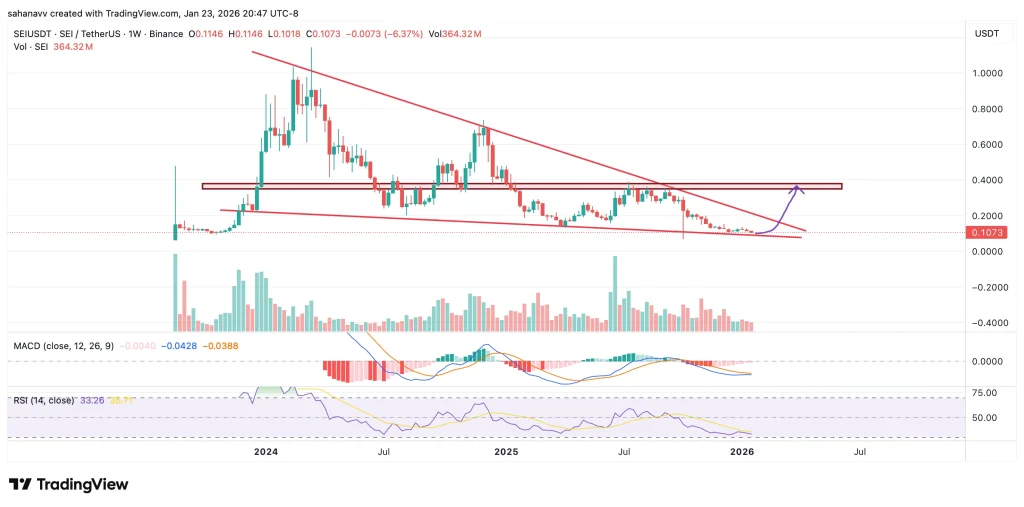
SEI gained immense popularity in the first few days of its trade, when the price reached the highs above $1.14. Since then, the rally has been forming consecutive lower highs and lows as the bears have been dominating. However, the bearish influence over the token could ease in the coming days, as the rally is approaching the edge of the consolidation. 

SEI’s weekly chart shows a market that has been compressing for months as price trends lower within a broad descending structure. After a strong 2024 expansion, momentum has steadily faded, pushing SEI back toward long-term support near the $0.10–$0.12 region. This zone now sits at the intersection of historical demand and a falling trendline, making it a critical area where the next medium-term directional move is likely to be decided.
sei price

Technically, SEI remains below a long-term descending resistance, with repeated failures near the $0.35–$0.40 supply zone confirming seller control. Price is currently hugging trendline support, while RSI stays weak near the low 30s, suggesting bearish momentum but also growing downside exhaustion. MACD remains negative, though selling pressure is slowing. A sustained bounce from this base could trigger a relief rally toward resistance, while a clean breakdown would expose new cycle lows.

Will the SEI Price Reach $1 in 2026?

SEI reaching $1 in 2026 is possible, but it’s not the base case from this chart. Price is still in a long-term downtrend and sitting near support, so the first job is to reclaim and hold the $0.35–$0.40 supply zone. For a $1 run, SEI likely needs a clean trend reversal, rising liquidity (stablecoins), and sustained app usage, plus a supportive broader market. If the rally fails at resistance, $1 stays a stretch target.

Disclaimer: The articles reposted on this site are sourced from public platforms and are provided for informational purposes only. They do not necessarily reflect the views of MEXC. All rights remain with the original authors. If you believe any content infringes on third-party rights, please contact service@support.mexc.com for removal. MEXC makes no guarantees regarding the accuracy, completeness, or timeliness of the content and is not responsible for any actions taken based on the information provided. The content does not constitute financial, legal, or other professional advice, nor should it be considered a recommendation or endorsement by MEXC.

You May Also Like

The Channel Factories We’ve Been Waiting For

The Channel Factories We’ve Been Waiting For

The post The Channel Factories We’ve Been Waiting For appeared on BitcoinEthereumNews.com. Visions of future technology are often prescient about the broad strokes while flubbing the details. The tablets in “2001: A Space Odyssey” do indeed look like iPads, but you never see the astronauts paying for subscriptions or wasting hours on Candy Crush.  Channel factories are one vision that arose early in the history of the Lightning Network to address some challenges that Lightning has faced from the beginning. Despite having grown to become Bitcoin’s most successful layer-2 scaling solution, with instant and low-fee payments, Lightning’s scale is limited by its reliance on payment channels. Although Lightning shifts most transactions off-chain, each payment channel still requires an on-chain transaction to open and (usually) another to close. As adoption grows, pressure on the blockchain grows with it. The need for a more scalable approach to managing channels is clear. Channel factories were supposed to meet this need, but where are they? In 2025, subnetworks are emerging that revive the impetus of channel factories with some new details that vastly increase their potential. They are natively interoperable with Lightning and achieve greater scale by allowing a group of participants to open a shared multisig UTXO and create multiple bilateral channels, which reduces the number of on-chain transactions and improves capital efficiency. Achieving greater scale by reducing complexity, Ark and Spark perform the same function as traditional channel factories with new designs and additional capabilities based on shared UTXOs.  Channel Factories 101 Channel factories have been around since the inception of Lightning. A factory is a multiparty contract where multiple users (not just two, as in a Dryja-Poon channel) cooperatively lock funds in a single multisig UTXO. They can open, close and update channels off-chain without updating the blockchain for each operation. Only when participants leave or the factory dissolves is an on-chain transaction…
Share
BitcoinEthereumNews2025/09/18 00:09
Polygon Tops RWA Rankings With $1.1B in Tokenized Assets

Polygon Tops RWA Rankings With $1.1B in Tokenized Assets

The post Polygon Tops RWA Rankings With $1.1B in Tokenized Assets appeared on BitcoinEthereumNews.com. Key Notes A new report from Dune and RWA.xyz highlights Polygon’s role in the growing RWA sector. Polygon PoS currently holds $1.13 billion in RWA Total Value Locked (TVL) across 269 assets. The network holds a 62% market share of tokenized global bonds, driven by European money market funds. The Polygon POL $0.25 24h volatility: 1.4% Market cap: $2.64 B Vol. 24h: $106.17 M network is securing a significant position in the rapidly growing tokenization space, now holding over $1.13 billion in total value locked (TVL) from Real World Assets (RWAs). This development comes as the network continues to evolve, recently deploying its major “Rio” upgrade on the Amoy testnet to enhance future scaling capabilities. This information comes from a new joint report on the state of the RWA market published on Sept. 17 by blockchain analytics firm Dune and data platform RWA.xyz. The focus on RWAs is intensifying across the industry, coinciding with events like the ongoing Real-World Asset Summit in New York. Sandeep Nailwal, CEO of the Polygon Foundation, highlighted the findings via a post on X, noting that the TVL is spread across 269 assets and 2,900 holders on the Polygon PoS chain. The Dune and https://t.co/W6WSFlHoQF report on RWA is out and it shows that RWA is happening on Polygon. Here are a few highlights: – Leading in Global Bonds: Polygon holds 62% share of tokenized global bonds (driven by Spiko’s euro MMF and Cashlink euro issues) – Spiko U.S.… — Sandeep | CEO, Polygon Foundation (※,※) (@sandeepnailwal) September 17, 2025 Key Trends From the 2025 RWA Report The joint publication, titled “RWA REPORT 2025,” offers a comprehensive look into the tokenized asset landscape, which it states has grown 224% since the start of 2024. The report identifies several key trends driving this expansion. According to…
Share
BitcoinEthereumNews2025/09/18 00:40
Explosive 25% Penalty On Nations Trading With Tehran

Explosive 25% Penalty On Nations Trading With Tehran

The post Explosive 25% Penalty On Nations Trading With Tehran appeared on BitcoinEthereumNews.com. Trump Iran Tariffs: Explosive 25% Penalty On Nations Trading
Share
BitcoinEthereumNews2026/02/07 08:10