Jupiter (JUP) Price Prediction 2026, 2027 – 2030: Can JUP Hit $10 by 2030?

The post Jupiter (JUP) Price Prediction 2026, 2027 – 2030: Can JUP Hit $10 by 2030? appeared first on Coinpedia Fintech News
Story Highlights
- The Jupiter price today is $ 0.19539798.
- Price predictions for 2026 range from $0.60 to $4.00.
- JUP could extend toward $10 by 2030, if the recovery structure holds.
Jupiter (JUP), a leading liquidity aggregation protocol within the Solana ecosystem, enters February at a point where fundamentals and technicals are beginning to converge. On the fundamental side, Jupiter continues to remain a core piece of Solana’s on-chain trading infrastructure, maintaining relevance even as broader market participation cooled. On the technical side, JUP’s price action has shifted noticeably over recent months from persistent decline to a more controlled, range-bound phase.
After an extended post-launch correction, the token is no longer experiencing aggressive sell-offs. Instead, price volatility has compressed, and reactions around key demand zones have become more consistent. This combination often reflects a market transitioning from distribution into accumulation. As February begins, attention is now focused on whether JUP can sustain this stabilization phase and begin laying the groundwork for a longer-term recovery cycle extending into 2026 and beyond.
Jupiter Price Today
| Cryptocurrency | Jupiter |
| Token | JUP |
| Price | $0.1954  6.86% 6.86% |
| Market Cap | $ 633,849,805.89 |
| 24h Volume | $ 79,905,137.3728 |
| Circulating Supply | 3,243,891,294.88 |
| Total Supply | 6,863,982,813.3681 |
| All-Time High | $ 2.0433 on 31 January 2024 |
| All-Time Low | $ 0.1300 on 10 October 2025 |
Table of contents
- Jupiter (JUP) Price February 2026 Outlook
- Jupiter (JUP) Price Prediction 2026
- Jupiter Crypto Price Prediction 2026 – 2030
- Jupiter Price Prediction 2026
- Jupiter Crypto Forecast 2027
- Jupiter Token Price Outlook 2028
- Jupiter Coin Future Prediction 2029
- Jupiter Price Prediction 2030
- Jupiter Price Prediction 2031, 2032, 2033, 2040, 2050
- Jupiter (JUP) Price Prediction: Market Analysis?
- CoinPedia’s Jupiter Price Prediction
- FAQs
Jupiter (JUP) Price February 2026 Outlook
February is shaping up to be a confirmation month rather than a breakout month for Jupiter. Current price behavior suggests that the market is prioritizing balance, with buyers and sellers testing levels without committing to large directional bets. If JUP continues to hold above its recent demand zone, February could reinforce the view that downside risk is diminishing.
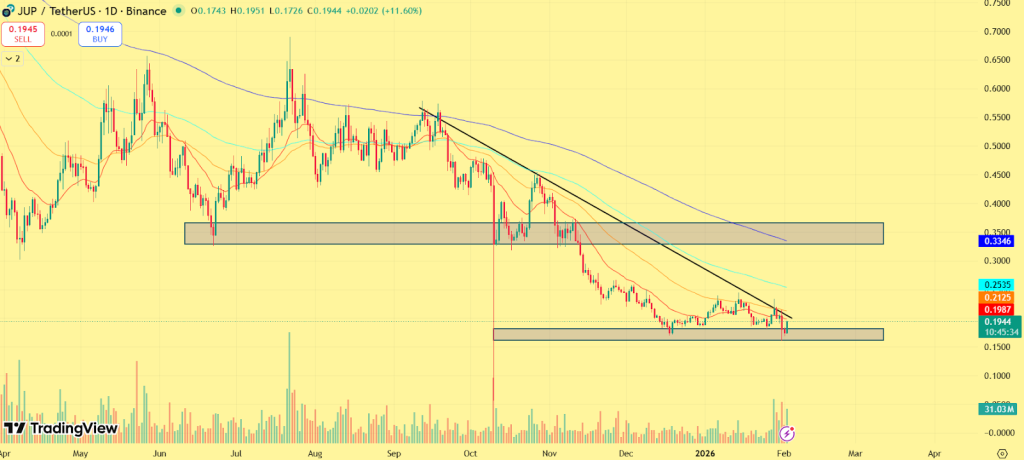
This type of behavior is often seen before broader trend development, even if price remains visually unimpressive in the short term. However, if price loses support decisively during February, it would likely extend the consolidation phase rather than trigger a fresh collapse. At this stage, the technical bias favors range continuation with improving stability, not renewed distribution. By the end of this month, JUP may cross the next hurdle of $0.4000.
Jupiter (JUP) Price Prediction 2026
Looking ahead, 2026 appears to be a structural transition year for Jupiter, rather than a year of immediate price euphoria. The prolonged consolidation seen so far suggests that speculative excess has largely been absorbed, allowing price to begin rebuilding from a more stable foundation.
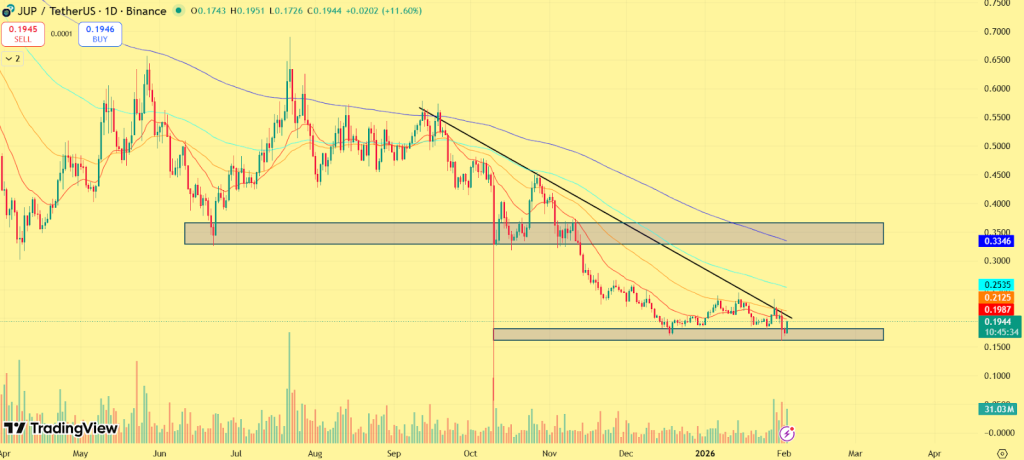
In the first half of 2026, JUP is likely to continue oscillating within a broad range as long-term participants accumulate and short-term traders test resistance levels. This phase is crucial, as it determines whether Jupiter can convert prior resistance into sustainable support. If JUP manages to reclaim higher levels and hold above key breakout zones later in the year, price could begin transitioning into an early expansion phase. This would likely unfold gradually, marked by higher lows and improving trend structure rather than sharp vertical moves. By the end of 2026, Jupiter price may reach a potential high of $4.00.
Jupiter Crypto Price Prediction 2026 – 2030
| Year | Potential Low ($) | Potential Average ($ | Potential High ($) |
| 2026 | 0.60 | 1.60 | 4.00 |
| 2027 | 1.70 | 3.60 | 5.00 |
| 2028 | 2.50 | 4.50 | 6.80 |
| 2029 | 3.50 | 6.20 | 8.50 |
| 2030 | 4.00 | 7.50 | 10.00 |
Jupiter Price Prediction 2026
The Jupiter price range in 2026 is expected to be between $0.60 and $4.00.
Jupiter Crypto Forecast 2027
Jupiter (JUP) price range can be between $1.70 to $5.00 during the year 2027.
Jupiter Token Price Outlook 2028
In 2028, Jupiter price is forecasted to potentially reach a low price of $2.50 and a high price of $6.80.
Jupiter Coin Future Prediction 2029
Thereafter, the Jupiter (JUP) price for the year 2029 could range between $3.50 and $8.50.
Jupiter Price Prediction 2030
Finally, in 2030, the price of Jupiter is predicted to maintain a steady positive. It may trade between $4.00 and $10.00.
Jupiter Price Prediction 2031, 2032, 2033, 2040, 2050
Based on the historic data and trend analysis of the cryptocurrency along with the market sentiments, here are the possible Jupiter price targets for the longer time frames.
| Year | Potential Low ($) | Potential Average ($) | Potential High ($) |
| 2031 | 480 | 8.50 | 11.90 |
| 2032 | 5.60 | 10.00 | 13.80 |
| 2033 | 6.40 | 11.30 | 15.60 |
| 2040 | 9.50 | 17.20 | 25.00 |
| 2050 | 14.00 | 26.00 | 40.00 |
Jupiter (JUP) Price Prediction: Market Analysis?
| Year | 2026 | 2027 | 2030 |
| Changelly | $2.00 | $4.30 | $8.00 |
| CoinCodex | $2.80 | $5.00 | $8.20 |
| WalletInvestor | $4.00 | $6.00 | $12 |
CoinPedia’s Jupiter Price Prediction
Coinpedia’s price prediction indicates that Jupiter is currently transitioning from a prolonged corrective phase into early-stage accumulation. If JUP maintains stability above its demand zones and gradually reclaims resistance levels, we expect the token to trade toward $3+ during 2026, with the potential to reach the $4–$10 range by 2030 under sustained market expansion.
| Year | Potential Low ($) | Potential Average ($) | Potential High ($) |
| 2026 | 0.60 | 1.60 | 4.00 |
Never Miss a Beat in the Crypto World!
Stay ahead with breaking news, expert analysis, and real-time updates on the latest trends in Bitcoin, altcoins, DeFi, NFTs, and more.
 Subscribe to Price Prediction
FAQs
Jupiter is Solana’s leading liquidity aggregator, helping traders get the best swap prices by routing trades across multiple on-chain venues efficiently.
Jupiter’s 2026 price is projected to range between $0.60 and $4.00, depending on market conditions and its ability to hold long-term support.
By 2030, Jupiter could trade between $4.00 and $10.00 if Solana adoption grows and JUP maintains its role in on-chain liquidity.
Long-term projections suggest Jupiter may reach up to $25 by 2040, assuming sustained ecosystem relevance and broader crypto market expansion.
Jupiter can appeal long-term if Solana usage grows and liquidity demand rises, but like all crypto, it carries risk and requires careful research.
You May Also Like

SBI VC Trade Adds Litecoin to Japanese Lending Program

Work Dogs TGE Is Running — Is WD About to Drop in Q2 After March 30?