

$2.8 Billion Lost to Exploits Highlights Need for Chainlink’s Cross-Chain Solution
- The crypto market has lost over $15 billion to hackers, with a fifth of it lost in bridge exploits, which Chainlink says highlights the need for its cross-chain solution.
- Cross-chain interoperability only works if security is built in, moving away from centralized single points of failure, the network says.
The crypto market has continued to be a prime target for cyber criminals, who keep making away with billions of dollars every year. Cross-chain bridges are among the most vulnerable, and according to Chainlink, its cross-chain infrastructure is the ultimate solution.
In 2025, hackers stole $2.87 billion in 147 hacks, a new report by TRM Labs reveals. While it’s the lowest number of hacks in the past four years, the average per incident is the highest in three years at $19.5 million. The Bybit hack in February was the largest by far, with hackers stealing over $1.4 billion, as we reported.
Cumulatively, hackers have stolen $15.8 billion since 2016, data from DeFiLlama shows. DeFi is the most targeted ecosystem, losing over $7 billion to these criminals. In recent years, cross-chain bridges have become another goldmine for the hackers, with $2.89 billion lost.
 Data courtesy of DeFiLlama.
This is where Chainlink can provide a solution, the network says, adding, “Exploits are a problem that is solved through sound architecture and a rigorous security-first approach.”
A cross-chain bridge is a tool that allows users to move crypto assets or data from one chain to another. While there are dozens of bridges, Wormhole and LayerZero remain among the most popular.
As Chainlink points out, most bridges rely on one security layer with a small validator set, one oracle network and one relayer. This security is weak as validators can get hacked, or private keys can be leaked, and this would give hackers access to users’ assets.
Defense in depth is the best approach, with “multiple decentralized networks working to secure a single cross-chain transaction,” Chainlink says.
Chainlink’s CCIP Sets Industry Standard
The Cross-Chain Interoperability Protocol (CCIP) remains the industry standard for cross-chain messaging, Chainlink says. CCIP is the only defense-in-depth solution that offers multiple decentralized oracle networks to verify the cross-chain messages. If one oracle is compromised or sends the wrong data, the others can block it.
CCIP also offers configurable rate limits and circuit breakers which can pause a transfer midway if anything looks off. Other solutions only attend to the suspicious activity after the damage is done.
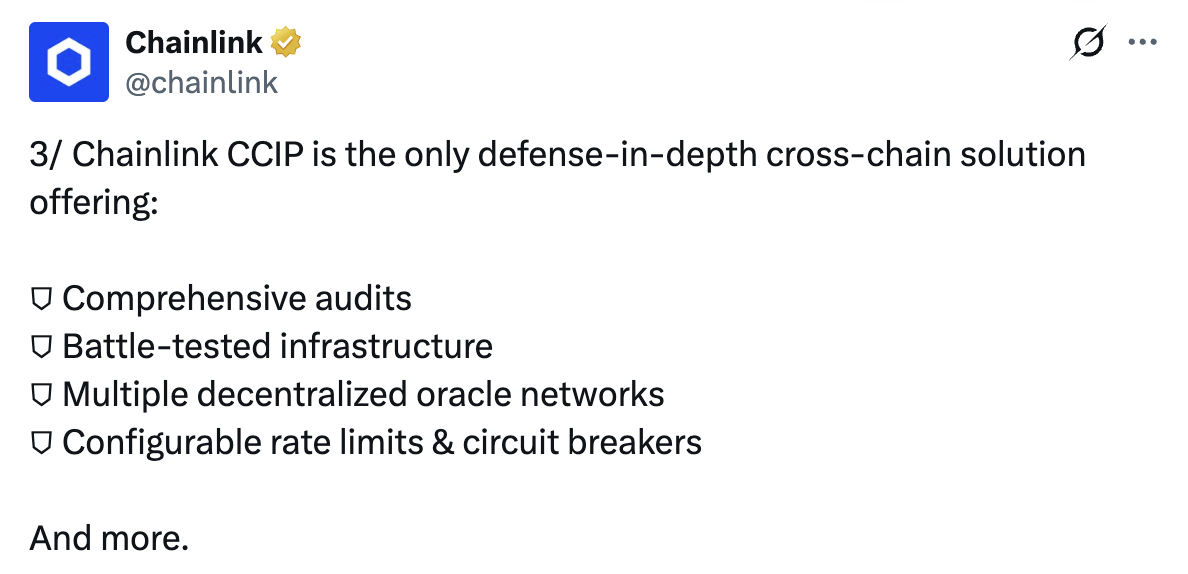 Image courtesy of Chainlink.
Chainlink’s infrastructure is already battle-tested and is used to secure most high-profile exchanges, DeFi platforms and crypto services. As we reported, it has enabled the movement of over $27 trillion and relayed 19 billion messages for over 2,500 projects.
LINK trades at $9.58, losing 19.2% in the past week for a $6.78 billion market cap.
]]>You May Also Like

Paxos launches new startup to help institutions offer DeFi products

Forward Industries Bets Big on Solana With $4B Capital Plan
