TLDR Gold prices surged 6% to $4,930.80 per ounce while silver jumped 12% to $86.64 on Tuesday after a devastating two-day crash The precious metals collapse sawTLDR Gold prices surged 6% to $4,930.80 per ounce while silver jumped 12% to $86.64 on Tuesday after a devastating two-day crash The precious metals collapse saw

Gold and Silver Stage Dramatic Recovery After Massive Selloff

3 min read

TLDR

  • Gold prices surged 6% to $4,930.80 per ounce while silver jumped 12% to $86.64 on Tuesday after a devastating two-day crash
  • The precious metals collapse saw gold drop 13% and silver plunge 33% following Kevin Warsh’s nomination as Federal Reserve chair
  • Friday’s gold decline was the steepest in over ten years, prompting widespread buying from investors seeking bargains
  • Deutsche Bank analysts stand by their $6,000 gold price target despite recent market turbulence
  • Major Chinese banks are imposing stricter controls on gold trading as volatility reaches extreme levels

Precious metals markets bounced back Tuesday with gold and silver posting strong gains after experiencing their worst decline in years. Gold futures climbed 6% to reach $4,930.80 per ounce. Silver futures soared 12% to $86.64 per ounce.
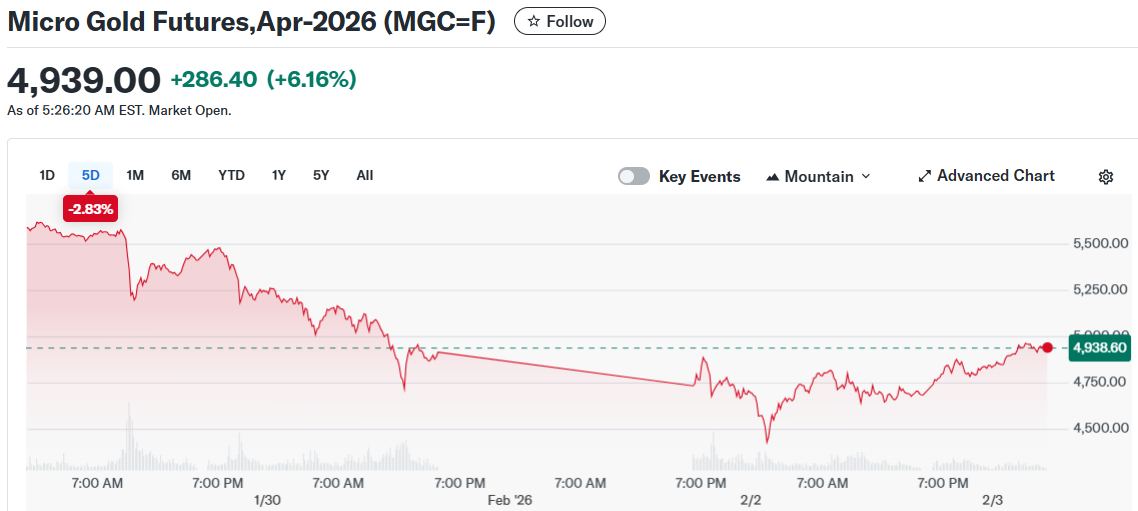
Micro Gold Futures,Apr-2026 (MGC=F)Micro Gold Futures,Apr-2026 (MGC=F)

The rebound came after a crushing two-day period that wiped trillions of dollars from precious metals valuations. Gold had tumbled more than 13% from its Thursday record of $5,626 per ounce. Silver suffered an even worse fate, crashing 33% during the same timeframe.

The selloff began when President Trump announced Kevin Warsh as his choice for Federal Reserve chair. Market participants viewed Warsh as less dovish compared to other candidates. This perception reduced investor appetite for gold as a protective asset.

The dollar strengthened following the announcement, adding pressure to precious metals prices. On Tuesday, the greenback gave back some gains with the DXY index dropping 0.2%. This currency weakness helped fuel the recovery in gold and silver.

Historic Price Swings Rock Markets

Friday’s gold price drop represented the largest single-day fall in more than a decade. The extreme move attracted bargain hunters looking to buy at reduced levels. Silver managed to push back above $87 per ounce during Tuesday’s session.

Analysts had cautioned that the preceding rally was unsustainable. Gold’s relative-strength index had climbed above 90 last Wednesday, far exceeding the 70 threshold that suggests overheated conditions. The indicator retreated to 54 by Tuesday.

Deutsche Bank remained optimistic about gold’s long-term prospects. Analyst Michael Hsueh wrote Monday that $6,000 per ounce remains achievable. “The conditions do not appear primed for a sustained reversal in gold prices,” Hsueh stated.

Chinese Demand Critical for Direction

China’s participation in the market will heavily influence where prices head next. Shoppers crowded Shenzhen’s main gold market over the weekend buying jewelry and bars before Lunar New Year. Chinese markets shut down February 16 for more than a week.

Major Chinese banks are implementing tighter restrictions on gold investments to control volatility. The measures aim to bring stability amid wild price fluctuations. Pepperstone Group strategist Ahmad Assiri noted that gold’s fundamental support remains intact despite the correction.

Geopolitical tensions, anticipated looser monetary policy, and portfolio diversification continue to underpin demand. Assiri warned that elevated volatility will persist as markets digest recent events. Platinum and palladium both gained over 3% Tuesday.

Vantage Markets analyst Hebe Chen characterized the market as hypersensitive and emotion-driven. She described the violent selloff and sharp recovery as signs of unclear direction. The uncomfortable volatility is expected to continue short-term.

Potential progress on Iran nuclear talks could impact gold prices. President Trump indicated negotiations might occur within days. Any diplomatic breakthrough would diminish gold’s safe haven appeal and potentially pressure prices downward.

The post Gold and Silver Stage Dramatic Recovery After Massive Selloff appeared first on Blockonomi.

Disclaimer: The articles reposted on this site are sourced from public platforms and are provided for informational purposes only. They do not necessarily reflect the views of MEXC. All rights remain with the original authors. If you believe any content infringes on third-party rights, please contact service@support.mexc.com for removal. MEXC makes no guarantees regarding the accuracy, completeness, or timeliness of the content and is not responsible for any actions taken based on the information provided. The content does not constitute financial, legal, or other professional advice, nor should it be considered a recommendation or endorsement by MEXC.

You May Also Like

Cashing In On University Patents Means Giving Up On Our Innovation Future

Cashing In On University Patents Means Giving Up On Our Innovation Future

The post Cashing In On University Patents Means Giving Up On Our Innovation Future appeared on BitcoinEthereumNews.com. “It’s a raid on American innovation that would deliver pennies to the Treasury while kneecapping the very engine of our economic and medical progress,” writes Pipes. Getty Images Washington is addicted to taxing success. Now, Commerce Secretary Howard Lutnick is floating a plan to skim half the patent earnings from inventions developed at universities with federal funding. It’s being sold as a way to shore up programs like Social Security. In reality, it’s a raid on American innovation that would deliver pennies to the Treasury while kneecapping the very engine of our economic and medical progress. Yes, taxpayer dollars support early-stage research. But the real payoff comes later—in the jobs created, cures discovered, and industries launched when universities and private industry turn those discoveries into real products. By comparison, the sums at stake in patent licensing are trivial. Universities collectively earn only about $3.6 billion annually in patent income—less than the federal government spends on Social Security in a single day. Even confiscating half would barely register against a $6 trillion federal budget. And yet the damage from such a policy would be anything but trivial. The true return on taxpayer investment isn’t in licensing checks sent to Washington, but in the downstream economic activity that federally supported research unleashes. Thanks to the bipartisan Bayh-Dole Act of 1980, universities and private industry have powerful incentives to translate early-stage discoveries into real-world products. Before Bayh-Dole, the government hoarded patents from federally funded research, and fewer than 5% were ever licensed. Once universities could own and license their own inventions, innovation exploded. The result has been one of the best returns on investment in government history. Since 1996, university research has added nearly $2 trillion to U.S. industrial output, supported 6.5 million jobs, and launched more than 19,000 startups. Those companies pay…
Share
BitcoinEthereumNews2025/09/18 03:26
VectorUSA Achieves Fortinet’s Engage Preferred Services Partner Designation

VectorUSA Achieves Fortinet’s Engage Preferred Services Partner Designation

TORRANCE, Calif., Feb. 3, 2026 /PRNewswire/ — VectorUSA, a trusted technology solutions provider, specializes in delivering integrated IT, security, and infrastructure
Share
AI Journal2026/02/05 00:02
Top Solana Treasury Firm Forward Industries Unveils $4 Billion Capital Raise To Buy More SOL ⋆ ZyCrypto

Top Solana Treasury Firm Forward Industries Unveils $4 Billion Capital Raise To Buy More SOL ⋆ ZyCrypto

The post Top Solana Treasury Firm Forward Industries Unveils $4 Billion Capital Raise To Buy More SOL ⋆ ZyCrypto appeared on BitcoinEthereumNews.com. Advertisement &nbsp &nbsp Forward Industries, the largest publicly traded Solana treasury company, has filed a $4 billion at-the-market (ATM) equity offering program with the U.S. SEC  to raise more capital for additional SOL accumulation. Forward Strategies Doubles Down On Solana Strategy In a Wednesday press release, Forward Industries revealed that the 4 billion ATM equity offering program will allow the company to issue and sell common stock via Cantor Fitzgerald under a sales agreement dated Sept. 16, 2025. Forward said proceeds will go toward “general corporate purposes,” including the pursuit of its Solana balance sheet and purchases of income-generating assets. The sales of the shares are covered by an automatic shelf registration statement filed with the US Securities and Exchange Commission that is already effective – meaning the shares will be tradable once they’re sold. An automatic shelf registration allows certain publicly listed companies to raise capital with flexibility swiftly.  Kyle Samani, Forward’s chairman, astutely described the ATM offering as “a flexible and efficient mechanism” to raise and deploy capital for the company’s Solana strategy and bolster its balance sheet.  Advertisement &nbsp Though the maximum amount is listed as $4 billion, the firm indicated that sales may or may not occur depending on existing market conditions. “The ATM Program enhances our ability to continue scaling that position, strengthen our balance sheet, and pursue growth initiatives in alignment with our long-term vision,” Samani said. Forward Industries kicked off its Solana treasury strategy on Sept. 8. The Wednesday S-3 form follows Forward’s $1.65 billion private investment in public equity that closed last week, led by crypto heavyweights like Galaxy Digital, Jump Crypto, and Multicoin Capital. The company started deploying that capital this week, announcing it snatched up 6.8 million SOL for approximately $1.58 billion at an average price of $232…
Share
BitcoinEthereumNews2025/09/18 03:42