

Top gainers and losers in crypto this week
The final week of July saw the crypto market end with obvious indications of capital rotation: while larger L1s and DeFi staples moderately cooled off, micro- and mid-cap altcoins surged due to speculative pumps, DeFi activity, and narrative tailwinds.
Even while Bitcoin traded in a narrow range of $118K to $120,000, Ethereum ETFs remained the talk of the town, driving altcoin rallies. Despite recent FOMC news and macroeconomic uncertainties, the entire market capitalization remained resilient, hovering at $3.89 trillion.
Summary:
- Despite pressure from the FOMC, altcoins rose: The cryptocurrency market remained stable following the FOMC’s July 30 meeting, which kept interest rates unchanged. As a result, altcoins were able to recover well from the mid-month decline.
- The greatest winners this week were PENGU (+65.42%), PEPE (+52.66%), and FLOKI (+41.22%), all of which were propelled by the momentum of meme coins and robust community support.
- AKT (-17.60%), THETA (-11.47%), and ICP (-9.88%) were this week’s top losers. These drops were mostly caused by profit-taking and deteriorating technical structure.
- Although Bitcoin remained range-bound between $118K and $120,000, significant inflows into meme tokens and community projects indicate that select altcoin strength is expected to continue into August.
Table of Contents
- 1. Pump.fun
- 2. Ethena
- 3. Story Protocol
- 1. Conflux
- 2. Sonic
- 3. Curve DAO
- Final summary
Attention was drawn to altcoins with strong community enthusiasm or novel triggers; Story and Sonic tokens also showed great momentum, while Pump.fun and Ethena lead with double-digit gains. As traders shifted to higher-risk opportunities, tokens like Conflux, Celestia, and Uniswap that had experienced large previous rallies or had contentious storylines dipped slightly.
Now let’s dive deep into the top gainers and losers in crypto this week:
Top weekly gainers
1. Pump.fun

Market cap
<$600M with ~$580M volume
Change in 7 Days
≈+22.7%
Price update
Pump.fun (PUMP) led the list of gainers with a huge ~22.7% surge on high volume, primarily due to hype cycles and momentum trading, and was trading close to $0.003095 as of July 31.
What is Pump.fun?
Pump.fun is a meme-style micro-cap coin that has a reputation for making quick, dramatic swings without any underlying support.
Pros
- Gains that are accelerated during pump cycles.
- Quickly captures speculative and societal attitudes.
Cons
- High risk of liquidity and volatility
- No long-term plan or utility
2. Ethena

Market cap
~$900M–$1B
Change in 7 Days
+12.8%
Price update
Ethena (ENA) is currently trading at around $0.6601, having gained roughly 12.8% in the last 24 hours and performing well each week thanks to synchronization with interest in nominal derivatives and whale accumulation.
What is Ethena?
Using DeFi primitives, this protocol exposes users to ETH and USD movements by leveraging synthetic stablecoins such as vUSDe and vETHd.
Pros
- Innovative derivatives design
- gaining popularity among DeFi traders looking for yield
Cons
- High risk of volatility and liquidation.
- Retail comfort is diminished by complexity.
3. Story Protocol

Market cap
Mid-cap level with ~$72M 24h volume
Change in 7 Days
≈ +8.9%
Price update
Driven by narrative-driven momentum and speculative interest, Story Protocol (IP) finished in the top three with a gain of about 8.9% at roughly $6.18.
What is Story Protocol?
An altcoin with social appeal and tokenomics likely tied to storytelling or NFT integrations.
Pros
- Powerful appeal of branding.
- Captures capital driven by hype.
Cons
- Limited transparency or utility.
- Likely susceptible to quick profit-taking.
Top weekly losers
1. Conflux
Market cap
~$450M–$500M (daily volume ~457M)
Change in 7 Days
–~6.7%
Price update
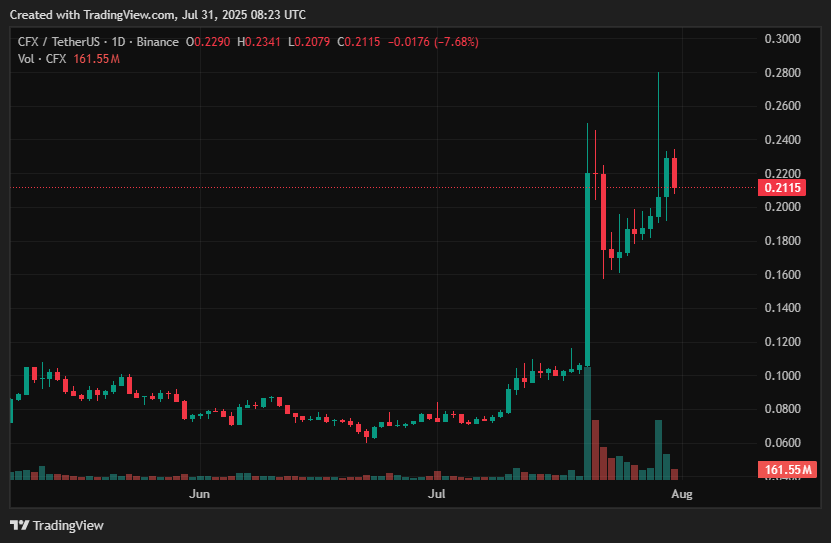
With a 24-hour fall of almost 6.7%, Conflux (CFX) is currently trading at $0.2126. A weeklong reversal follows earlier gains, indicating profit-taking and a change in attitude, according to CoinMarketCap.
What is Conflux?
Conflux is a public blockchain with Asian roots that prioritizes developer interest and high throughput.
Pros
- Robust technological framework
- Growing interest in Asia among institutions
Cons
- Increasing pressure from competitors and speculative positioning
- Limited momentum worldwide
2. Sonic

Market cap
$188M based on volume ~188M
Change in 7 Days
+8.34% intraday; weaker weekly likely due to earlier pump
Price update
Sonic (S), which is currently trading around $0.3314, saw significant intraday gains of almost 8.3%, but it wasn’t one of the top weekly movers, indicating volatility without consistent growth, according to CoinMarketCap.
What is Sonic?
Sonic is relatively a smaller token that was probably fueled by transient excitement and might have been connected to exchange listings or specialized news.
Pros
- Rapid increases on little catalysts
- Windows of high liquidity during rallies
Cons
- Lacks the ability to maintain momentum
- High chance of abrupt drop-offs
3. Curve DAO

Market cap
~$1B+ (daily volume ~482M)
Change in 7 Days
+~4.5% intraday, but down moderately over the week
Price update
Curve DAO (CRV), which is currently trading close to $1.05, saw modest gains today (around 4.5%) but a poorer weekly performance when compared to the cryptocurrencies that are trending, according to CoinMarketCap.
What is Curve DAO?
Curve Finance, a well-known decentralized stablecoin liquidity DEX, uses the Curve DAO Token as its native governance token.
Pros
- Essential to the liquidity of DeFi’s stablecoin
- A large number of users and the volume of protocols
Cons
- Flat growth in the absence of significant improvements
- Being exposed to regulatory obstacles
| Coin / Token | 7‑Day Gain/Loss | Approx. Price | Market Position | Key Driver |
| Pump.fun (PUMP) | +22.7% | ~$0.003095 | Micro-cap, hyped token | Speculative/social momentum |
| Ethena (ENA) | +12.8% | ~$0.66 | DeFi derivatives niche | Whale accumulation, listing buzz |
| Story (IP) | +8.9% | ~$6.18 | Narrative-driven alt | Social attention, mid-cap momentum |
| Conflux (CFX) | –6.7% | ~$0.2126 | L1 with regional traction | Profit-taking into rotation |
| Sonic (S) | +8.3% (intraday) | ~$0.3314 | Small-cap vol token | Short-lived hype attacks |
| Curve DAO (CRV) | +4.5% (intra-day) | ~$1.05 | DeFi liquidity staple | Mild rebound, but flat week |
Final summary
Smaller and mid-cap cryptocurrencies dominated headlines as of July 31, 2025, with speculative and DeFi-driven interest producing the largest upside for Pump.fun, Ethena, and Story. A shift in capital toward higher-risk, higher-reward assets is indicated by the small underperformance of well-known firms like Conflux and Curve DAO. As July draws to a conclusion, this pattern demonstrates a definite risk-on attitude among traders.
Disclosure: This content is provided by a third party. Neither crypto.news nor the author of this article endorses any product mentioned on this page. Users should conduct their own research before taking any action related to the company.
You May Also Like

Cashing In On University Patents Means Giving Up On Our Innovation Future

VectorUSA Achieves Fortinet’s Engage Preferred Services Partner Designation
