Securities and Exchange Commission (SEC) Chairman Paul Atkins announced the launch of “ Project Crypto ” on July 31, a comprehensive initiative designed to modernize securities regulations and allow America’s financial markets to move on-chain. The announcement came during a speech at the America First Policy Institute, where Atkins outlined plans to bring crypto asset distributions back to America and establish regulatory frameworks for digital asset trading. JUST IN: 🇺🇸 SEC launches 'Project Crypto' to help make America the “crypto capital of the world.” pic.twitter.com/if6lHudlTt — Bitcoin Magazine (@BitcoinMagazine) July 31, 2025 The initiative follows the release of a 166-page White House report titled “ Strengthening American Leadership in Digital Financial Technology ,” which categorizes cryptocurrency as “ next-generation technology ” alongside railroads and the internet. The document condemns the Biden administration’s regulatory approach as creating a “hostile environment” for crypto businesses and calls for reversing policies that drove fintech firms offshore. Framework Targets Onshoring Crypto Businesses Through Clear Guidelines Project Crypto seeks to establish clear rules for crypto asset distributions, custody, and trading through public notice and comment procedures. Atkins directed Commission staff to draft regulations addressing the confusion surrounding the Howey test, which has led entrepreneurs to treat all crypto assets as securities prophylactically. The SEC plans to develop guidelines helping market participants categorize crypto assets as digital collectibles, digital commodities, or stablecoins based on economic realities. Atkins also emphasized that being deemed a security should not carry stigma, noting that many issuers prefer the flexibility securities laws afford for product design and investor protections. The initiative includes purpose-fit disclosures, exemptions, and safe harbors for initial coin offerings, airdrops, and network rewards. Atkins stated that the goal is to ensure issuers include Americans in distributions rather than excluding them to avoid legal complexity. Source: Paul Atkins on X The SEC will also address tokenized securities requests from Wall Street firms and Silicon Valley unicorns seeking to distribute tokenized stocks, bonds, and partnership interests within the United States. Atkins reported that firms are “lined up at our doors” requesting tokenization capabilities previously available only offshore. Super-App Vision Facilitates Integrated Trading Platforms The SEC plans to allow securities intermediaries to offer comprehensive services under a single license through “super-app” functionality. Broker-dealers with alternative trading systems could offer trading in non-security crypto assets alongside crypto asset securities, traditional securities, and services like staking and lending without requiring multiple federal or state licenses. Atkins directed staff to develop frameworks allowing non-security crypto assets and crypto asset securities to trade side-by-side on SEC-regulated platforms. The Commission will evaluate its authority to permit non-security crypto assets subject to investment contracts to trade on unregistered venues. The approach allows state-licensed crypto platforms not registered with the SEC to list certain crypto assets while allowing CFTC-regulated platforms to offer products with margin capabilities. As a result, the approach eliminates the need for additional Congressional authority while unlocking greater asset liquidity. Project Crypto also addresses outdated custody requirements that limited custodial service provider options. The SEC plans to modernize custody rules for registered intermediaries, moving away from the previous administration’s “special-purpose broker-dealer” framework and SAB 121 guidance . 🏦Vanessa A. Countryman, Secretary of the SEC, confirmed that SAB 122 has officially replaced SAB 121 in the regulatory framework. #SAB121 #CryptoAccounting #USSEC https://t.co/feyCzuakYH — Cryptonews.com (@cryptonews) January 24, 2025 Innovation Exemption Speeds Market Entry for New Business Models The SEC is considering an innovation exemption that would allow registrants and non-registrants to quickly enter markets with new business models that don’t fit existing regulations, for which a similar standard was released for ETFs earlier today. 🚀 SEC establishes new crypto ETF listing standards enabling approximately dozen major digital assets to gain approval by October through streamlined framework. #SEC #ETFs https://t.co/grlJtGb5tH — Cryptonews.com (@cryptonews) July 31, 2025 Innovators could comply with principles-based conditions, achieving core securities law policy goals rather than burdensome prescriptive requirements. Proposed conditions include periodic Commission reporting, whitelisting functionality, and restrictions on tokenized securities not adhering to compliant token standards like ERC3643. Atkins also emphasized commercial viability as the “true north” for evaluating various models. Additionally, the initiative coincides with growing corporate adoption. A Deloitte survey found 23% of North American CFOs expect their treasury departments to use cryptocurrency within two years, rising to nearly 40% among firms with $10 billion or more in revenue. 💰 Deloitte reports CFOs eye crypto treasury adoption, with governance, regulation, and workforce readiness emerging as next-phase priorities. #deloitte #treasury https://t.co/boA1QnYOwm — Cryptonews.com (@cryptonews) July 31, 2025 Forty-three percent cited price volatility as their top concern, followed by accounting complexity and regulatory uncertainty. The White House report also confirms plans for a strategic Bitcoin reserve administered by the Treasury, though it admits the reserve is not yet operational. The document calls for Congress to affirm people’s rights to self-custody digital assets and engage in peer-to-peer transactions without financial intermediaries. Despite these positive regulatory announcements, Bitcoin is still trading relatively flat, slightly above $118,000, with Ethereum gaining modestly above $3,760.Securities and Exchange Commission (SEC) Chairman Paul Atkins announced the launch of “ Project Crypto ” on July 31, a comprehensive initiative designed to modernize securities regulations and allow America’s financial markets to move on-chain. The announcement came during a speech at the America First Policy Institute, where Atkins outlined plans to bring crypto asset distributions back to America and establish regulatory frameworks for digital asset trading. JUST IN: 🇺🇸 SEC launches 'Project Crypto' to help make America the “crypto capital of the world.” pic.twitter.com/if6lHudlTt — Bitcoin Magazine (@BitcoinMagazine) July 31, 2025 The initiative follows the release of a 166-page White House report titled “ Strengthening American Leadership in Digital Financial Technology ,” which categorizes cryptocurrency as “ next-generation technology ” alongside railroads and the internet. The document condemns the Biden administration’s regulatory approach as creating a “hostile environment” for crypto businesses and calls for reversing policies that drove fintech firms offshore. Framework Targets Onshoring Crypto Businesses Through Clear Guidelines Project Crypto seeks to establish clear rules for crypto asset distributions, custody, and trading through public notice and comment procedures. Atkins directed Commission staff to draft regulations addressing the confusion surrounding the Howey test, which has led entrepreneurs to treat all crypto assets as securities prophylactically. The SEC plans to develop guidelines helping market participants categorize crypto assets as digital collectibles, digital commodities, or stablecoins based on economic realities. Atkins also emphasized that being deemed a security should not carry stigma, noting that many issuers prefer the flexibility securities laws afford for product design and investor protections. The initiative includes purpose-fit disclosures, exemptions, and safe harbors for initial coin offerings, airdrops, and network rewards. Atkins stated that the goal is to ensure issuers include Americans in distributions rather than excluding them to avoid legal complexity. Source: Paul Atkins on X The SEC will also address tokenized securities requests from Wall Street firms and Silicon Valley unicorns seeking to distribute tokenized stocks, bonds, and partnership interests within the United States. Atkins reported that firms are “lined up at our doors” requesting tokenization capabilities previously available only offshore. Super-App Vision Facilitates Integrated Trading Platforms The SEC plans to allow securities intermediaries to offer comprehensive services under a single license through “super-app” functionality. Broker-dealers with alternative trading systems could offer trading in non-security crypto assets alongside crypto asset securities, traditional securities, and services like staking and lending without requiring multiple federal or state licenses. Atkins directed staff to develop frameworks allowing non-security crypto assets and crypto asset securities to trade side-by-side on SEC-regulated platforms. The Commission will evaluate its authority to permit non-security crypto assets subject to investment contracts to trade on unregistered venues. The approach allows state-licensed crypto platforms not registered with the SEC to list certain crypto assets while allowing CFTC-regulated platforms to offer products with margin capabilities. As a result, the approach eliminates the need for additional Congressional authority while unlocking greater asset liquidity. Project Crypto also addresses outdated custody requirements that limited custodial service provider options. The SEC plans to modernize custody rules for registered intermediaries, moving away from the previous administration’s “special-purpose broker-dealer” framework and SAB 121 guidance . 🏦Vanessa A. Countryman, Secretary of the SEC, confirmed that SAB 122 has officially replaced SAB 121 in the regulatory framework. #SAB121 #CryptoAccounting #USSEC https://t.co/feyCzuakYH — Cryptonews.com (@cryptonews) January 24, 2025 Innovation Exemption Speeds Market Entry for New Business Models The SEC is considering an innovation exemption that would allow registrants and non-registrants to quickly enter markets with new business models that don’t fit existing regulations, for which a similar standard was released for ETFs earlier today. 🚀 SEC establishes new crypto ETF listing standards enabling approximately dozen major digital assets to gain approval by October through streamlined framework. #SEC #ETFs https://t.co/grlJtGb5tH — Cryptonews.com (@cryptonews) July 31, 2025 Innovators could comply with principles-based conditions, achieving core securities law policy goals rather than burdensome prescriptive requirements. Proposed conditions include periodic Commission reporting, whitelisting functionality, and restrictions on tokenized securities not adhering to compliant token standards like ERC3643. Atkins also emphasized commercial viability as the “true north” for evaluating various models. Additionally, the initiative coincides with growing corporate adoption. A Deloitte survey found 23% of North American CFOs expect their treasury departments to use cryptocurrency within two years, rising to nearly 40% among firms with $10 billion or more in revenue. 💰 Deloitte reports CFOs eye crypto treasury adoption, with governance, regulation, and workforce readiness emerging as next-phase priorities. #deloitte #treasury https://t.co/boA1QnYOwm — Cryptonews.com (@cryptonews) July 31, 2025 Forty-three percent cited price volatility as their top concern, followed by accounting complexity and regulatory uncertainty. The White House report also confirms plans for a strategic Bitcoin reserve administered by the Treasury, though it admits the reserve is not yet operational. The document calls for Congress to affirm people’s rights to self-custody digital assets and engage in peer-to-peer transactions without financial intermediaries. Despite these positive regulatory announcements, Bitcoin is still trading relatively flat, slightly above $118,000, with Ethereum gaining modestly above $3,760.

SEC Launches ‘Project Crypto’ Initiative to Make America the ‘Crypto Capital of the World’

4 min read

Securities and Exchange Commission (SEC) Chairman Paul Atkins announced the launch of “Project Crypto” on July 31, a comprehensive initiative designed to modernize securities regulations and allow America’s financial markets to move on-chain.

The announcement came during a speech at the America First Policy Institute, where Atkins outlined plans to bring crypto asset distributions back to America and establish regulatory frameworks for digital asset trading.

The initiative follows the release of a 166-page White House report titled “Strengthening American Leadership in Digital Financial Technology,” which categorizes cryptocurrency as “next-generation technology” alongside railroads and the internet.

The document condemns the Biden administration’s regulatory approach as creating a “hostile environment” for crypto businesses and calls for reversing policies that drove fintech firms offshore.

Framework Targets Onshoring Crypto Businesses Through Clear Guidelines

Project Crypto seeks to establish clear rules for crypto asset distributions, custody, and trading through public notice and comment procedures.

Atkins directed Commission staff to draft regulations addressing the confusion surrounding the Howey test, which has led entrepreneurs to treat all crypto assets as securities prophylactically.

The SEC plans to develop guidelines helping market participants categorize crypto assets as digital collectibles, digital commodities, or stablecoins based on economic realities.

Atkins also emphasized that being deemed a security should not carry stigma, noting that many issuers prefer the flexibility securities laws afford for product design and investor protections.

The initiative includes purpose-fit disclosures, exemptions, and safe harbors for initial coin offerings, airdrops, and network rewards. Atkins stated that the goal is to ensure issuers include Americans in distributions rather than excluding them to avoid legal complexity.
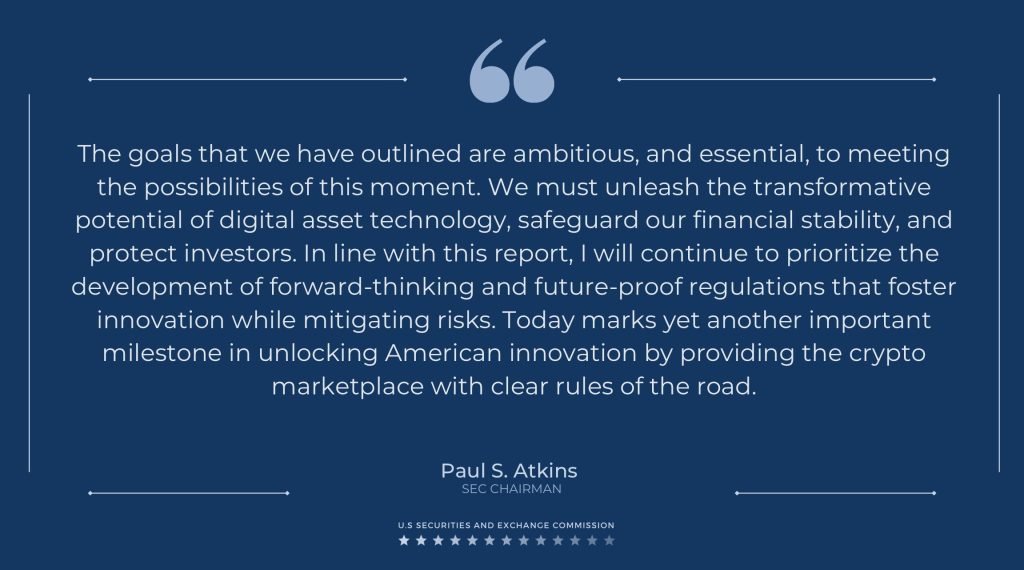
SEC Launches 'Project Crypto' Initiative to Make America the 'Crypto Capital of the World'Source: Paul Atkins on X

The SEC will also address tokenized securities requests from Wall Street firms and Silicon Valley unicorns seeking to distribute tokenized stocks, bonds, and partnership interests within the United States.

Atkins reported that firms are “lined up at our doors” requesting tokenization capabilities previously available only offshore.

Super-App Vision Facilitates Integrated Trading Platforms

The SEC plans to allow securities intermediaries to offer comprehensive services under a single license through “super-app” functionality.

Broker-dealers with alternative trading systems could offer trading in non-security crypto assets alongside crypto asset securities, traditional securities, and services like staking and lending without requiring multiple federal or state licenses.

Atkins directed staff to develop frameworks allowing non-security crypto assets and crypto asset securities to trade side-by-side on SEC-regulated platforms. The Commission will evaluate its authority to permit non-security crypto assets subject to investment contracts to trade on unregistered venues.

The approach allows state-licensed crypto platforms not registered with the SEC to list certain crypto assets while allowing CFTC-regulated platforms to offer products with margin capabilities. As a result, the approach eliminates the need for additional Congressional authority while unlocking greater asset liquidity.

Project Crypto also addresses outdated custody requirements that limited custodial service provider options.

The SEC plans to modernize custody rules for registered intermediaries, moving away from the previous administration’s “special-purpose broker-dealer” framework and SAB 121 guidance.

Innovation Exemption Speeds Market Entry for New Business Models

The SEC is considering an innovation exemption that would allow registrants and non-registrants to quickly enter markets with new business models that don’t fit existing regulations, for which a similar standard was released for ETFs earlier today.

Innovators could comply with principles-based conditions, achieving core securities law policy goals rather than burdensome prescriptive requirements.

Proposed conditions include periodic Commission reporting, whitelisting functionality, and restrictions on tokenized securities not adhering to compliant token standards like ERC3643.

Atkins also emphasized commercial viability as the “true north” for evaluating various models.

Additionally, the initiative coincides with growing corporate adoption. A Deloitte survey found 23% of North American CFOs expect their treasury departments to use cryptocurrency within two years, rising to nearly 40% among firms with $10 billion or more in revenue.

Forty-three percent cited price volatility as their top concern, followed by accounting complexity and regulatory uncertainty.

The White House report also confirms plans for a strategic Bitcoin reserve administered by the Treasury, though it admits the reserve is not yet operational.

The document calls for Congress to affirm people’s rights to self-custody digital assets and engage in peer-to-peer transactions without financial intermediaries.

Despite these positive regulatory announcements, Bitcoin is still trading relatively flat, slightly above $118,000, with Ethereum gaining modestly above $3,760.

Market Opportunity
Threshold Logo
Threshold Price(T)
$0.008082
$0.008082$0.008082
-0.63%
USD
Threshold (T) Live Price Chart
Disclaimer: The articles reposted on this site are sourced from public platforms and are provided for informational purposes only. They do not necessarily reflect the views of MEXC. All rights remain with the original authors. If you believe any content infringes on third-party rights, please contact service@support.mexc.com for removal. MEXC makes no guarantees regarding the accuracy, completeness, or timeliness of the content and is not responsible for any actions taken based on the information provided. The content does not constitute financial, legal, or other professional advice, nor should it be considered a recommendation or endorsement by MEXC.

You May Also Like

Shibarium May No Longer Turbocharge Shiba Inu Price Rally, Here’s Reason

Shibarium May No Longer Turbocharge Shiba Inu Price Rally, Here’s Reason

The post Shibarium May No Longer Turbocharge Shiba Inu Price Rally, Here’s Reason appeared on BitcoinEthereumNews.com. Shibarium, the layer-2 blockchain of the Shiba Inu (SHIB) ecosystem, is battling to stay active. Shibarium has slipped from hitting transaction milestones to struggling to record any transactions on its platform, a development that could severely impact SHIB. Shibarium transactions crash from millions to near zero As per Shibariumscan data, the total daily transactions on Shibarium as of Sept. 16 stood at 11,600. This volume of transactions reflects how low the transaction count has dropped for the L2, whose daily average ranged between 3.5 million and 4 million last month. However, in the last week of August, daily transaction volume on Shibarium lost momentum, slipping from 1.3 million to 9,590 as of Aug. 28. This pattern has lingered for much of September, with the highest peak so far being on Sept. 5, when it posted 1.26 million transactions. The low user engagement has greatly affected the transaction count in recent days. In addition, the security breach over the weekend by malicious attackers on Shibarium has probably worsened issues. Although developer Kaal Dhairya reassured the community that the attack to steal millions of BONE tokens was successfully prevented, users’ confidence appears shaken. This has also impacted the price outlook for Shiba Inu, the ecosystem’s native token. Following reports of the malicious attack on Shibarium, SHIB dipped immediately into the red zone. Unlike on previous occasions where investors accumulated on the dip, market participants did not flock to Shiba Inu. Shiba Inu price struggles, can burn mechanism help? With the current near-zero crash in transaction volume for Shibarium, SHIB’s price cannot depend on it to support a rally. It might take a while to rebuild user confidence and for transactions to pick up again. In the meantime, Shiba Inu might have to rely on other means to boost prices from its low levels. This…
Share
BitcoinEthereumNews2025/09/18 07:57
👨🏿‍🚀TechCabal Daily – When banks go cashless

👨🏿‍🚀TechCabal Daily – When banks go cashless

In today's edition: South Africa's biggest banks are going cashless || Onafriq and PAPSS pilot Naira wallet transfers from Nigeria to Ghana || South Africa just
Share
Techcabal2026/02/04 14:02
Wormhole launches reserve tying protocol revenue to token

Wormhole launches reserve tying protocol revenue to token

The post Wormhole launches reserve tying protocol revenue to token appeared on BitcoinEthereumNews.com. Wormhole is changing how its W token works by creating a new reserve designed to hold value for the long term. Announced on Wednesday, the Wormhole Reserve will collect onchain and offchain revenues and other value generated across the protocol and its applications (including Portal) and accumulate them into W, locking the tokens within the reserve. The reserve is part of a broader update called W 2.0. Other changes include a 4% targeted base yield for tokenholders who stake and take part in governance. While staking rewards will vary, Wormhole said active users of ecosystem apps can earn boosted yields through features like Portal Earn. The team stressed that no new tokens are being minted; rewards come from existing supply and protocol revenues, keeping the cap fixed at 10 billion. Wormhole is also overhauling its token release schedule. Instead of releasing large amounts of W at once under the old “cliff” model, the network will shift to steady, bi-weekly unlocks starting October 3, 2025. The aim is to avoid sharp periods of selling pressure and create a more predictable environment for investors. Lockups for some groups, including validators and investors, will extend an additional six months, until October 2028. Core contributor tokens remain under longer contractual time locks. Wormhole launched in 2020 as a cross-chain bridge and now connects more than 40 blockchains. The W token powers governance and staking, with a capped supply of 10 billion. By redirecting fees and revenues into the new reserve, Wormhole is betting that its token can maintain value as demand for moving assets and data between chains grows. This is a developing story. This article was generated with the assistance of AI and reviewed by editor Jeffrey Albus before publication. Get the news in your inbox. Explore Blockworks newsletters: Source: https://blockworks.co/news/wormhole-launches-reserve
Share
BitcoinEthereumNews2025/09/18 01:55