Stablecoin giant Tether has released its Q2 2025 attestation, revealing $127 billion in holdings of U.S. Treasuries and a net profit of $4.9 billion for the quarter. The report , completed by global accounting firm BDO, confirms the company’s asset backing for its USDT stablecoin and shows continued momentum in Tether’s global expansion. As of June 30, the total value of Tether’s assets reached over $162 billion, with liabilities tied to issued tokens sitting just above $157 billion. That means the company’s assets continue to exceed its liabilities, reinforcing its solvency. Tether Now Among Top 20 Holders of U.S. Treasuries With $127B Exposure Tether’s exposure to U.S. Treasuries, $105.5 billion in direct holdings and $21.3 billion in indirect holdings, puts it ahead of several countries, including Germany, in total U.S. debt ownership. That amount has grown by $8 billion since the previous quarter, placing Tether among the top 20 holders of U.S. Treasury securities globally. Tether Issues $20B in USD₮ YTD, Becomes One of Largest U.S. Debt Holders with $127B in Treasuries, Net Profit ~$4.9B in Q2 2025 Attestation Report Read more: https://t.co/0sJW8MiSoO — Tether (@Tether_to) July 31, 2025 Tether CEO Paolo Ardoino commented on the findings, saying, “Q2 2025 affirms what markets have been telling us all year: trust in Tether is accelerating. With over $127 billion in U.S. Treasury exposure, robust bitcoin and gold reserves, and over $20 billion in new USD₮ issued, we’re not just keeping pace with global demand, we’re shaping it.” USDT’s circulating supply reached over $157 billion by the end of June, up by $20 billion since the start of the year. According to Tether, $13.4 billion of that was issued in Q2 alone, indicating growing demand across both emerging markets and digital finance platforms. Beyond profits and supply growth, Tether’s report shows that the company’s shareholder equity remains steady at around $5.47 billion. This reserve buffer is meant to shield the company from shocks and ensure long-term operational strength. Of the $4.9 billion Q2 profit, $3.1 billion came from recurring operations. The rest came from gains in Tether’s bitcoin and gold holdings. Gregory Cowles, Chief Strategy Officer of Intellistake.ai, noted while speaking to CryptoNews that “when a stablecoin issuer starts to rival sovereign holders of debt, it shifts the conversation entirely. And with $4.9 billion in profit this quarter, most of it recurring, we’re seeing a model that isn’t just surviving—it’s thriving and operating at scale, showing real financial strength.” Source: Paolo Ardoino In total, Tether has made $5.7 billion in profit during the first half of 2025. The company says it’s using this cash to fund long-term projects. That includes investments in technology platforms, data infrastructure, and media tools, such as the Rumble Wallet and XXI Capital. The report also shows that nearly $4 billion of those investments have gone toward initiatives within the United States. Tether says it’s reinvesting more into foundational infrastructure than it ever has before. Tether’s financial positioning comes as stablecoins draw closer attention from regulators. The U.S. has proposed several bills that would formalize the legal framework for digital dollars. In this context, Tether is pitching itself as a working example of a private sector solution that meets public objectives. “USD₮ is helping billions access the stability of the U.S. dollar,” Ardoino said. “That mission has never been more urgent or more relevant.” Connor Howe, CEO of Enso—a DeFi platform designed to be a DeFi-native liquidity layer—told CryptoNews, “Tether has positioned itself as one of the largest, if not the largest, influences of crypto adoption throughout the world. Netting $4.9b+ is great and shows how much of an impact Tether has had throughout the industry. Recently, their investment portfolios were released, further showing their ability to think out of the box compared to traditional crypto VCs; they enter new market segments to bring crypto adoption, like agriculture.” Tether Expands Gold Reserves, Eyes U.S. Market Amid Stablecoin Growth Stablecoins saw rapid growth in the first half of 2025, with total supply climbing from $204 billion to $252 billion, according to a report by CertiK . Monthly settlement volumes reached $1.39 trillion, driven largely by Tether’s USDT, which now commands over 62% of the stablecoin market. Ardoino revealed that the company has amassed around $8 billion in gold reserves , stored in a private vault in Switzerland. “We have our own vault. I believe it’s the most secure vault in the world,” Ardoino told Bloomberg, declining to disclose its exact location. 🏦 Tether owns the vast majority of about 80 tons of gold stockpile, worth around $8 billion, stored in a private vault in Switzerland. #Tether #GoldReserves #USDT https://t.co/uqizAQWeZS — Cryptonews.com (@cryptonews) July 9, 2025 Ardoino framed the gold holdings as a hedge against potential fiat instability, citing growing concerns over U.S. debt. “If people start to get concerned about the potential increase of the debt of the U.S., they might look at alternatives,” he said. Tether is also preparing for a return to the U.S. market following the recent passage of the GENIUS Act, signed by President Trump. The legislation introduces new federal oversight for stablecoin issuers, including a ban on interest-bearing tokens and stricter reserve disclosure requirements. 🚀 USDT issuer @Tether_to is gearing up for a US comeback, spurred by Trump’s new stablecoin law and a friendlier regulatory climate. #Tether #Stablecoins https://t.co/rfNQsNcp7A — Cryptonews.com (@cryptonews) July 24, 2025 “We are well in progress of establishing our U.S. domestic strategy,” Ardoino said, noting a focus on institutional payments and interbank settlements.Stablecoin giant Tether has released its Q2 2025 attestation, revealing $127 billion in holdings of U.S. Treasuries and a net profit of $4.9 billion for the quarter. The report , completed by global accounting firm BDO, confirms the company’s asset backing for its USDT stablecoin and shows continued momentum in Tether’s global expansion. As of June 30, the total value of Tether’s assets reached over $162 billion, with liabilities tied to issued tokens sitting just above $157 billion. That means the company’s assets continue to exceed its liabilities, reinforcing its solvency. Tether Now Among Top 20 Holders of U.S. Treasuries With $127B Exposure Tether’s exposure to U.S. Treasuries, $105.5 billion in direct holdings and $21.3 billion in indirect holdings, puts it ahead of several countries, including Germany, in total U.S. debt ownership. That amount has grown by $8 billion since the previous quarter, placing Tether among the top 20 holders of U.S. Treasury securities globally. Tether Issues $20B in USD₮ YTD, Becomes One of Largest U.S. Debt Holders with $127B in Treasuries, Net Profit ~$4.9B in Q2 2025 Attestation Report Read more: https://t.co/0sJW8MiSoO — Tether (@Tether_to) July 31, 2025 Tether CEO Paolo Ardoino commented on the findings, saying, “Q2 2025 affirms what markets have been telling us all year: trust in Tether is accelerating. With over $127 billion in U.S. Treasury exposure, robust bitcoin and gold reserves, and over $20 billion in new USD₮ issued, we’re not just keeping pace with global demand, we’re shaping it.” USDT’s circulating supply reached over $157 billion by the end of June, up by $20 billion since the start of the year. According to Tether, $13.4 billion of that was issued in Q2 alone, indicating growing demand across both emerging markets and digital finance platforms. Beyond profits and supply growth, Tether’s report shows that the company’s shareholder equity remains steady at around $5.47 billion. This reserve buffer is meant to shield the company from shocks and ensure long-term operational strength. Of the $4.9 billion Q2 profit, $3.1 billion came from recurring operations. The rest came from gains in Tether’s bitcoin and gold holdings. Gregory Cowles, Chief Strategy Officer of Intellistake.ai, noted while speaking to CryptoNews that “when a stablecoin issuer starts to rival sovereign holders of debt, it shifts the conversation entirely. And with $4.9 billion in profit this quarter, most of it recurring, we’re seeing a model that isn’t just surviving—it’s thriving and operating at scale, showing real financial strength.” Source: Paolo Ardoino In total, Tether has made $5.7 billion in profit during the first half of 2025. The company says it’s using this cash to fund long-term projects. That includes investments in technology platforms, data infrastructure, and media tools, such as the Rumble Wallet and XXI Capital. The report also shows that nearly $4 billion of those investments have gone toward initiatives within the United States. Tether says it’s reinvesting more into foundational infrastructure than it ever has before. Tether’s financial positioning comes as stablecoins draw closer attention from regulators. The U.S. has proposed several bills that would formalize the legal framework for digital dollars. In this context, Tether is pitching itself as a working example of a private sector solution that meets public objectives. “USD₮ is helping billions access the stability of the U.S. dollar,” Ardoino said. “That mission has never been more urgent or more relevant.” Connor Howe, CEO of Enso—a DeFi platform designed to be a DeFi-native liquidity layer—told CryptoNews, “Tether has positioned itself as one of the largest, if not the largest, influences of crypto adoption throughout the world. Netting $4.9b+ is great and shows how much of an impact Tether has had throughout the industry. Recently, their investment portfolios were released, further showing their ability to think out of the box compared to traditional crypto VCs; they enter new market segments to bring crypto adoption, like agriculture.” Tether Expands Gold Reserves, Eyes U.S. Market Amid Stablecoin Growth Stablecoins saw rapid growth in the first half of 2025, with total supply climbing from $204 billion to $252 billion, according to a report by CertiK . Monthly settlement volumes reached $1.39 trillion, driven largely by Tether’s USDT, which now commands over 62% of the stablecoin market. Ardoino revealed that the company has amassed around $8 billion in gold reserves , stored in a private vault in Switzerland. “We have our own vault. I believe it’s the most secure vault in the world,” Ardoino told Bloomberg, declining to disclose its exact location. 🏦 Tether owns the vast majority of about 80 tons of gold stockpile, worth around $8 billion, stored in a private vault in Switzerland. #Tether #GoldReserves #USDT https://t.co/uqizAQWeZS — Cryptonews.com (@cryptonews) July 9, 2025 Ardoino framed the gold holdings as a hedge against potential fiat instability, citing growing concerns over U.S. debt. “If people start to get concerned about the potential increase of the debt of the U.S., they might look at alternatives,” he said. Tether is also preparing for a return to the U.S. market following the recent passage of the GENIUS Act, signed by President Trump. The legislation introduces new federal oversight for stablecoin issuers, including a ban on interest-bearing tokens and stricter reserve disclosure requirements. 🚀 USDT issuer @Tether_to is gearing up for a US comeback, spurred by Trump’s new stablecoin law and a friendlier regulatory climate. #Tether #Stablecoins https://t.co/rfNQsNcp7A — Cryptonews.com (@cryptonews) July 24, 2025 “We are well in progress of establishing our U.S. domestic strategy,” Ardoino said, noting a focus on institutional payments and interbank settlements.

Tether Shocks Wall Street With $127B in Treasuries – What’s the Catch?

5 min read

Stablecoin giant Tether has released its Q2 2025 attestation, revealing $127 billion in holdings of U.S. Treasuries and a net profit of $4.9 billion for the quarter.

The report, completed by global accounting firm BDO, confirms the company’s asset backing for its USDT stablecoin and shows continued momentum in Tether’s global expansion.

As of June 30, the total value of Tether’s assets reached over $162 billion, with liabilities tied to issued tokens sitting just above $157 billion. That means the company’s assets continue to exceed its liabilities, reinforcing its solvency.

Tether Now Among Top 20 Holders of U.S. Treasuries With $127B Exposure

Tether’s exposure to U.S. Treasuries, $105.5 billion in direct holdings and $21.3 billion in indirect holdings, puts it ahead of several countries, including Germany, in total U.S. debt ownership. That amount has grown by $8 billion since the previous quarter, placing Tether among the top 20 holders of U.S. Treasury securities globally.

Tether CEO Paolo Ardoino commented on the findings, saying, “Q2 2025 affirms what markets have been telling us all year: trust in Tether is accelerating. With over $127 billion in U.S. Treasury exposure, robust bitcoin and gold reserves, and over $20 billion in new USD₮ issued, we’re not just keeping pace with global demand, we’re shaping it.”

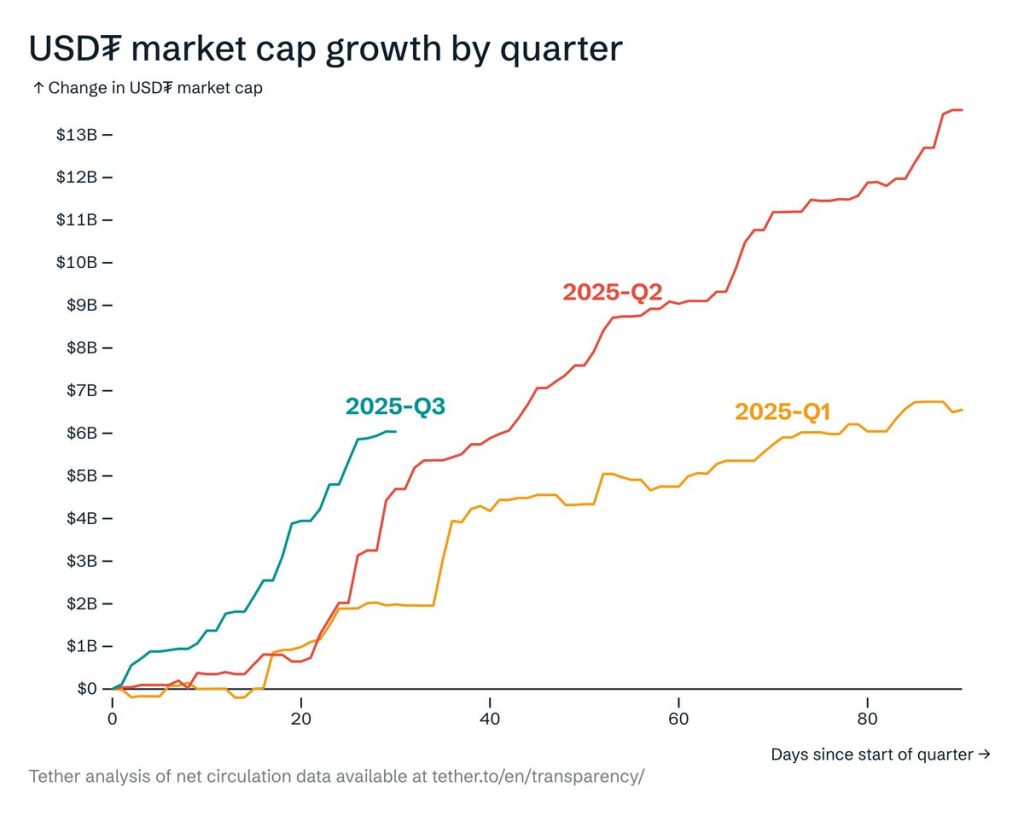
USDT’s circulating supply reached over $157 billion by the end of June, up by $20 billion since the start of the year. According to Tether, $13.4 billion of that was issued in Q2 alone, indicating growing demand across both emerging markets and digital finance platforms.

Beyond profits and supply growth, Tether’s report shows that the company’s shareholder equity remains steady at around $5.47 billion. This reserve buffer is meant to shield the company from shocks and ensure long-term operational strength.

Of the $4.9 billion Q2 profit, $3.1 billion came from recurring operations. The rest came from gains in Tether’s bitcoin and gold holdings.

Gregory Cowles, Chief Strategy Officer of Intellistake.ai, noted while speaking to CryptoNews that “when a stablecoin issuer starts to rival sovereign holders of debt, it shifts the conversation entirely. And with $4.9 billion in profit this quarter, most of it recurring, we’re seeing a model that isn’t just surviving—it’s thriving and operating at scale, showing real financial strength.”
Source: Paolo Ardoino

In total, Tether has made $5.7 billion in profit during the first half of 2025. The company says it’s using this cash to fund long-term projects. That includes investments in technology platforms, data infrastructure, and media tools, such as the Rumble Wallet and XXI Capital.

The report also shows that nearly $4 billion of those investments have gone toward initiatives within the United States. Tether says it’s reinvesting more into foundational infrastructure than it ever has before.

Tether’s financial positioning comes as stablecoins draw closer attention from regulators. The U.S. has proposed several bills that would formalize the legal framework for digital dollars. In this context, Tether is pitching itself as a working example of a private sector solution that meets public objectives.

“USD₮ is helping billions access the stability of the U.S. dollar,” Ardoino said. “That mission has never been more urgent or more relevant.”

Connor Howe, CEO of Enso—a DeFi platform designed to be a DeFi-native liquidity layer—told CryptoNews, “Tether has positioned itself as one of the largest, if not the largest, influences of crypto adoption throughout the world. Netting $4.9b+ is great and shows how much of an impact Tether has had throughout the industry. Recently, their investment portfolios were released, further showing their ability to think out of the box compared to traditional crypto VCs; they enter new market segments to bring crypto adoption, like agriculture.”

Tether Expands Gold Reserves, Eyes U.S. Market Amid Stablecoin Growth

Stablecoins saw rapid growth in the first half of 2025, with total supply climbing from $204 billion to $252 billion, according to a report by CertiK. Monthly settlement volumes reached $1.39 trillion, driven largely by Tether’s USDT, which now commands over 62% of the stablecoin market.

Ardoino revealed that the company has amassed around $8 billion in gold reserves, stored in a private vault in Switzerland.

“We have our own vault. I believe it’s the most secure vault in the world,” Ardoino told Bloomberg, declining to disclose its exact location.

Ardoino framed the gold holdings as a hedge against potential fiat instability, citing growing concerns over U.S. debt. “If people start to get concerned about the potential increase of the debt of the U.S., they might look at alternatives,” he said.

Tether is also preparing for a return to the U.S. market following the recent passage of the GENIUS Act, signed by President Trump. The legislation introduces new federal oversight for stablecoin issuers, including a ban on interest-bearing tokens and stricter reserve disclosure requirements.

“We are well in progress of establishing our U.S. domestic strategy,” Ardoino said, noting a focus on institutional payments and interbank settlements.

Market Opportunity
Threshold Logo
Threshold Price(T)
$0.007579
$0.007579$0.007579
-1.68%
USD
Threshold (T) Live Price Chart
Disclaimer: The articles reposted on this site are sourced from public platforms and are provided for informational purposes only. They do not necessarily reflect the views of MEXC. All rights remain with the original authors. If you believe any content infringes on third-party rights, please contact service@support.mexc.com for removal. MEXC makes no guarantees regarding the accuracy, completeness, or timeliness of the content and is not responsible for any actions taken based on the information provided. The content does not constitute financial, legal, or other professional advice, nor should it be considered a recommendation or endorsement by MEXC.

You May Also Like

Cashing In On University Patents Means Giving Up On Our Innovation Future

Cashing In On University Patents Means Giving Up On Our Innovation Future

The post Cashing In On University Patents Means Giving Up On Our Innovation Future appeared on BitcoinEthereumNews.com. “It’s a raid on American innovation that would deliver pennies to the Treasury while kneecapping the very engine of our economic and medical progress,” writes Pipes. Getty Images Washington is addicted to taxing success. Now, Commerce Secretary Howard Lutnick is floating a plan to skim half the patent earnings from inventions developed at universities with federal funding. It’s being sold as a way to shore up programs like Social Security. In reality, it’s a raid on American innovation that would deliver pennies to the Treasury while kneecapping the very engine of our economic and medical progress. Yes, taxpayer dollars support early-stage research. But the real payoff comes later—in the jobs created, cures discovered, and industries launched when universities and private industry turn those discoveries into real products. By comparison, the sums at stake in patent licensing are trivial. Universities collectively earn only about $3.6 billion annually in patent income—less than the federal government spends on Social Security in a single day. Even confiscating half would barely register against a $6 trillion federal budget. And yet the damage from such a policy would be anything but trivial. The true return on taxpayer investment isn’t in licensing checks sent to Washington, but in the downstream economic activity that federally supported research unleashes. Thanks to the bipartisan Bayh-Dole Act of 1980, universities and private industry have powerful incentives to translate early-stage discoveries into real-world products. Before Bayh-Dole, the government hoarded patents from federally funded research, and fewer than 5% were ever licensed. Once universities could own and license their own inventions, innovation exploded. The result has been one of the best returns on investment in government history. Since 1996, university research has added nearly $2 trillion to U.S. industrial output, supported 6.5 million jobs, and launched more than 19,000 startups. Those companies pay…
Share
BitcoinEthereumNews2025/09/18 03:26
VectorUSA Achieves Fortinet’s Engage Preferred Services Partner Designation

VectorUSA Achieves Fortinet’s Engage Preferred Services Partner Designation

TORRANCE, Calif., Feb. 3, 2026 /PRNewswire/ — VectorUSA, a trusted technology solutions provider, specializes in delivering integrated IT, security, and infrastructure
Share
AI Journal2026/02/05 00:02
Top Solana Treasury Firm Forward Industries Unveils $4 Billion Capital Raise To Buy More SOL ⋆ ZyCrypto

Top Solana Treasury Firm Forward Industries Unveils $4 Billion Capital Raise To Buy More SOL ⋆ ZyCrypto

The post Top Solana Treasury Firm Forward Industries Unveils $4 Billion Capital Raise To Buy More SOL ⋆ ZyCrypto appeared on BitcoinEthereumNews.com. Advertisement &nbsp &nbsp Forward Industries, the largest publicly traded Solana treasury company, has filed a $4 billion at-the-market (ATM) equity offering program with the U.S. SEC  to raise more capital for additional SOL accumulation. Forward Strategies Doubles Down On Solana Strategy In a Wednesday press release, Forward Industries revealed that the 4 billion ATM equity offering program will allow the company to issue and sell common stock via Cantor Fitzgerald under a sales agreement dated Sept. 16, 2025. Forward said proceeds will go toward “general corporate purposes,” including the pursuit of its Solana balance sheet and purchases of income-generating assets. The sales of the shares are covered by an automatic shelf registration statement filed with the US Securities and Exchange Commission that is already effective – meaning the shares will be tradable once they’re sold. An automatic shelf registration allows certain publicly listed companies to raise capital with flexibility swiftly.  Kyle Samani, Forward’s chairman, astutely described the ATM offering as “a flexible and efficient mechanism” to raise and deploy capital for the company’s Solana strategy and bolster its balance sheet.  Advertisement &nbsp Though the maximum amount is listed as $4 billion, the firm indicated that sales may or may not occur depending on existing market conditions. “The ATM Program enhances our ability to continue scaling that position, strengthen our balance sheet, and pursue growth initiatives in alignment with our long-term vision,” Samani said. Forward Industries kicked off its Solana treasury strategy on Sept. 8. The Wednesday S-3 form follows Forward’s $1.65 billion private investment in public equity that closed last week, led by crypto heavyweights like Galaxy Digital, Jump Crypto, and Multicoin Capital. The company started deploying that capital this week, announcing it snatched up 6.8 million SOL for approximately $1.58 billion at an average price of $232…
Share
BitcoinEthereumNews2025/09/18 03:42