XRP’s short-term setup is facing renewed pressure after a sharp burst of exchange inflows to Binance, with on-chain data showing that the move was driven primarilyXRP’s short-term setup is facing renewed pressure after a sharp burst of exchange inflows to Binance, with on-chain data showing that the move was driven primarily

XRP Faces Short-Term Risk As Whale Inflows Hit Binance, On-Chain Data Shows

2026/02/23 20:30
3 min read

XRP’s short-term setup is facing renewed pressure after a sharp burst of exchange inflows to Binance, with on-chain data showing that the move was driven primarily by large holders. The spike matters because it points to a sudden increase in potential sell-side supply at a time when broader market momentum remains weak.

CryptoQuant contributor Darkfost flagged the move in a post on X today, tying the development to a softer backdrop for altcoins while Bitcoin remains rangebound. “BTC continues to range, offering limited directional clarity in the short term. This lack of momentum is weighing on the broader market, with altcoins continuing to underperform in the absence of a clear trend,” Darkfost wrote.

Are XRP Whales Selling?

That context is important for XRP. In a market with limited follow-through, large exchange deposits can carry more weight than they would during a strong risk-on phase, especially when the flows are concentrated in whale-sized cohorts.

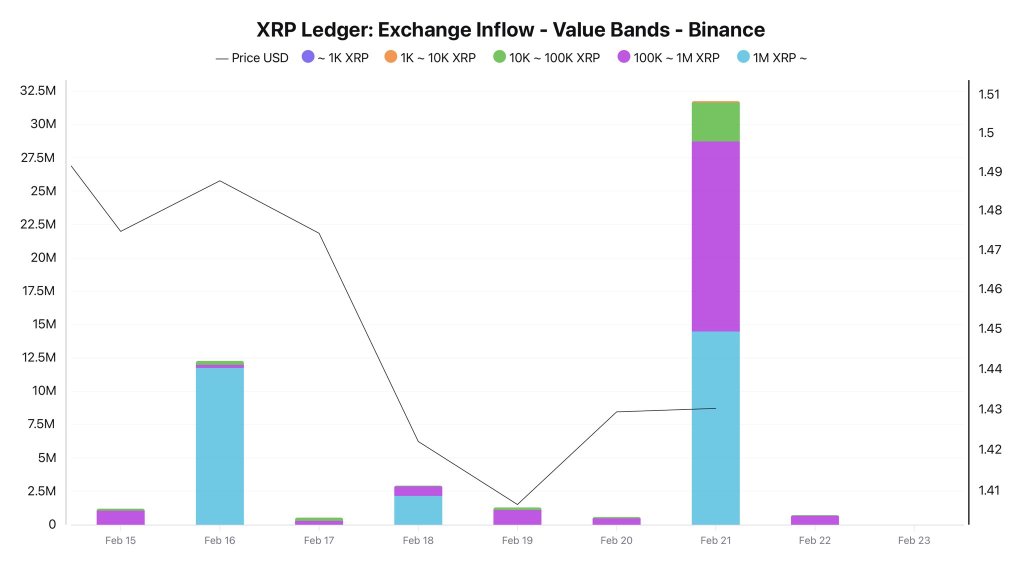
The chart shared by Darkfost, titled “XRP Ledger: Exchange Inflow – Value Bands – Binance,” shows a clear outlier on Feb. 21. Total inflows jump to more than 31 million XRP, far above the surrounding days in the Feb. 15–23 window, with the stacked bars dominated by the 100k–1M XRP and >1M XRP cohorts.

Darkfost summarized the move directly: “This week was notably marked by a significant XRP inflow to Binance, which remains the go-to exchange for large transactions thanks to its deep liquidity. More than 31 million XRP were transferred to the exchange in a single day yesterday.”

The chart also suggests this was not a broad-based retail event. Smaller cohorts contributed relatively little to the spike, while large holders accounted for nearly all of the move. That pattern aligns with Darkfost’s central argument that the event raises short-term risk because it represents concentrated, potentially market-moving supply arriving at a highly liquid venue.
XRP Binance inflows

According to the breakdown shared in the post, the inflows were led by the two largest cohorts: 14,236,825 XRP from wallets in the 100k–1M band and 14,494,865 XRP from whale wallets holding more than 1M XRP. Mid-sized wallets in the 10k–100k range added 2,938,809 XRP, while the sub-10k segments contributed only a small fraction of the total.

Taken together, the distribution reinforces that the event was whale-led rather than diffuse. In practical terms, that matters because large-holder exchange inflows are often watched as a proxy for potential intent to sell, even if inflow alone does not confirm execution.

Darkfost framed the risk in dollar terms, writing: “Altogether, this represents a sudden potential sell-side pressure of nearly $45 million that warrants close monitoring. Should this selling pressure persist, XRP may struggle to recover from its ongoing correction in the near term.”

The price line overlaid on the chart shows XRP trading lower across much of the same period, sliding from the upper end of the displayed range around Feb. 15–16 before bottoming near Feb. 19 and only modestly rebounding afterward. By the time the large Feb. 21 inflow hit Binance, price had recovered somewhat but remained below earlier levels in the week. However, the rebound was completely erased during the early European morning session, as XRP fell to as low as $1.33.

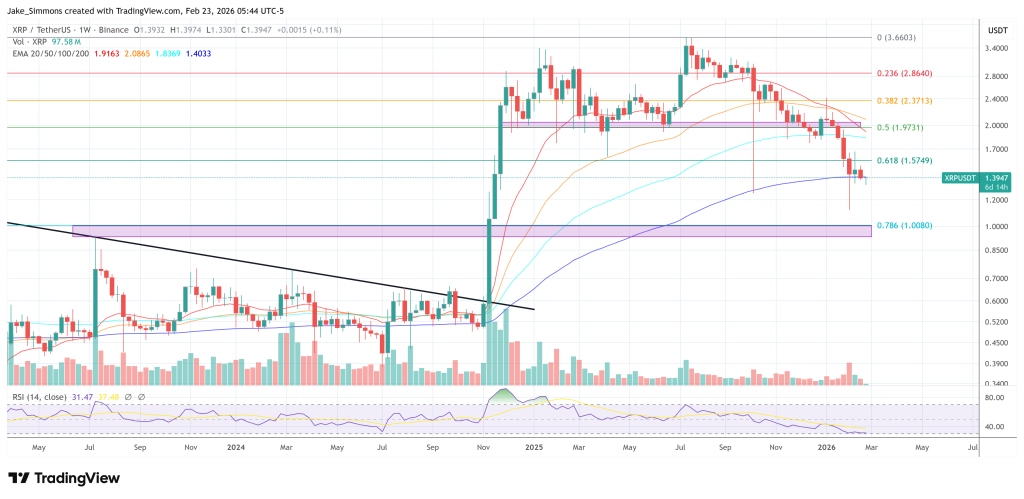
At press time, XRP traded at $1.3947.
XRP price chart
Market Opportunity
XRP Logo
XRP Price(XRP)
$1.376
$1.376$1.376
-1.22%
USD
XRP (XRP) Live Price Chart
Disclaimer: The articles reposted on this site are sourced from public platforms and are provided for informational purposes only. They do not necessarily reflect the views of MEXC. All rights remain with the original authors. If you believe any content infringes on third-party rights, please contact service@support.mexc.com for removal. MEXC makes no guarantees regarding the accuracy, completeness, or timeliness of the content and is not responsible for any actions taken based on the information provided. The content does not constitute financial, legal, or other professional advice, nor should it be considered a recommendation or endorsement by MEXC.

You May Also Like

New 15% global tariff reshapes landscape – Commerzbank

New 15% global tariff reshapes landscape – Commerzbank

The post New 15% global tariff reshapes landscape – Commerzbank appeared on BitcoinEthereumNews.com. Commerzbank’s Economic Research team, led by Dr. Vincent Stamer
Share
BitcoinEthereumNews2026/02/23 21:03
The GENIUS Act Is Already Law. Banks Shouldn’t Try to Rewrite It Now

The GENIUS Act Is Already Law. Banks Shouldn’t Try to Rewrite It Now

The post The GENIUS Act Is Already Law. Banks Shouldn’t Try to Rewrite It Now appeared on BitcoinEthereumNews.com. Healthy competition drives innovation and better products for consumers; it is at the center of American economic leadership. Unfortunately, now that the bipartisan GENIUS Act has been signed into law, major legacy financial institutions seem to be having second thoughts about the innovations that stablecoins can bring to financial markets. Bank lobbying groups and public affairs teams have been peppering Congress with complaints about the law, urging members to reopen debate and introduce changes to the legislation that will ensure the stablecoin market doesn’t grow too quickly, protecting banks’ profits and stifling consumer choice. This reactionary response is both overblown and unnecessary. What legacy financial firms should do instead is embrace competition and offer exciting new products and services that consumers want, not try to kneecap emerging players through anti-innovation rules and regulations. The GENIUS Act was carefully designed with a thorough bipartisan process to strengthen consumer safeguards, ensure regulatory oversight, and preserve financial stability. Efforts to roll back its provisions are less about protecting families and more about protecting entrenched banking interests from the competition that helps ensure the U.S. banking system stays the strongest and most innovative in the world. Critics warn that allowing stablecoins to provide rewards could lead to massive deposit outflows from community banks, with figures as high as $6.6 trillion cited. But closer examination shows this fear is unfounded. A July 2025 analysis by consulting firm Charles River Associates found no statistically significant relationship between stablecoin adoption and community bank deposit outflows. In fact, the overwhelming majority of stablecoin reserves remain in the traditional financial system — either in commercial bank accounts or in short-term Treasuries — where they continue to support liquidity and credit in the broader U.S. economy. The dire estimates rely on unrealistic assumptions that every dollar of stablecoin issuance permanently…
Share
BitcoinEthereumNews2025/09/18 09:39
Strategy bitcoin milestone in sight as Michael Saylor prepares 100th purchase amid deep unrealized losses

Strategy bitcoin milestone in sight as Michael Saylor prepares 100th purchase amid deep unrealized losses

Investors are watching closely as Strategy bitcoin activity signals another bold move in the middle of a volatile market cycle. Michael Saylor signals 100th Bitcoin
Share
The Cryptonomist2026/02/23 20:55