In a sign of how crypto capital is reshaping health technology, a major tether investment has flowed into sleep-optimization startup Eight Sleep. Tether backs EightIn a sign of how crypto capital is reshaping health technology, a major tether investment has flowed into sleep-optimization startup Eight Sleep. Tether backs Eight

AI-driven health push accelerates with new tether investment in Eight Sleep


For feedback or concerns regarding this content, please contact us at crypto.news@mexc.com
tether investment

In a sign of how crypto capital is reshaping health technology, a major tether investment has flowed into sleep-optimization startup Eight Sleep.

Tether backs Eight Sleep at $1.5 billion valuation

Tether, the company behind the USDT stablecoin, has invested $50 million in sleep technology startup Eight Sleep at a $1.5 billion valuation, according to a company press release and funding data. The deal underscores how the stablecoin issuer is deploying profits into fast-growing sectors beyond traditional crypto infrastructure.

The fresh Eight Sleep funding will support development of new AI-driven health features powered by Tether’s QVAC architecture. This computing framework is designed to prioritize device side processing, handling sensitive data directly on hardware instead of relying solely on remote cloud systems.

Inside Eight Sleep’s Pod technology

Eight Sleep develops sensor-equipped sleep systems that continuously monitor biometrics during the night. Its flagship Pod sleep system tracks indicators such as heart rate and body temperature, then uses that real-time data to optimize mattress temperature for better rest.

Moreover, the Pod product generates detailed sleep insights based on physiological signals collected over time. That data can then power personalized recommendations, which Eight Sleep believes can help users improve both sleep quality and overall recovery. The Tether partnership aims to expand those capabilities with more advanced AI models.

AI, QVAC and the QVAC Health platform

With this deal, Eight Sleep will integrate AI-driven health features on top of Tether’s QVAC architecture. The framework focuses on keeping personal data closer to the user by processing it locally when possible. However, it can still leverage the cloud for heavier workloads while maintaining encryption and privacy controls.

The agreement also builds on Tether’s recent launch of the QVAC Health platform, which aggregates health data from wearables and other sources. That platform is designed to keep information encrypted and under the user’s control, reinforcing a broader push toward privacy-preserving digital health infrastructure.

In a statement, Paolo Ardoino, CEO of Tether, said: “We believe advanced personalized AI is the perfect pathway to understand and expand human potential.” His comments highlight how the tether investment is being pitched not only as a financial move, but also as part of a long-term vision for applied artificial intelligence in everyday life.

Tether expands beyond stablecoins

The Eight Sleep deal is the latest example of Tether diversifying beyond stablecoins and core crypto infrastructure. The firm is best known for USDT, one of the largest dollar-pegged tokens in the market, and has reported more than $10 billion in net profits through 2025. That said, it has increasingly steered those earnings into strategic venture deals.

Moreover, Tether has been allocating capital across energy, payments, artificial intelligence and health technology as it looks to build a broader ecosystem around its core financial products. This approach reflects a wider trend of stablecoin venture investment, where leading issuers use cash reserves and profits to back adjacent technologies that could drive future adoption.

The partnership with Eight Sleep positions Tether at the intersection of crypto, AI and digital health. However, it also raises questions familiar to investors who ask is tether a good investment 2022 and beyond, as the company balances its role in global stablecoin markets with increasingly ambitious bets in emerging sectors.

Overall, the Eight Sleep funding round marks a significant step in Tether’s effort to turn its financial strength into a diversified technology portfolio, while advancing AI-enhanced sleep technology built around user-centric data control.

Disclaimer: The articles reposted on this site are sourced from public platforms and are provided for informational purposes only. They do not necessarily reflect the views of MEXC. All rights remain with the original authors. If you believe any content infringes on third-party rights, please contact crypto.news@mexc.com for removal. MEXC makes no guarantees regarding the accuracy, completeness, or timeliness of the content and is not responsible for any actions taken based on the information provided. The content does not constitute financial, legal, or other professional advice, nor should it be considered a recommendation or endorsement by MEXC.

You May Also Like

CEO Sandeep Nailwal Shared Highlights About RWA on Polygon

CEO Sandeep Nailwal Shared Highlights About RWA on Polygon

The post CEO Sandeep Nailwal Shared Highlights About RWA on Polygon appeared on BitcoinEthereumNews.com. Polygon CEO Sandeep Nailwal highlighted Polygon’s lead in global bonds, Spiko US T-Bill, and Spiko Euro T-Bill. Polygon published an X post to share that its roadmap to GigaGas was still scaling. Sentiments around POL price were last seen to be bearish. Polygon CEO Sandeep Nailwal shared key pointers from the Dune and RWA.xyz report. These pertain to highlights about RWA on Polygon. Simultaneously, Polygon underlined its roadmap towards GigaGas. Sentiments around POL price were last seen fumbling under bearish emotions. Polygon CEO Sandeep Nailwal on Polygon RWA CEO Sandeep Nailwal highlighted three key points from the Dune and RWA.xyz report. The Chief Executive of Polygon maintained that Polygon PoS was hosting RWA TVL worth $1.13 billion across 269 assets plus 2,900 holders. Nailwal confirmed from the report that RWA was happening on Polygon. The Dune and https://t.co/W6WSFlHoQF report on RWA is out and it shows that RWA is happening on Polygon. Here are a few highlights: – Leading in Global Bonds: Polygon holds 62% share of tokenized global bonds (driven by Spiko’s euro MMF and Cashlink euro issues) – Spiko U.S.… — Sandeep | CEO, Polygon Foundation (※,※) (@sandeepnailwal) September 17, 2025 The X post published by Polygon CEO Sandeep Nailwal underlined that the ecosystem was leading in global bonds by holding a 62% share of tokenized global bonds. He further highlighted that Polygon was leading with Spiko US T-Bill at approximately 29% share of TVL along with Ethereum, adding that the ecosystem had more than 50% share in the number of holders. Finally, Sandeep highlighted from the report that there was a strong adoption for Spiko Euro T-Bill with 38% share of TVL. He added that 68% of returns were on Polygon across all the chains. Polygon Roadmap to GigaGas In a different update from Polygon, the community…
Share
BitcoinEthereumNews2025/09/18 01:10
BlackRock Increases U.S. Stock Exposure Amid AI Surge
BlackRock Increases U.S. Stock Exposure Amid AI Surge

The post BlackRock Increases U.S. Stock Exposure Amid AI Surge appeared on BitcoinEthereumNews.com. Key Points: BlackRock significantly increased U.S. stock exposure. AI sector driven gains boost S&P 500 to historic highs. Shift may set a precedent for other major asset managers. BlackRock, the largest asset manager, significantly increased U.S. stock and AI sector exposure, adjusting its $185 billion investment portfolios, according to a recent investment outlook report.. This strategic shift signals strong confidence in U.S. market growth, driven by AI and anticipated Federal Reserve moves, influencing significant fund flows into BlackRock’s ETFs. The reallocation increases U.S. stocks by 2% while reducing holdings in international developed markets. BlackRock’s move reflects confidence in the U.S. stock market’s trajectory, driven by robust earnings and the anticipation of Federal Reserve rate cuts. As a result, billions of dollars have flowed into BlackRock’s ETFs following the portfolio adjustment. “Our increased allocation to U.S. stocks, particularly in the AI sector, is a testament to our confidence in the growth potential of these technologies.” — Larry Fink, CEO, BlackRock The financial markets have responded favorably to this adjustment. The S&P 500 Index recently reached a historic high this year, supported by AI-driven investment enthusiasm. BlackRock’s decision aligns with widespread market speculation on the Federal Reserve’s next moves, further amplifying investor interest and confidence. AI Surge Propels S&P 500 to Historic Highs At no other time in history has the S&P 500 seen such dramatic gains driven by a single sector as the recent surge spurred by AI investments in 2023. Experts suggest that the strategic increase in U.S. stock exposure by BlackRock may set a precedent for other major asset managers. Historically, shifts of this magnitude have influenced broader market behaviors as others follow suit. Market analysts point to the favorable economic environment and technological advancements that are propelling the AI sector’s momentum. The continued growth of AI technologies is…
Share
BitcoinEthereumNews2025/09/18 02:49
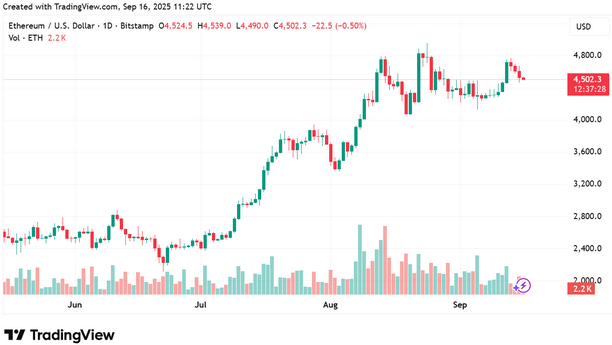
Ethereum Price Prediction: ETH Targets $10,000 In 2026 But Layer Brett Could Reach $1 From $0.0058

Ethereum Price Prediction: ETH Targets $10,000 In 2026 But Layer Brett Could Reach $1 From $0.0058

Ethereum price predictions are turning heads, with analysts suggesting ETH could climb to $10,000 by 2026 as institutional demand and network upgrades drive growth. While Ethereum remains a blue-chip asset, investors looking for sharper multiples are eyeing Layer Brett (LBRETT). Currently in presale at just $0.0058, the Ethereum Layer 2 meme coin is drawing huge [...] The post Ethereum Price Prediction: ETH Targets $10,000 In 2026 But Layer Brett Could Reach $1 From $0.0058 appeared first on Blockonomi.
Share
Blockonomi2025/09/17 23:45