Imagine a world where managing your finances is as simple as scrolling through your favorite social media app. Just a decade ago, budgeting and investing requiredImagine a world where managing your finances is as simple as scrolling through your favorite social media app. Just a decade ago, budgeting and investing required

Personal Finance App Industry Statistics 2026: Smart Money Apps Now

2026/03/12 12:34
7 min read
For feedback or concerns regarding this content, please contact us at crypto.news@mexc.com

Imagine a world where managing your finances is as simple as scrolling through your favorite social media app. Just a decade ago, budgeting and investing required spreadsheets and constant financial oversight. Today, personal finance apps have transformed how we manage our money, putting the power of budgeting, investing, and financial planning right in our pockets.

With growing adoption rates and a constantly evolving tech landscape, the personal finance app industry is more vibrant and expansive than ever. These apps will not only help individuals track expenses but also integrate with broader financial services, providing users with tailored insights and automated wealth management options.

Editor’s Choice

  • Digital personal finance apps are expected to grow at about 12.6% CAGR from 2026 to 2033, driven by rising smartphone adoption.​
  • Global user growth is forecast to rise by roughly 14% annually, reaching around 1.8 billion personal finance app users by mid‑decade.​
  • North America holds about 35% of the digital personal finance apps market share, followed by Europe with around 25%.​
  • Asia‑Pacific is projected to capture about 30% of the digital personal finance app share as the fastest‑growing region.​
  • Subscription and premium models contribute roughly 48% of total personal finance app revenue worldwide.​
  • Gen Z and Millennials account for over 70% of personal finance app users, underscoring strong adoption among younger cohorts.​
  • Around 57% of Gen Z primarily use mobile banking apps, reinforcing mobile‑first behavior for personal finance management.

Recent Developments

  • Apple Pay is expected to launch in the Philippines in 2026, following BSP approval for its operation as a payment technology service provider.
  • Plaid Transfer now supports instant pay-ins via Request for Payment on the RTP network, alongside instant payouts via RTP and FedNow for real-time multirail settlements.
  • Zelle reported about $1.2 trillion sent in 2025, with nearly 30% of all dollars flowing to or from small businesses and $357 billion in small-business payments.​
  • Zelle small-business transactions reached 647.6 million, up 23.5%, with 7.7 million enrolled small businesses, up 15% year over year.​
  • Zelle processed over 2 billion payments totaling nearly $600 billion in the first half of 2025, with small-business payments up 31% to 180 million transactions.​
  • Apple Pay’s planned entry in 2026 is expected to follow Google Pay’s rollout, expanding contactless and mobile wallet options for Philippine consumers and merchants.

Personal Finance Apps Market Size Growth

  • The personal finance apps market reached $165.9 billion in 2025, showing strong global adoption of digital money management tools.
  • The market will grow to around $207.69 billion in 2026 as more users rely on apps for budgeting, saving, and investing.
  • The industry will grow at a 25.0% CAGR from 2026 to 2030, reflecting rapid expansion in mobile financial services.
  • Increasing smartphone penetration and fintech innovation will push the market to about $259.6 billion in 2027.
  • AI-powered financial insights and automation will drive the market to nearly $324.5 billion in 2028.
  • Growing demand for digital banking and finance tools will expand the market to around $405.6 billion in 2029.
  • The personal finance apps market will reach approximately $507.64 billion by 2030, more than tripling its 2025 size within five years.
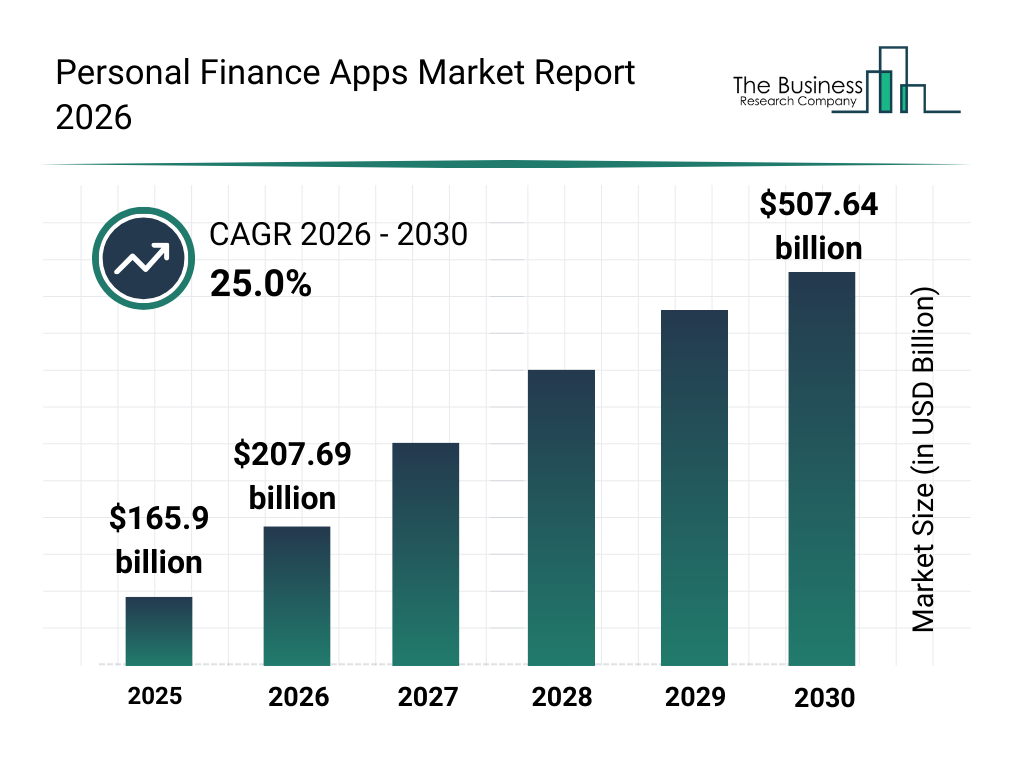
Personal Finance Apps Market Size Growth(Reference: The Business Research Company)

User Demographics

  • Millennials remain the largest personal finance app user group at around 45%, followed by Gen Z at 25% and Gen X at 20%.
  • The average U.S. personal finance app user income is about $70,000, with roughly 60% in the mid- to high-income bracket.
  • Men represent about 55% of global personal finance app users, while women account for 45%, rising to 48% in Europe.
  • Urban consumers make up roughly 75% of personal finance app users worldwide, compared with 25% from suburban and rural areas combined.
  • In the U.S., Hispanic and African American personal finance app users have grown by approximately 18% and 15%, respectively.
  • About 89% of Gen Z use digital banking tools and mostly prefer managing finances through mobile apps rather than branches.
  • Around 57% of Gen Z primarily rely on mobile banking apps for daily financial activities.
  • Roughly 84% of Gen Z and 79% of Millennials are familiar with generative AI and increasingly use AI tools for budgeting and investing.

Key Growth Areas for Finance Apps

  • Around 40% of leading personal finance apps now include wealth management or robo-advisory features as users seek integrated investing tools.
  • Roughly 42% of consumer finance apps offer cryptocurrency tracking, trading, or payment integrations.
  • More than 30% of finance and budgeting apps now use gamification features such as badges, streaks, and milestones to increase engagement.
  • BNPL and flexible payment integrations in finance and shopping apps have grown by over 60% year over year.
  • Financial education-focused apps have seen download growth of roughly 15%, largely driven by younger first-time investors and savers.

Average Cost per Tap in Apple Ads for Finance Apps

  • The global average cost per tap for finance apps reached $6.06.​
  • In the U.S., finance apps saw high CPT as part of North America’s top-cost markets.​
  • The U.K. finance CPT aligns with elevated EMEA costs around $2.60 median.​
  • France recorded a lower CPT at approximately $3.06 for competitive campaigns.​
  • Germany’s average CPT for finance stood near $3.66.​
  • Korea’s finance apps averaged $3.99 CPT amid APAC trends.​
  • Overall, Apple Ads CPT across categories averaged $2.25, with finance being higher.​
  • Finance maintained premium positioning after sports at $6.06 CPT.

Top Finance Apps Ranking

  • Mint leads budgeting apps with 32 million active users.
  • Acorns expanded to 16.2 million customers and $28 billion invested.
  • Cash App holds 59 million monthly active users.
  • YNAB grew its user base by 20% among Gen Z users.
  • Robinhood reports 26.8 million funded customers.
  • Chime neobank reaches 19.5 million active users.
  • Honeydue maintains 1.2 million couples managing joint finances.

Finance App Retention and Engagement

  • AI recommendation apps boosted retention by 42% over standard apps.
  • Average session length increased to 6.8 minutes per user.
  • Weekly logins averaged 5.2 times per active user.
  • Personalized notifications tripled weekly engagement to 13.5 sessions.
  • Gamified goals improved retention by 32% with frequent milestone checks.
  • Tax season Q1 engagement surged by 52% year-over-year.
  • Personalized dashboards lifted daily active usage by 27%.

Personal Finance Investment Portfolio Allocation

  • 34% of investments are allocated to retirement funds like 401k and IRA.
  • 26% directed to high-yield savings accounts for secure returns.
  • 22% invested in individual stocks for growth opportunities.
  • 18% placed in CDs and mutual funds, prioritizing stability.
  • ETFs captured 15% of portfolios amid diversification trends.
  • Real estate investments accounted for 12% of total allocations.
  • Cryptocurrency holdings reached 8% across investor portfolios.
  • Bonds comprised 10%, reflecting risk-averse strategies.
  • ESG funds gained 14% allocation driven by a sustainability focus.
  • Alternative investments like commodities took 5% of portfolios.

Technological Advancements in Personal Finance Apps

  • AI powers 68% of finance apps for budgeting and investment advice.
  • Biometric verification cuts fraud by 70% in adopting apps.
  • Open banking APIs connect 58% of apps to real-time bank data.
  • Voice commands are supported in 22% of apps for quick transactions.
  • Wearable integration reaches 37% of apps for on-the-go tracking.
  • Blockchain security is adopted by 25% of high-end finance apps.

Frequently Asked Questions (FAQs)

What is the estimated size of the broader financial app market in 2026?

The broader financial app market is expected to increase from about $3.45 billion in 2025 to approximately $3.98 billion in 2026.

What is the 2026 valuation and growth outlook of the global neobanking market linked to finance apps?

The global neobanking market, a key driver of app-based personal finance, is projected to grow from about $310.15 billion in 2026 to $7,661.57 billion by 2034 at a 49.30% CAGR.

What market share do savings/checking accounts have within neobanking services in 2026?

Within neobanking services, savings and checking accounts represent around 50.23% of the global market share in 2026.

Conclusion

The personal finance app industry is booming, with rapid growth driven by technological innovations, expanding user demographics, and increased focus on financial literacy. As users demand more integrated and personalized tools, finance apps are adapting with advanced AI, blockchain integration, and seamless banking services. The industry’s leaders continue to evolve while emerging players carve niches with specialized offerings.

This year marks a pivotal moment for finance apps, as they transition from basic budgeting tools to comprehensive financial management platforms, paving the way for an empowered, financially literate global population.

The post Personal Finance App Industry Statistics 2026: Smart Money Apps Now appeared first on CoinLaw.

Market Opportunity
Smart Blockchain Logo
Smart Blockchain Price(SMART)
$0.004179
$0.004179$0.004179
-1.73%
USD
Smart Blockchain (SMART) Live Price Chart
Disclaimer: The articles reposted on this site are sourced from public platforms and are provided for informational purposes only. They do not necessarily reflect the views of MEXC. All rights remain with the original authors. If you believe any content infringes on third-party rights, please contact crypto.news@mexc.com for removal. MEXC makes no guarantees regarding the accuracy, completeness, or timeliness of the content and is not responsible for any actions taken based on the information provided. The content does not constitute financial, legal, or other professional advice, nor should it be considered a recommendation or endorsement by MEXC.

You May Also Like

UNI Price Prediction: Testing $4.17 Upper Band Resistance, Targets $4.50 by April 2026

UNI Price Prediction: Testing $4.17 Upper Band Resistance, Targets $4.50 by April 2026

Uniswap trades at $3.88 with neutral RSI at 51.98. Technical analysis suggests potential breakout to $4.17 upper Bollinger Band, with bullish targets reaching $
Share
BlockChain News2026/03/12 17:21
Speed, Cost, and Intelligence: How Kie.ai’s Gemini 3 Flash API Balances Performance and Budget for Developers

Speed, Cost, and Intelligence: How Kie.ai’s Gemini 3 Flash API Balances Performance and Budget for Developers

Integrating AI into applications is a balancing act between performance, cost, and intelligence. Traditionally, high-performance AI models come with steep costs
Share
Techbullion2026/03/12 16:55
Cash Flow Valuation HyperLiquid: Could $HYPE Reach $385 in Five Years?

Cash Flow Valuation HyperLiquid: Could $HYPE Reach $385 in Five Years?

Author: G3ronimo Compiled by: TechFlow HyperLiquid has grown into a mature crypto-native exchange, with the majority of its net fees programmatically distributed directly to token holders through an "Assistance Fund" (AF). This design makes $HYPE one of the few tokens capable of being valued based on cash flow. To date, most valuations of HyperLiquid have relied on traditional multiples, comparing it to established financial platforms like Coinbase and Robinhood, using EBITDA or revenue multiples as a reference. Unlike traditional corporate stocks, where management typically retains and reinvests earnings at their discretion, HyperLiquid systematically returns 93% of transaction fees directly to token holders through a support fund. This model creates predictable and quantifiable cash flows, making it well-suited for detailed discounted cash flow (DCF) analysis rather than static multiple comparisons. Our methodology begins by determining $HYPE's cost of capital. We then invert the current market price to determine the market-implied future earnings. Finally, we apply growth projections to these earnings streams and compare the resulting intrinsic value to today's market price, revealing the valuation gap between current pricing and fundamental value. Why choose discounted cash flow (DCF) over a multiple? While other valuation methods compare HyperLiquid to Coinbase and Robinhood via EBITDA multiples, these methods have the following limitations: The difference between the corporate and token structures: Coinbase and Robinhood are corporate stocks, whose capital allocation is guided by the board of directors, and profits are retained and reinvested by management; while HyperLiquid systematically returns 93% of trading fees directly to token holders through a relief fund. Direct Cash Flow: HyperLiquid's design generates predictable cash flows that are well-suited to DCF models, rather than static multiples. Growth and risk characteristics: DCFs are able to explicitly model different growth scenarios and risk adjustments, whereas multiples may not adequately capture growth and risk dynamics. Determining an appropriate discount rate To determine our cost of equity, we start with reference data from the public market and adjust for cryptocurrency-specific risks: Cost of equity (r) ≈ Risk-free rate + β × Market risk premium + Crypto/illiquidity premium Beta Analysis Based on regression analysis with the S&P 500: Robinhood (HOOD): Beta of 2.5, implied cost of equity of 15.6%; Coinbase (COIN): Beta of 2.0, implied cost of equity of 13.6%; HyperLiquid (HYPE): Beta is 1.38 and the implied cost of equity is 10.5%. At first glance, $HYPE appears to have a lower beta, and therefore a lower cost of equity than Robinhood and Coinbase. However, the R² value reveals an important limitation: HOOD: The S&P 500 explains 50% of its returns; COIN: The S&P 500 explains 34% of its return; HYPE: The S&P 500 only explains 5% of its returns. $HYPE’s low R² suggests that traditional stock market factors are insufficient to explain its price fluctuations, and crypto-native risk factors need to be considered. risk assessment Despite $HYPE’s lower beta, we still adjust its discount rate from 10.5% to 13% (which is more conservative compared to COIN’s 13.6% and HOOD’s 15.6%) for the following reasons: Lower governance risk: Direct programmatic distribution of 93% of fees reduces concerns about corporate governance. In contrast, COIN and HOOD do not return any earnings to shareholders, and their capital allocation is determined by management. Higher Market Risk: $HYPE is a crypto-native asset and is subject to additional regulatory and technological uncertainties. Liquidity considerations: Token markets are generally less liquid than established stock markets. Get the Market Implied Price (MIP) Using our 13% discount rate, we can reverse engineer the market’s implied earnings expectations at the current $HYPE token price of approximately $54: Current market expectations: 2025: Total revenue of $700 million 2026: Total revenue of $1.4 billion Terminal growth: 3% annual growth thereafter These assumptions yield an intrinsic value of approximately $54, which is consistent with current market prices. This suggests that the market is pricing in modest growth based on current fee levels. At this point we need to ask a question: Does the market-implied price (MIP) reflect future cash flows? Alternative growth scenarios @Keisan_Crypto presents an attractive 2-year and 5-year bull market scenario. Original tweet link: Click here Two-year bull market forecast According to @Keisan_Crypto’s analysis, if HyperLiquid achieves the following goals: Annualized fees: $3.6 billion Aid fund income: $3.35 billion (93% of fees) Result: HYPE's intrinsic value is $128 (140% undervalued at current price) Related links Five-year bull market scenario Under a five-year bull market scenario (link), he predicts that transaction fees will reach $10 billion annually, with $9.3 billion accruing to $HYPE. He assumes HyperLiquid's global market share will grow from its current 5% to 50% by 2030. Even if it doesn't reach 50% market share, these figures are still achievable with a smaller market share as global trading volumes continue to grow. Five-year bull market forecast Annualized fees: $10 billion Aid fund income: $9.3 billion Result: HYPE's intrinsic value is $385 (600% undervalued at current price) Related links While this valuation is lower than Keisan's $1,000 target, the difference stems from our assumption of normalized earnings growth at 3% annually thereafter, while Keisan's model uses a cash flow multiple. We believe using cash flow multiples to project long-term value is problematic, as market multiples are volatile and can vary significantly over time. Furthermore, the multiples themselves incorporate earnings growth assumptions, while using the same cash flow multiple five years from now as one or two years later implies that growth levels from 2030 onward will be consistent with those in 2026/2027. Therefore, the multiples are more appropriate for short-term asset pricing. However, regardless of which model is used, $HYPE remains undervalued; this is a subtle difference. Additional Value Driver: USDH Under the Native Market model, USDH will use 50% of its stablecoin revenue for buybacks similar to a bailout fund. As a result, $HYPE can increase its free cash flow by $100 million (50% of $200 million) annually. Looking ahead five years, if USDH's market capitalization reaches $25 billion (currently still one-third of USDC's, and an even smaller portion of the total stablecoin market five years from now), its annual revenue could reach $1 billion. Following the same 50% distribution model, this would generate an additional $500 million in free cash flow per year for the aid fund. This would value each token at over $400. Excluding Value Drivers: HIP-3 and HyperEVM This DCF analysis intentionally excludes two important potential value drivers that are not amenable to cash flow modeling. Clearly, these would provide additional incremental value and could therefore be evaluated separately using different valuation methodologies and then added to this valuation. Summarize Our DCF analysis indicates that if HyperLiquid can maintain its growth trajectory and market position, the $HYPE token is significantly undervalued. The token's unique feature of programmatic fee distribution makes it particularly suitable for cash flow-based valuation methodologies. Methodological Notes This analysis builds on research by @Keisan_Crypto and @GLC_Research. The DCF model is open source and can be modified at the following link: https://valypto.xyz/project/hyperliquid/oNQraQIg Market data and forecasts are subject to change, and models should be updated promptly based on the latest information.
Share
PANews2025/09/19 08:00
