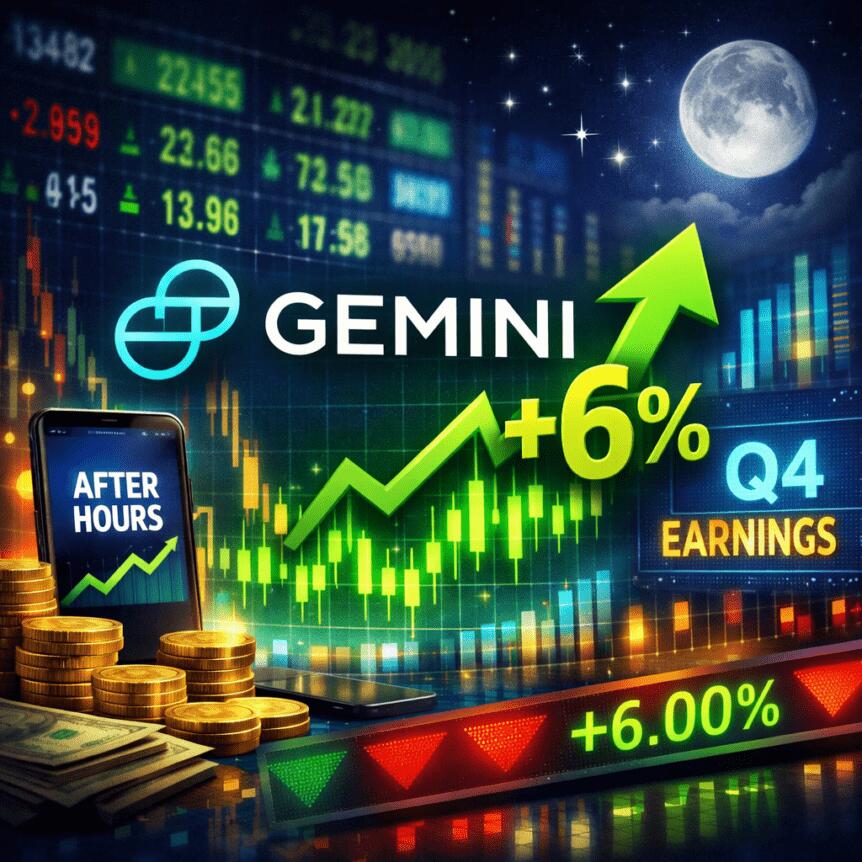
Gemini stock gains 6% after-hours on Q4 earnings
Gemini pushed through a better-than-expected fourth quarter even as the broader crypto market remained under pressure. The exchange reported revenue of $60.3 million for Q4, up 39% from a year earlier and ahead of consensus estimates of about $51.7 million. However, the company also posted a net loss of $140.8 million for the quarter, widening from a $27 million loss in the same period a year ago. For the full year, Gemini’s loss totaled $585 million in 2025, compared with $156.6 million in 2024. The results come after the platform went public in September and amid a late-2025 crypto drawdown that saw Bitcoin slide from its peak above $126,000 in October.
Shares of Gemini initially moved higher in after-hours trading, climbing as much as 14% to a high of $6.83 before settling around $6.36, for a gain of roughly 6% on the session. The day’s action mirrored the market’s mixed reception to a growth-focused quarter that delivered a revenue win but did not escape the ongoing profitability challenge for many crypto incumbents.
Key takeaways
- Gemini’s Q4 revenue of $60.3 million rose 39% year over year and beat estimates of about $51.7 million, signaling business momentum even as trading volumes cooled.
- The quarter produced a net loss of $140.8 million, deepening from a $27 million loss a year earlier; the company’s 2025 loss reached $585 million, higher than 2024’s $156.6 million.
- Management cited deliberate fee-structure optimization and other efficiency measures as drivers of revenue growth, even with a softer trading environment.
- Gemini is accelerating a strategic shift toward a markets-focused organization, highlighted by the launch of Gemini Predictions across all 50 states and a plan to leverage that infrastructure for perpetual futures once approved in the U.S.
Strategic ambitions sharpen as cost discipline takes center stage
In a February update, Gemini said it was trimming its workforce by roughly 30% since the start of 2026, citing challenging market conditions. The leadership framing this downsizing as part of a broader pivot toward a more AI-driven, efficiency-first operating model. Co-founders Cameron and Tyler Winklevoss highlighted a rapid integration of artificial intelligence into the development process, noting that AI is now used in more than 40% of production code changes and is expected to rise significantly in the near term. “Not using AI at Gemini will soon be the equivalent of showing up to work with a typewriter instead of a laptop,” they wrote in a shareholder letter.
The Winklevoss duo signaled a clear pivot toward a U.S.-centric growth strategy, underscoring optimism about a pro-crypto regulatory environment in the United States. They stressed that 2026 would be about focusing and expanding in America, aligning with a broader investor interest in platforms that can scale within clearer regulatory boundaries.
From trading floors to markets infrastructure: Predictions and futures ambitions
Gemini has been building out its markets-oriented toolkit, most notably with Gemini Predictions. The platform rolled out its in-house prediction market across all 50 states in December, shortly after obtaining a license from the Commodity Futures Trading Commission. The company described its longer-term plan as turning Gemini into a “markets company” anchored by predictions, with the potential to extend that framework to perpetual futures contracts once U.S. approval is secured.
The December launch followed a prior line of coverage noting Gemini’s broader ambition to expand beyond traditional exchange functions into more complex financial primitives. As part of the 2026 roadmap, the company intends to refine and grow Predictions while simultaneously scaling its credit card program and exchange services, tapping into a more diversified revenue mix that could help weather ongoing volatility in crypto trading volumes. In evaluating the strategic path, investors will also be watching how regulatory feedback in the U.S. shapes the pace of approvals for new product categories, including perpetual futures.
These plans come against the backdrop of a February update that confirmed Gemini’s withdrawal from the U.K., the EU and Australia, a move the company attributed to tougher market conditions. The leadership’s stated aim is to “focus and double down on America,” a stance that aligns with the firm’s renewed investment in U.S.-based market infrastructure and its growing bets on a more favorable regulatory climate for crypto innovation.
The company’s quarterly results reflect a broader pattern among newer, publicly traded crypto platforms: revenue growth can outpace trading volumes due to fee-structure optimization, product diversification and active expansion into non-trading monetization streams. Gemini’s fourth-quarter performance—driven by its credit card program and pricing strategy—offers a data point suggesting that meaningful upside can still emerge even amid a subdued price cycle. The question for investors now is whether the path to profitability can be accelerated through AI-enabled efficiency gains and a clearer, U.S.-centered growth engine, supported by product bets in prediction markets and, potentially, regulated futures.
According to the company’s investor materials, the Q4 results marked the highest quarterly revenue in three years, reflecting the impact of the revised fee structure through the back half of 2025 and a push into more monetizable products. The combination of revenue resilience and continued investment in AI-driven scale positions Gemini as a case study in how crypto platforms seek to balance growth with cost discipline during a protracted market downturn.
For investors and builders watching the sector, the key takeaway is that 2026 could hinge on how quickly Gemini translates its market infrastructure into sustainable profitability, the pace at which U.S. regulators greenlight broader product suites, and how effectively the firm scales non-trading revenue streams, like predictions markets and card programs, in a regulated environment.
Readers should keep an eye on next-quarter earnings and regulatory developments that could determine the speed at which Gemini completes its shift toward a broader markets-facing business model while continuing to nurture its consumer-facing products.
This article was originally published as Gemini stock gains 6% after-hours on Q4 earnings on Crypto Breaking News – your trusted source for crypto news, Bitcoin news, and blockchain updates.
You May Also Like

EUR/CHF slides as Euro struggles post-inflation data

Interview | HIVE CFO: Hydro-cooled mining and AI cloud give us an edge post-halving