Key Takeaways: The late-2024 Fed rate cuts triggered crypto rallies. Bitcoin and Ethereum both posted double-digit gains in the first weeks. Later cuts saw weaker or even negative moves, as the market had already priced in easier policy. Crypto tends to react most strongly to the first signs of a policy shift rather than to continued easing. With another rate cut expected this month, it’s unclear whether history will repeat. Other forces like sentiment, regulation, and global risks could play a role. The Federal Reserve is expected to cut interest rates by 25 basis points later in October. According to the CME Group’s FedWatch Tool, there is now a 96.7 % chance of a rate cut at the next meeting. At the same time, the crypto market is under pressure from other macro headlines, such as the Donald Trump-China tariffs and worries about U.S. regional banks and bad loans. How could the next rate cut affect crypto? When the Fed cuts rates, the market often experiences short-term volatility. While cuts are usually seen as a tailwind, the actual outcome depends on more than just policy: overall economic conditions, market sentiment, regulation, and geopolitical events all matter. In this research, we examine the latest four Fed rate cuts — September 18, 2024, November 7, 2024, December 18, 2024, and September 17, 2025 — and look at how they affected Bitcoin and Ethereum immediately after the announcements. The September 2024 cut sparked the biggest rally of the cycle. Within a week, Bitcoin jumped about 6.6% to around $64,300, and Ethereum climbed nearly 13% to $2,650. Over the next month, both gained roughly 11%. That could mean investors welcomed the Fed’s first clear pivot toward easier policy. After the November 2024 cut, Bitcoin surged 16% in a week and more than 32% in a month. Ethereum rose 17% and 47.5% over the same periods. By December 2024, the rally began to cool. Bitcoin briefly broke above $108,000 before falling back below $100,000. Ethereum dropped about 10% over the following month. The most recent cut in September 2025 came at a time of already low rates and softer sentiment. Bitcoin slipped about 7% in the next month, and Ethereum lost around 13%. That could mean the impact of monetary easing is starting to fade for crypto. The chart below tracks the Ethereum price against changes in the Fed’s rate. It shows general ETH/ USD price trends from September 2024 through October 2025. The right axis shows how much the Fed funds rate has fallen in total since the start of the easing cycle.The ETH price line between points illustrates general movement across policy events and does not capture intra-period fluctuations. The data shows how the first rate cuts in September and November 2024 came with strong crypto rallies, while the later ones in December 2024 and September 2025 brought smaller or even negative moves. It suggests the market’s reaction weakened as investors had already priced in easier policy. What It Means The first two moves in September and November 2024 delivered the biggest gains, with Bitcoin and Ethereum both posting double-digit jumps over the following weeks. However, by late 2024, the excitement seems to have faded. Markets had already priced in continued easing, and later cuts brought little or no upside. The strongest reaction came early in the cycle, when investors first sensed a turn toward looser policy. As the Fed is expected to cut rates again this month, history shows that Bitcoin and Ethereum often react quickly at first but lose steam as the easing cycle continues. Market sentiment, regulation, and global risks also play a role, which suggests that monetary policy is only part of the story Key Takeaways: The late-2024 Fed rate cuts triggered crypto rallies. Bitcoin and Ethereum both posted double-digit gains in the first weeks. Later cuts saw weaker or even negative moves, as the market had already priced in easier policy. Crypto tends to react most strongly to the first signs of a policy shift rather than to continued easing. With another rate cut expected this month, it’s unclear whether history will repeat. Other forces like sentiment, regulation, and global risks could play a role. The Federal Reserve is expected to cut interest rates by 25 basis points later in October. According to the CME Group’s FedWatch Tool, there is now a 96.7 % chance of a rate cut at the next meeting. At the same time, the crypto market is under pressure from other macro headlines, such as the Donald Trump-China tariffs and worries about U.S. regional banks and bad loans. How could the next rate cut affect crypto? When the Fed cuts rates, the market often experiences short-term volatility. While cuts are usually seen as a tailwind, the actual outcome depends on more than just policy: overall economic conditions, market sentiment, regulation, and geopolitical events all matter. In this research, we examine the latest four Fed rate cuts — September 18, 2024, November 7, 2024, December 18, 2024, and September 17, 2025 — and look at how they affected Bitcoin and Ethereum immediately after the announcements. The September 2024 cut sparked the biggest rally of the cycle. Within a week, Bitcoin jumped about 6.6% to around $64,300, and Ethereum climbed nearly 13% to $2,650. Over the next month, both gained roughly 11%. That could mean investors welcomed the Fed’s first clear pivot toward easier policy. After the November 2024 cut, Bitcoin surged 16% in a week and more than 32% in a month. Ethereum rose 17% and 47.5% over the same periods. By December 2024, the rally began to cool. Bitcoin briefly broke above $108,000 before falling back below $100,000. Ethereum dropped about 10% over the following month. The most recent cut in September 2025 came at a time of already low rates and softer sentiment. Bitcoin slipped about 7% in the next month, and Ethereum lost around 13%. That could mean the impact of monetary easing is starting to fade for crypto. The chart below tracks the Ethereum price against changes in the Fed’s rate. It shows general ETH/ USD price trends from September 2024 through October 2025. The right axis shows how much the Fed funds rate has fallen in total since the start of the easing cycle.The ETH price line between points illustrates general movement across policy events and does not capture intra-period fluctuations. The data shows how the first rate cuts in September and November 2024 came with strong crypto rallies, while the later ones in December 2024 and September 2025 brought smaller or even negative moves. It suggests the market’s reaction weakened as investors had already priced in easier policy. What It Means The first two moves in September and November 2024 delivered the biggest gains, with Bitcoin and Ethereum both posting double-digit jumps over the following weeks. However, by late 2024, the excitement seems to have faded. Markets had already priced in continued easing, and later cuts brought little or no upside. The strongest reaction came early in the cycle, when investors first sensed a turn toward looser policy. As the Fed is expected to cut rates again this month, history shows that Bitcoin and Ethereum often react quickly at first but lose steam as the easing cycle continues. Market sentiment, regulation, and global risks also play a role, which suggests that monetary policy is only part of the story

How Could Fed’s Next Rate Cut Affect Bitcoin and Ethereum? Here’s What History Shows

Key Takeaways:

  • The late-2024 Fed rate cuts triggered crypto rallies. Bitcoin and Ethereum both posted double-digit gains in the first weeks.
  • Later cuts saw weaker or even negative moves, as the market had already priced in easier policy.
  • Crypto tends to react most strongly to the first signs of a policy shift rather than to continued easing.
  • With another rate cut expected this month, it’s unclear whether history will repeat. Other forces like sentiment, regulation, and global risks could play a role.

The Federal Reserve is expected to cut interest rates by 25 basis points later in October. According to the CME Group’s FedWatch Tool, there is now a 96.7 % chance of a rate cut at the next meeting. At the same time, the crypto market is under pressure from other macro headlines, such as the Donald Trump-China tariffs and worries about U.S. regional banks and bad loans.

How could the next rate cut affect crypto? When the Fed cuts rates, the market often experiences short-term volatility. While cuts are usually seen as a tailwind, the actual outcome depends on more than just policy: overall economic conditions, market sentiment, regulation, and geopolitical events all matter.

In this research, we examine the latest four Fed rate cuts — September 18, 2024, November 7, 2024, December 18, 2024, and September 17, 2025 — and look at how they affected Bitcoin and Ethereum immediately after the announcements.
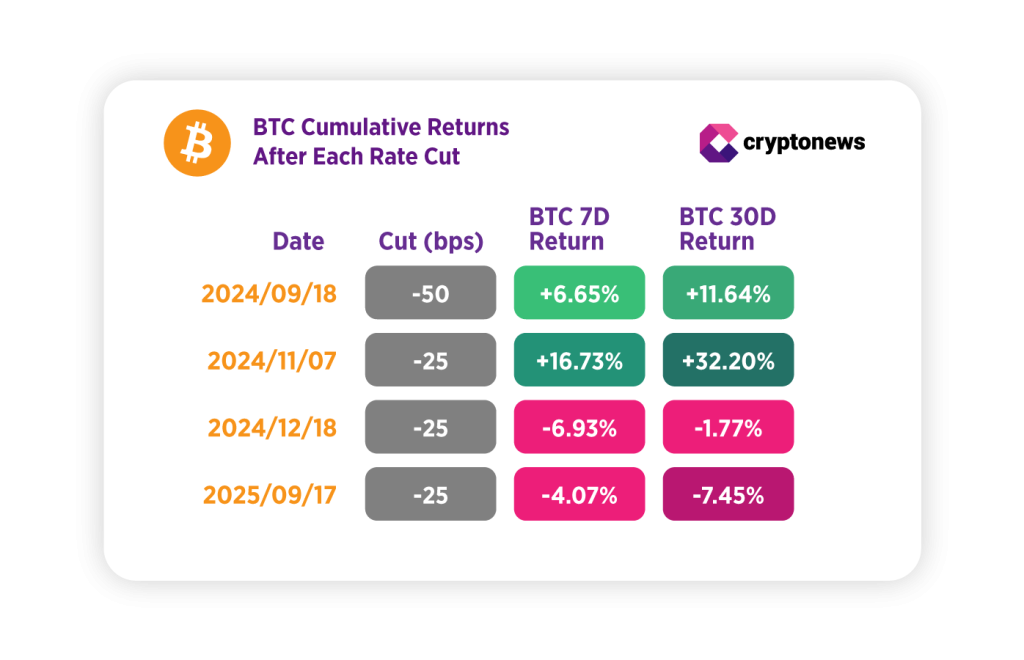
The September 2024 cut sparked the biggest rally of the cycle. Within a week, Bitcoin jumped about 6.6% to around $64,300, and Ethereum climbed nearly 13% to $2,650. Over the next month, both gained roughly 11%. That could mean investors welcomed the Fed’s first clear pivot toward easier policy.

After the November 2024 cut, Bitcoin surged 16% in a week and more than 32% in a month. Ethereum rose 17% and 47.5% over the same periods.

By December 2024, the rally began to cool. Bitcoin briefly broke above $108,000 before falling back below $100,000. Ethereum dropped about 10% over the following month.

The most recent cut in September 2025 came at a time of already low rates and softer sentiment. Bitcoin slipped about 7% in the next month, and Ethereum lost around 13%. That could mean the impact of monetary easing is starting to fade for crypto.

The chart below tracks the Ethereum price against changes in the Fed’s rate. It shows general ETH/ USD price trends from September 2024 through October 2025. The right axis shows how much the Fed funds rate has fallen in total since the start of the easing cycle.

The ETH price line between points illustrates general movement across policy events and does not capture intra-period fluctuations.

The data shows how the first rate cuts in September and November 2024 came with strong crypto rallies, while the later ones in December 2024 and September 2025 brought smaller or even negative moves. It suggests the market’s reaction weakened as investors had already priced in easier policy.

What It Means

The first two moves in September and November 2024 delivered the biggest gains, with Bitcoin and Ethereum both posting double-digit jumps over the following weeks.

However, by late 2024, the excitement seems to have faded. Markets had already priced in continued easing, and later cuts brought little or no upside. The strongest reaction came early in the cycle, when investors first sensed a turn toward looser policy.

As the Fed is expected to cut rates again this month, history shows that Bitcoin and Ethereum often react quickly at first but lose steam as the easing cycle continues. Market sentiment, regulation, and global risks also play a role, which suggests that monetary policy is only part of the story.

Sorumluluk Reddi: Bu sitede yeniden yayınlanan makaleler, halka açık platformlardan alınmıştır ve yalnızca bilgilendirme amaçlıdır. MEXC'nin görüşlerini yansıtmayabilir. Tüm hakları telif sahiplerine aittir. Herhangi bir içeriğin üçüncü taraf haklarını ihlal ettiğini düşünüyorsanız, kaldırılması için lütfen service@support.mexc.com ile iletişime geçin. MEXC, içeriğin doğruluğu, eksiksizliği veya güncelliği konusunda hiçbir garanti vermez ve sağlanan bilgilere dayalı olarak alınan herhangi bir eylemden sorumlu değildir. İçerik, finansal, yasal veya diğer profesyonel tavsiye niteliğinde değildir ve MEXC tarafından bir tavsiye veya onay olarak değerlendirilmemelidir.

Ayrıca Şunları da Beğenebilirsiniz

MoneyGram launches stablecoin-powered app in Colombia

MoneyGram launches stablecoin-powered app in Colombia

The post MoneyGram launches stablecoin-powered app in Colombia appeared on BitcoinEthereumNews.com. MoneyGram has launched a new mobile application in Colombia that uses USD-pegged stablecoins to modernize cross-border remittances. According to an announcement on Wednesday, the app allows customers to receive money instantly into a US dollar balance backed by Circle’s USDC stablecoin, which can be stored, spent, or cashed out through MoneyGram’s global retail network. The rollout is designed to address the volatility of local currencies, particularly the Colombian peso. Built on the Stellar blockchain and supported by wallet infrastructure provider Crossmint, the app marks MoneyGram’s most significant move yet to integrate stablecoins into consumer-facing services. Colombia was selected as the first market due to its heavy reliance on inbound remittances—families in the country receive more than 22 times the amount they send abroad, according to Statista. The announcement said future expansions will target other remittance-heavy markets. MoneyGram, which has nearly 500,000 retail locations globally, has experimented with blockchain rails since partnering with the Stellar Development Foundation in 2021. It has since built cash on and off ramps for stablecoins, developed APIs for crypto integration, and incorporated stablecoins into its internal settlement processes. “This launch is the first step toward a world where every person, everywhere, has access to dollar stablecoins,” CEO Anthony Soohoo stated. The company emphasized compliance, citing decades of regulatory experience, though stablecoin oversight remains fluid. The US Congress passed the GENIUS Act earlier this year, establishing a framework for stablecoin regulation, which MoneyGram has pointed to as providing clearer guardrails. This is a developing story. This article was generated with the assistance of AI and reviewed by editor Jeffrey Albus before publication. Get the news in your inbox. Explore Blockworks newsletters: Source: https://blockworks.co/news/moneygram-stablecoin-app-colombia
Paylaş
BitcoinEthereumNews2025/09/18 07:04
WIF Price Prediction: Targeting $0.48 Recovery Within 2 Weeks as MACD Shows Bullish Divergence

WIF Price Prediction: Targeting $0.48 Recovery Within 2 Weeks as MACD Shows Bullish Divergence

The post WIF Price Prediction: Targeting $0.48 Recovery Within 2 Weeks as MACD Shows Bullish Divergence appeared on BitcoinEthereumNews.com. James Ding Dec 16
Paylaş
BitcoinEthereumNews2025/12/17 17:32
Tokyo’s Metaplanet Launches Miami Subsidiary to Amplify Bitcoin Income

Tokyo’s Metaplanet Launches Miami Subsidiary to Amplify Bitcoin Income

Metaplanet Inc., the Japanese public company known for its bitcoin treasury, is launching a Miami subsidiary to run a dedicated derivatives and income strategy aimed at turning holdings into steady, U.S.-based cash flow. Japanese Bitcoin Treasury Player Metaplanet Opens Miami Outpost The new entity, Metaplanet Income Corp., sits under Metaplanet Holdings, Inc. and is based […]
Paylaş
Coinstats2025/09/18 00:32