Launchpad

Launchpads are decentralized platforms that facilitate early-stage fundraising for new Web3 projects through Initial DEX Offerings (IDOs). They provide investors with curated access to token sales while offering startups a community-driven capital injection. In 2026, launchpads have evolved into full-stack incubators, focusing on project quality and long-term sustainability. Follow this tag for the latest in token distribution models, tier-based participation, and the emergence of the next generation of "unicorn" protocols across various blockchain ecosystems.

2918 Articles
Created: 2026/02/02 18:52
Updated: 2026/02/02 18:52

Too Late for Polkadot’s $55 Peak? MoonBull Shows Why It’s the Best Crypto to Join for Short Term Gains in 2025

Too Late for Polkadot’s $55 Peak? MoonBull Shows Why It’s the Best Crypto to Join for Short Term Gains in 2025

Best crypto to join for short term gains is the question echoing in every community chat right now. How many […] The post Too Late for Polkadot’s $55 Peak? MoonBull Shows Why It’s the Best Crypto to Join for Short Term Gains in 2025 appeared first on Coindoo.

Author: Coindoo
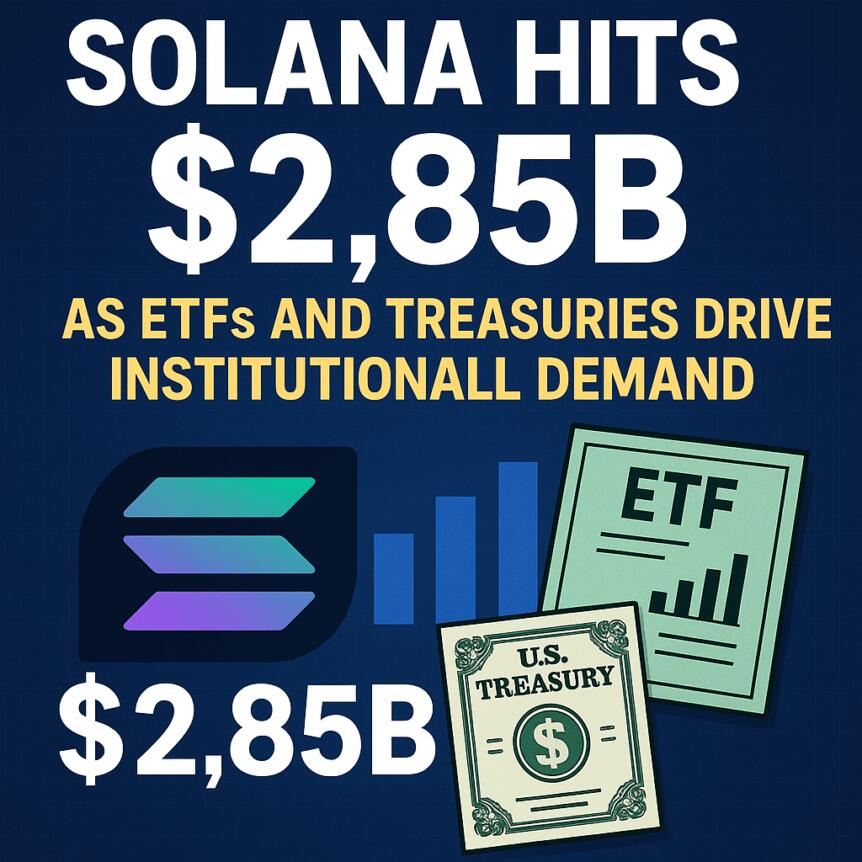
Solana Hits $2.85B as ETFs and Treasuries Drive Institutional Demand

Solana Hits $2.85B as ETFs and Treasuries Drive Institutional Demand

As the cryptocurrency landscape continues to evolve, Solana has emerged as a significant revenue-generating blockchain platform, with recent reports highlighting its impressive financial performance over the past year. Driven largely by activity on trading platforms and various ecosystem applications, Solana’s revenue showcases its growing influence within the broader crypto markets. Solana earned approximately $2.85 billion [...]

Author: Crypto Breaking News
Solana’s $2.8B revenue outpaces Ethereum’s early growth: 21Shares

Solana’s $2.8B revenue outpaces Ethereum’s early growth: 21Shares

                                                                               Solana pulled in $2.85 billion in annual revenue across DeFi, AI and trading apps, as institutions push the network into mainstream finance.                     Solana generated $2.85 billion in revenue over the past year, according to a new report from 21Shares, driven by trading platform activity. Between October 2024 and September 2025, Solana averaged about $240 million in monthly revenue, peaking at $616 million in January during the memecoin boom led by tokens like Official Trump (TRUMP). But even after the frenzy cooled, monthly revenue was between $150 million and $250 million.Solana validators earn revenue from fees on transactions. Over the past year, revenue from fees flowed from across the ecosystem, including decentralized finance (DeFi), memecoins, AI apps, decentralized exchanges, DePIN, launchpads and trading tools.Read more

Author: Coinstats
Bitcoin Leads the Market, but Experts Call This New Altcoin the Best Buy of 2025

Bitcoin Leads the Market, but Experts Call This New Altcoin the Best Buy of 2025

Bitcoin continues to make headlines with breathtaking strength. Over the past 24 hours it surged past prior highs, briefly touching […] The post Bitcoin Leads the Market, but Experts Call This New Altcoin the Best Buy of 2025 appeared first on Coindoo.

Author: Coindoo
3 Meme Coins to Stack for Big Gains in 2025 If Dogecoin (DOGE) at $0.002 Passed You

3 Meme Coins to Stack for Big Gains in 2025 If Dogecoin (DOGE) at $0.002 Passed You

Shiba Inu (SHIB) and Pepe (PEPE) repeated the script, minting fortunes for those who spotted the trend early. In this […] The post 3 Meme Coins to Stack for Big Gains in 2025 If Dogecoin (DOGE) at $0.002 Passed You appeared first on Coindoo.

Author: Coindoo
This Low-Priced Competitor to Dogecoin (DOGE) Could Rise 12044% from Under $0.003

This Low-Priced Competitor to Dogecoin (DOGE) Could Rise 12044% from Under $0.003

The post This Low-Priced Competitor to Dogecoin (DOGE) Could Rise 12044% from Under $0.003 appeared on BitcoinEthereumNews.com. Little Pepe ($LILPEPE) has positioned itself as a utility-driven meme coin built on its own Ethereum-compatible Layer 2 blockchain. At its presale price of only $0.0022 in Stage 13, the LILPEPE token is still below the $0.003 threshold, but the expected growth of 12,044% shows the possibility of early entry levels.  The high presale demand, tokenomics, and zero tax design of the project make it a serious threat to Dogecoin, unlike the conventional meme coins. Little Pepe has sold 16,183,380,869 tokens at its present stage, which has raised $26,428,440 of the targeted $28,775,000. The presale’s next phase, Stage 14, will increase the token price to $0.0023. Presale Journey and Investor Gains The LILPEPE presale started at $0.0010 during stage 1; at stage 2 it was $0.0011, and the third stage was priced at $0.0012. Stage 4 was selling at a price of $0.0013. Stage 5 had a significant role with a selling price of $0.0014. Stage 6 depleted the allocated token and was priced at $0.0015. Additionally, stage 7 was depleted at a price value of $0.0016. The 8th stage also depleted at a price of $0.0017. After this stage, level 9 took control with a pricing value of $0.0018. Stage 10 then took over, and the LILPEPE tokens were priced at $0.0019. The presale stage 11, priced at $0.0020, ushered in stage 12, which was completed fully at $0.0021. Stage 13 is now live, priced at $0.0022. The next stage will be stage 14 and will see another price increase to $0.0023, maintaining the gaining spree for those who opted in early, with more expected. This structured growth reflects a steady accumulation trend. Early participants from Stage 1 already see more than double their entry value. The presale’s Stage 13 completion rate stands at 93.82%, with limited tokens remaining…

Author: BitcoinEthereumNews
Umbra’s ICO and MetaDAO’s ‘Unruggable’ futarchy take center stage

Umbra’s ICO and MetaDAO’s ‘Unruggable’ futarchy take center stage

The post Umbra’s ICO and MetaDAO’s ‘Unruggable’ futarchy take center stage appeared on BitcoinEthereumNews.com. This is a segment from the Lightspeed newsletter. To read full editions, subscribe. A little-known privacy project, Umbra, launched its initial coin offering (ICO) on Solana yesterday. As I write this, Umbra is already 1169% oversubscribed over its $750 million raise target. Source: MetaDAO The real story here isn’t Umbra — it’s the infrastructure that’s powering its sale: MetaDAO’s “Unruggable ICO” futarchy launchpad. A lot has already been written on the intersection of crypto and futarchy by people smarter than me, but here’s the gist: Futarchy is the simple idea that governance should be decided by markets, rather than “one man, one vote” democratic rules, or DAO token voting. If you believe Donald Trump will spur economic growth more than Joe Biden, buying “Pass Trump” shares will get him elected if enough traders buy it past a set threshold. Or if you believe Facebook spending $50 billion on investments in the metaverse will not improve Meta’s stock price, then do the opposite and buy “Fail” shares. Futarchy markets work similarly to prediction markets: They channel the wisdom of markets by requiring participants put their money where their mouth is. The key difference is that with futarchy, actual outcomes are influenced by how markets “vote.” This radical idea was popularized by the libertarian economist Robin Hanson and has existed for years as a topic of nerdy fascination in technolibertarian circles.  (Hanson, incidentally, was also responsible for advancing many of crypto’s major innovations, like automated market makers and prediction markets.) For some time, DAOs like Drift, Sanctum and Marinade have experimented with piecemeal futarchy governance using MetaDAO’s core protocol. The ongoing Umbra ICO is taking place on a relatively newer MetaDAO product, its futarchy-powered ICO launchpad. Source: Blockworks Research By launching on MetaDAO’s ICO launchpad, teams like Umbra in effect bind its…

Author: BitcoinEthereumNews
Meteora's tokenomics arrive ahead of October 23 token rollout

Meteora's tokenomics arrive ahead of October 23 token rollout

Decentralized exchange Meteora has released the economics of its upcoming MET token, just two weeks ahead of its planned liquidity generation event (LGE), scheduled for October 23. The Solana-based liquidity protocol shared details of MET in a Medium post published on Tuesday, unveiling what it calls the “Phoenix Rising Plan.” The tokenomics is meant to eliminate inflation and continuous unlocks, in tandem with the project’s promise for transparency and community participation. Meteora stated that the Phoenix Rising Plan will see all allocated MET tokens liquidated from the outset, with no vesting periods for stakeholders, except for the core team and the Meteora reserve.  ‘LGE’ will unlock all tokens for holders Meteora’s token generation event (TGE) plans to unlock 100% for all stakeholders except the team and long-term reserves. According to the published distribution details, 20% of MET will go to Mercurial stakeholders, while 15% will be distributed to users of Meteora under the platform’s LP stimulus plan. The allocation also commits 3% for launchpads and the launchpool ecosystem, 2% for off-chain contributors, 3% for Jupiter stakers stimulus package, and another 3% for centralized exchanges, market makers, and related entities.  An additional 2% will be distributed to stake-to-earn M3M3 memecoin holders. M3M3 allows users who hold memecoins to stake them and compete for fee rewards derived from liquidity pools that are permanently locked. Only the top stakers, like the top 100 stakeholders by stake size, are eligible for these rewards. Still, Meteora’s internal team and reserve tokens will be subject to long-term vesting schedules. The team will receive 18% of the total supply, which will be vested linearly over a six-year period. The Meteora reserve, accounting for 34%, will follow the same vesting period. Meteora believes this higher initial float could “break apart the low-float/high-FDV models” common in most token launches. Meteora to reconfigure airdrops through liquidity distributor MET’s launch will include a mechanism dubbed the “liquidity distributor,” where instead of early buyers receiving claimable tokens that may prompt immediate selling, recipients will receive a liquidity position that automatically earns trading fees as they gradually “sell” their airdrop exposure over time. Meteora decided to embed the distribution into liquidity pools, allowing airdrop token holders to earn yield through trading fees, rather than needing to sell tokens manually. The platform said that 10% of MET’s circulating supply will be distributed via the liquidity distributor at TGE, and participants can choose their preferred liquidity position.  According to the Solana LP, this enables the project to bootstrap liquidity for the MET debut without requiring the team to supply tokens directly. Liquidity will come from the community, which will also benefit from trading revenue and fees. “This will lead to high volume (fees) for our LP Army and Launch Pool, and lays the foundation for Meteora in the future,” the team stated. Meteora hits $200 billion cumulative DEX volume The 24-hour trading volume of Meteora was $358.1 million, up 35.9% from the previous day, according to statistics from CoinGecko. In addition, data from DefiLlama shows that the platform has made almost $208.7 billion since its start in February 2023 and $30.5 billion in the past 30 days. Among other DEXs, it ranks seventh in total value locked (TVL) with $706.54 million, $300 million less than sixth-place Balancer. Meteora has listed over 840 coins, including wrapped Solana (wSOL), wrapped Bitcoin (wBTC), and popular memecoins such as Official Trump and Popcat. Claim your free seat in an exclusive crypto trading community - limited to 1,000 members.

Author: Coinstats
The 4 Best Cryptos to Invest in This Q4: BlockDAG, Chainlink, Stellar & Polkadot!

The 4 Best Cryptos to Invest in This Q4: BlockDAG, Chainlink, Stellar & Polkadot!

As Q4 unfolds, the conversation around the best crypto to invest in is shifting from hype cycles to real-world execution. Established projects like Chainlink, Stellar, and Polkadot continue to deliver value through core infrastructure, cross-border functionality, and multi-chain interoperability.  At the same time, emerging names like BlockDAG are challenging legacy players by combining mass visibility [...] The post The 4 Best Cryptos to Invest in This Q4: BlockDAG, Chainlink, Stellar & Polkadot! appeared first on Blockonomi.

Author: Blockonomi
Pump.fun’s 80% Grip on Solana Memecoins: Can It Last?

Pump.fun’s 80% Grip on Solana Memecoins: Can It Last?

The post Pump.fun’s 80% Grip on Solana Memecoins: Can It Last? appeared on BitcoinEthereumNews.com. Key takeaways One-click minting, bonding-curve “graduation” and locked LPs concentrated liquidity, pushing Pump.fun’s share to 75%-80% at its peak. Launches and fees are cyclical. After plunging 80% from January highs, activity snapped back by late August. Rivals (LetsBonk, HeavenDEX, Raydium LaunchLab) can flip share in the short term with fees or incentives, but network effects often pull activity back. Security incidents and US class-action litigation (including RICO claims) are the biggest overhangs on durability. Pump.fun is a Solana-native launchpad that makes launching a token as easy as a few clicks. New coins start on a bonding-curve contract, where around 800 million tokens are sold in sequence. Once that supply is bought out, the token “graduates,” and trading automatically shifts to an automated market maker (AMM). Today, that’s Pump.fun’s own decentralized exchange (DEX), PumpSwap (earlier launches migrated to Raydium). For creators, the cost is minimal. There’s no fee to mint, and graduation carries only a small, fixed charge of 0.015 Solana (SOL) deducted from the token’s liquidity rather than as a separate payment. After graduation, PumpSwap burns the liquidity provider (LP) tokens linked to the trading pair, effectively locking liquidity so it can’t be withdrawn manually. Funds can only move through regular trading activity. This design standardizes early price discovery for new memecoins while sharply reducing traditional rug-pull risks. Did you know? Only a tiny fraction of Pump.fun tokens ever “graduate.” In July and August 2025, the graduation rate hovered around 0.7%-0.8% of launches. How Pump.fun captured 80% of Solana’s memecoin launches Pump.fun’s dominance came from pairing ultra-low-friction token creation with a standardized path to liquidity. By routing new tokens through a bonding-curve graduation into an AMM, Pump.fun made early price discovery more predictable and reduced one of the main ways creators could rug-pull. As the Solana meme cycle picked up,…

Author: BitcoinEthereumNews