Oracle

Oracles are essential infrastructure components that feed real-time, off-chain data (such as price feeds, weather, or sports results) into blockchain smart contracts. Without decentralized oracles like Chainlink and Pyth, DeFi could not function. In 2026, oracles have evolved to support verifiable randomness and cross-chain data synchronization. This tag covers the technical evolution of data availability, tamper-proof price feeds, and the critical role oracles play in ensuring the deterministic execution of complex decentralized applications.

5118 Articles
Created: 2026/02/02 18:52
Updated: 2026/02/02 18:52
USDe Drops 24% in November As Fiat-Backed Stablecoins Gain Ground

USDe Drops 24% in November As Fiat-Backed Stablecoins Gain Ground

The post USDe Drops 24% in November As Fiat-Backed Stablecoins Gain Ground appeared on BitcoinEthereumNews.com. Ethena’s synthetic-dollar stablecoin USDe saw one of its sharpest monthly contractions yet, while fiat-backed stablecoins including USDT, USDC and PYUSD attracted billions in inflows.  CoinGecko data showed that Ethena’s USDe stablecoin fell from a market capitalization of $9.3 billion on Nov. 1 to $7.1 billion on Nov. 30. The token saw about $2.2 billion in redemptions, marking a 24% decline in supply in November.  Ethena’s USDe is a synthetic stablecoin that maintains its dollar peg through trading strategies with crypto and futures contracts rather than holding actual dollars. USDe outflows mean that users are either selling USDe on the open market, withdrawing from pools or unwinding their positions on decentralized applications (DApps). At the time of writing, CoinGecko data shows that the overall stablecoin market cap is at $311 billion. The market remains dominated by US dollar stablecoins, capturing $303 billion of the sector’s total valuation.  Ethena USDe stablecoin’s 30-day market capitalization chart. Source: CoinGecko USDe outflows follow October depeg USDe’s November contraction comes weeks after the synthetic stablecoin suffered a depegging event on the crypto exchange Binance. At the time, USDe briefly plunged to $0.65 on the exchange.  Ethena founder Guy Young said that the drop was caused by a Binance-specific oracle issue and not a problem with USDe’s underlying collateral mechanism that backs the asset.  Young said that the USDe token’s minting and redemption functions operated “perfectly” during the incident, with about 2 billion tokens redeemed across decentralized finance (DeFi) platforms.  On Oct. 9, USDe market cap hovered at $14.8 billion, making it the third-largest stablecoin at the time. Since then, it has lost over 53% of its market capitalization.  At the time of writing, CoinGecko data shows that USDe has a total valuation of $6.9 billion, dropping it to the fourth spot in the stablecoin market cap…

Author: BitcoinEthereumNews
Chainlink Price Rebounds as GLNK ETF Debut Sparks Renewed Demand

Chainlink Price Rebounds as GLNK ETF Debut Sparks Renewed Demand

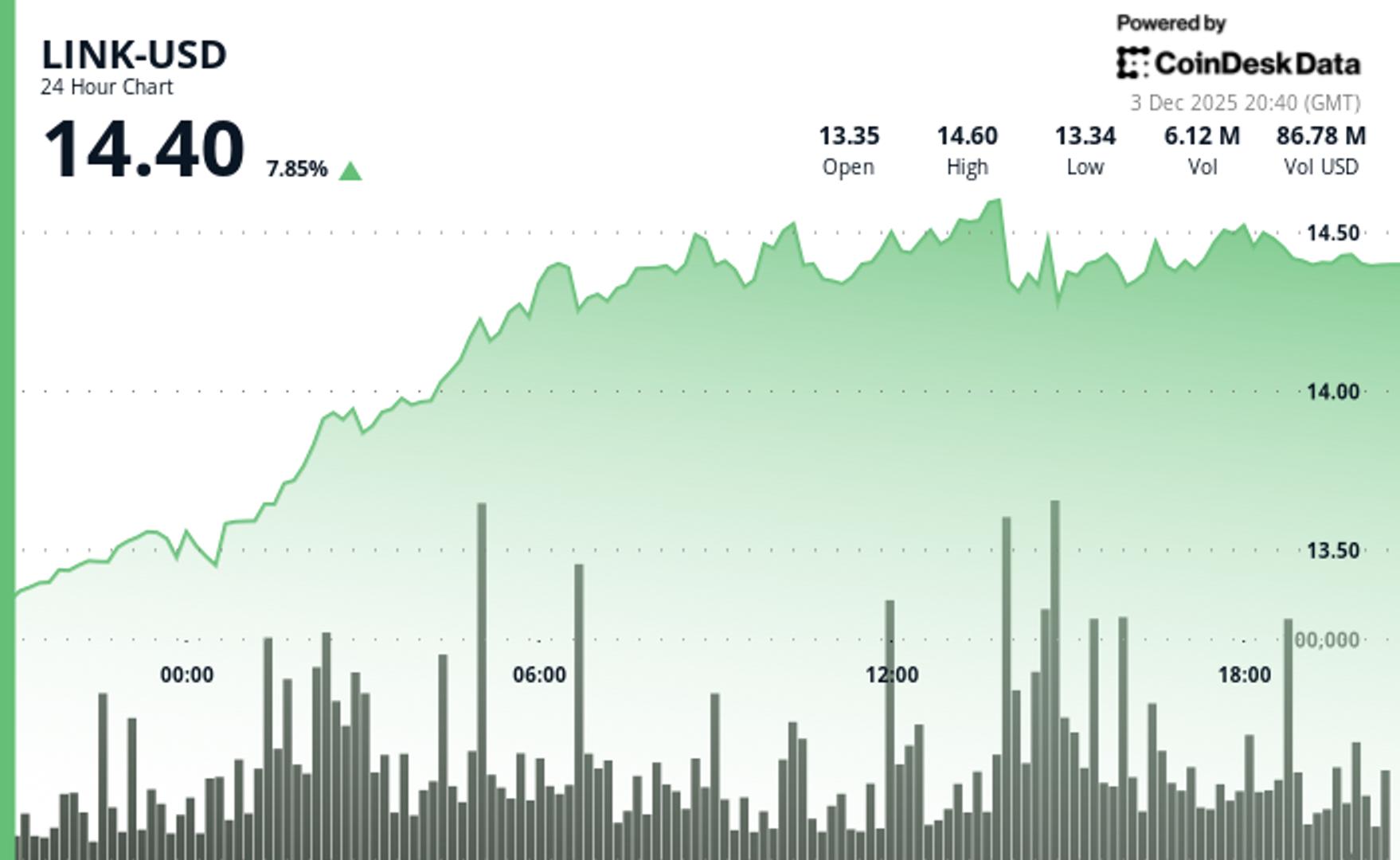
The post Chainlink Price Rebounds as GLNK ETF Debut Sparks Renewed Demand  appeared on BitcoinEthereumNews.com. The Chainlink price shows a sustained correction trend within the formation of a falling channel pattern. Grayscale’s new Chainlink spot ETF (ticker GLNK) registered a strong debut in Tuesday’s session. The relative strength index (RSI) back above the 60% mark accentuates a renewed recovery momentum in price LINK, the native cryptocurrency of the decentralized Oracle Network Chainlink, jumped 6.6% on Wednesday and reached a trading value of $14.37. Along with the renewed recovery momentum in the broader crypto market, the Chainlink price gained additional traction due to the outstanding response from investors to Grayscale’s spot LINK ETF (GLINK). The exchange-traded fund brought significant inflows and trading value on its debut, accentuating Chainlink’s demand in the traditional market.  Grayscale Chainlink ETF Logs Strong Opening Metrics The Grayscale spot Chainlink ETF with the ticker GLNK had a notable entry with trading activity and inflows on Tuesday. Data provided by Bloomberg ETF analyst Eric Balchunas showed the fund’s first-day volume of $13 million, breaking historical levels for its predecessor trust format. He noted that it “could see the same again today,” with sustained interest in the early trading hours of Wednesday. Inflows for the first session totaled about $41 million, according to Balchunas, making it a fast-mover in the wake of the recent introduction of cryptocurrency ETFs. This number is very close to that of Bloomberg’s James Seyffart, who reported “~$42 million” in net creations to bring total assets under management to $64 million by the end of the day. Seyffart came away from the performance describing it as “very good for a new launch,” with a lot of good volume without calling it a huge outlier. He saw how Chainlink, as a “longer tail asset,” shows viability in the ETF structure, extending the appeal beyond the top-tier cryptocurrencies. Balchunas put the rollout…

Author: BitcoinEthereumNews
Biggest Players Unite Behind 70M ADA Push to Spark On-Chain Growth

Biggest Players Unite Behind 70M ADA Push to Spark On-Chain Growth

The post Biggest Players Unite Behind 70M ADA Push to Spark On-Chain Growth appeared on BitcoinEthereumNews.com. The Cardano network’s core developing teams have pushed through a 70 million ADA treasury withdrawal to fund a slate of long-delayed infrastructure integrations, a move that represents the most coordinated ecosystem action the network has seen in years. ADA is higher by 9% over the past 24 hours, modestly outpacing a broader crypto market surge. The proposal — backed by various teams such as Input Output, the Cardano Foundation, EMURGO, Intersect, and the Midnight Foundation — cleared a governance vote with more than 60% support from delegated representatives, making it the fastest approval since Cardano’s on-chain voting system went live. Funds will be put into developing stablecoins, credible oracle feeds, cross-chain bridges, custody integrations, and analytics tooling, among other improvements to benefit the Cardano ecosystem. For years, Cardano builders have complained that the absence of these primitives has placed a ceiling on DeFi activity and prevented the network from keeping pace with liquidity and application growth on rival chains. Despite Cardano’s sizable treasury and multi-billion-dollar market cap, developers have repeatedly been forced to build around missing pieces or rely on limited third-party support. “This is about putting aside historic differences and coming together for the greater good of the ecosystem,” Hoskinson, in a release shared with CoinDesk, said. “By focusing our resources on these five areas, we are addressing fundamental challenges that are impeding Cardano’s growth in one decisive move, laying the groundwork for a broader, more robust ecosystem that can support everything from core DeFi to DePIN and RWA,” he said. The Cardano Foundation framed the vote as a sign that governance can coordinate large-scale spending when necessary, while EMURGO described the integrations as prerequisites for institutional adoption, a claim that the network has made for years but struggled to deliver on due to certain infrastructure gaps. Intersect, which…

Author: BitcoinEthereumNews
Fanatics Enters Prediction Markets With App Live in 10 States

Fanatics Enters Prediction Markets With App Live in 10 States

Markets Share Share this article

Copy linkX (Twitter)LinkedInFacebookEmail
Fanatics Enters Prediction Markets

Author: Coindesk
LINK Surges 7% as Grayscale’s Chainlink ETF Sees $37M in First-Day Inflow

LINK Surges 7% as Grayscale’s Chainlink ETF Sees $37M in First-Day Inflow

Markets Share Share this article

Copy linkX (Twitter)LinkedInFacebookEmail
LINK Surges 7% as Grayscale’s Chai

Author: Coindesk
Wells Fargo Eyes 39% Oracle Stock Upside in AI Super-Cycle Potential

Wells Fargo Eyes 39% Oracle Stock Upside in AI Super-Cycle Potential

The post Wells Fargo Eyes 39% Oracle Stock Upside in AI Super-Cycle Potential appeared on BitcoinEthereumNews.com. Wells Fargo initiated coverage on Oracle with an overweight rating and a $280 price target, implying a 39% upside from current levels, driven by its strong position in the AI super-cycle and massive cloud backlog exceeding $500 billion. Oracle’s cloud infrastructure is projected to reach 16% global market share by 2029. Key partnerships with OpenAI, Meta, TikTok, and xAI position Oracle at the forefront of enterprise AI. The company holds the industry’s largest cloud backlog at $455 billion, surpassing Microsoft’s $392 billion. Discover Wells Fargo’s bullish outlook on Oracle stock amid AI growth. Explore the $280 price target and cloud market projections for potential investment opportunities in 2025. What is Wells Fargo’s price target for Oracle stock? Oracle stock received an overweight rating from Wells Fargo analyst Michael Turrin, with a $280 price target that suggests a 39% increase from current trading levels. This optimism stems from Oracle’s pivotal role in the AI super-cycle, supported by over $500 billion in deals. Despite a 29% quarterly decline, the stock trades at 25 times projected 2027 earnings, 42% below its peak. How does Oracle’s cloud infrastructure compete in the market? Oracle Cloud Infrastructure is forecasted to capture 16% of the global cloud market by 2029, rising from 5% in 2025, according to Michael Turrin. This growth would place it among top providers like Amazon, Microsoft, and Google. The company’s $455 billion cloud backlog, potentially exceeding $500 billion on a pro forma basis, outpaces Microsoft’s reported $392 billion. Additional potential includes a $300 billion cloud contract and $75 billion in AI lab commitments. Oracle’s stock rose 2% following the announcement. Oracle maintains partnerships with leading AI entities such as OpenAI, Meta, TikTok, and xAI, securing its spot in large-scale enterprise AI deployments. Investors have shown impatience with high valuations, contributing to the stock’s…

Author: BitcoinEthereumNews
Bitcoin Core Audit, Ethereum Upgrades

Bitcoin Core Audit, Ethereum Upgrades

The post Bitcoin Core Audit, Ethereum Upgrades appeared on BitcoinEthereumNews.com. Developers, investors and regulators faced another dense month of protocol upgrades, security milestones and infrastructure launches in this November blockchain roundup. Bitcoin Core completes historic third-party security review Bitcoin development reached a major governance milestone as security firm Quarkslab, funded by Brink and coordinated by OSTIF, completed the first public third-party security audit in Bitcoin Core‘s history. The team invested 100 person-days, reviewing core modules including the P2P network, mempool, chain management and consensus. The audit reported no high-risk or medium-risk vulnerabilities, flagging only 2 low-risk issues and 13 improvement suggestions. Moreover, the exercise is being framed by contributors as a turning point that signals Bitcoin Core‘s transition into a more mature and formally governed development era. Ethereum protocol enters a new scaling and privacy phase The Ethereum roadmap advanced on several fronts. The long-awaited Fusaka upgrade completed its testnet phase successfully, with mainnet activation scheduled for 2025-12-03 21:49 UTC. In parallel, work continued on the Glamsterdam upgrade, which is expected to further reshape Ethereum’s consensus and execution layers. For Glamsterdam, EIP-7732 / ePBS has been confirmed as the core consensus-layer proposal, while EIP-7928 / Block-Level Access Lists will anchor the execution layer. However, the FOCIL anti-censorship transaction list will likely be postponed to the following Heka/Bogotá upgrade, pending a credible governance commitment. At Devcon, co-founder Vitalik Buterin unveiled the Kohaku privacy framework. This open-source project, driven by the Ethereum Foundation, aims to deliver modular on-chain privacy and security components. It already supports foundational modules compatible with Railgun and Privacy Pools, enabling wallets to offer opt-in default privacy modes and exploring future tools such as mixnets and ZK-enabled browsers. Ethereum’s account abstraction and chain abstraction teams also proposed an Ethereum Interoperability Layer (EIL). Built on ERC-4337, EIL is designed so that multiple L2 rollups feel like a single Ethereum chain.…

Author: BitcoinEthereumNews
AI agents spend just $1.22 to shatter smart contract security exposing a terrifying economic reality

AI agents spend just $1.22 to shatter smart contract security exposing a terrifying economic reality

Anthropic’s Frontier Red Team spent the past year teaching AI agents to behave like professional DeFi attackers. The agents learned to fork blockchains, write exploit scripts, drain liquidity pools, and pocket the proceeds, all in Docker containers where no real funds were at risk. On Dec. 1, the team published results that should recalibrate how […] The post AI agents spend just $1.22 to shatter smart contract security exposing a terrifying economic reality appeared first on CryptoSlate.

Author: CryptoSlate
Nvidia stock continues slide: is the AI darling’s moat drying up as competition intensifies?

Nvidia stock continues slide: is the AI darling’s moat drying up as competition intensifies?

Nvidia stock slipped on Wednesday as investors reacted to fresh competitive pressure from Amazon’s new Trainium 3 artificial intelligence chip, the latest sign that major cloud providers are accelerating efforts to develop their own AI silicon. At the time of publishing, the Nvidia stock was down 0.6% to trade at around $180.34.Amazon unveiled Trainium 3 on Tuesday, pitching it as a cost-efficient alternative for training and operating AI models. The company said the new chip can reduce AI training and inference costs by up to 50% compared with systems using equivalent GPUs — the category dominated by Nvidia.Amazon also said it plans to use Nvidia’s NVLink Fusion technology in its future AI computing infrastructure, integrating it with the forthcoming Trainium4 chip.“With Nvidia NVLink Fusion coming to AWS Trainium4, we’re unifying our scale-up architecture with AWS’s custom silicon to build a new generation of accelerated platforms,” Nvidia CEO Jensen Huang said. “Together, NVIDIA and AWS are creating the compute fabric for the AI industrial revolution.”Nvidia stresses long-term demand despite competitive movesNvidia is working to reassure investors that it can maintain dominant market share even as Amazon, Google and other hyperscalers expand use of in-house silicon. The company’s neutral position in the market — as a supplier rather than a direct cloud-services competitor — remains a strategic advantage, as some technology giants may prefer not to depend heavily on rival hardware.Nvidia CFO Colette Kress said Tuesday that AI models trained on its new Blackwell chips will begin emerging in about six months. She noted the company has $500 billion in bookings for Blackwell and Rubin chips through 2026, excluding an upcoming deal with OpenAI that has yet to be finalised.Separately, European AI start-up Mistral said it trained its next-generation models on Nvidia hardware. The companies highlighted that Mistral’s Large 3 model achieved a tenfold performance improvement on Nvidia’s GB200 NV72 server racks compared with the previous H200 generation.Competition landscape starting to get intenseWhile Oracle Cloud Infrastructure’s earlier adoption of more than 50,000 AMD chips signalled growing interest in non-Nvidia solutions, the competitive pressure now is coming most visibly from Amazon Web Services. With Trainium 3, AWS has taken a significant step toward deepening its in-house AI silicon strategy. The chip is said to offer four times the performance of its predecessor and reduces energy consumption by 40%, underscoring AWS’s ambition to optimise its data centres around its own hardware.Google, meanwhile, is extending more aggressive outreach for its Tensor Processing Units, promoting TPUs to major customers such as Meta. The push suggests Google is seeking to expand TPU adoption among hyperscalers that have traditionally relied on Nvidia GPUs.The combined efforts of Amazon, Google and AMD signal a broadening competitive landscape in the AI hardware sector. While Nvidia remains the clear leader, its largest customers are now among its most visible challengers — each moving to reduce reliance on external suppliers and expand control over their AI infrastructure.The post Nvidia stock continues slide: is the AI darling's moat drying up as competition intensifies? appeared first on Invezz

Author: Coinstats
Apex Fusion Connects Three Blockchain Architectures: What This Means for DeFi's $100B Future

Apex Fusion Connects Three Blockchain Architectures: What This Means for DeFi's $100B Future

Apex Fusion deployed bAP3X on Base through Skyline's Blade EVM infrastructure, connecting its tri-chain architecture (UTXO-based Vector, EVM-compatible Nexus, and Prime coordinator) to Coinbase's Layer 2 network. The implementation uses LayerZero's OFT standard to enable cross-chain transfers between fundamentally different blockchain execution models. Liquidity pools launched on Aerodrome ($8B monthly volume) and QuickSwap with Merkl incentives. The deployment creates pathways between Cardano's UTXO ecosystem and Base's $3.2B TVL, addressing DeFi's fragmentation across 40+ incompatible networks. Success depends on whether Cardano and Base communities generate sustained cross-chain transaction volume rather than one-time bridge activity. FINMA-guided token structure provides regulatory clarity but introduces complexity that may limit retail adoption. The infrastructure enables DeFi's potential return beyond $100B TVL through reunified liquidity, but market demand for cross-architecture interoperability remains unproven.

Author: Hackernoon