Dapp

Dapps are digital applications that run on a P2P network of computers rather than a single server, typically utilizing smart contracts to ensure transparency and uptime. In 2026, Dapps have achieved mass-market appeal through Account Abstraction, allowing for a "Web2-like" user experience with the security of Web3. This tag covers the entire ecosystem of decentralized software—from social media and productivity tools to governance platforms and identity management.

5021 Articles
Created: 2026/02/02 18:52
Updated: 2026/02/02 18:52
Cardano Price Slumps Amid TVL Drop, But Projects Signal Potential Rebound

Cardano Price Slumps Amid TVL Drop, But Projects Signal Potential Rebound

The post Cardano Price Slumps Amid TVL Drop, But Projects Signal Potential Rebound appeared on BitcoinEthereumNews.com. Cardano’s price has dropped 70% from its December 2023 peak to $0.4100 amid a market crash, with TVL falling 36% to $186 million. Founder Charles Hoskinson is optimistic, citing upcoming Midnight and RealFi projects as key drivers for network growth and potential rebound. Cardano’s price plunge of 70% since December 2023 highlights its underperformance in the broader crypto downturn. A 36% TVL decline to $186 million raises concerns about network activity, yet Hoskinson eyes future catalysts. Technical indicators like an oversold RSI and falling wedge pattern suggest a possible price recovery soon. Discover Cardano price struggles and recovery signals in 2025. TVL drops amid market crash, but Midnight and RealFi projects promise growth. Explore expert insights and technical analysis for ADA investors now. What is Causing Cardano’s Price Decline in 2025? Cardano’s price has fallen sharply to $0.4100, marking its lowest point in over a year and a 70% drop from its December 2023 high. This downturn mirrors the wider cryptocurrency market crash, where reduced investor confidence and macroeconomic pressures have hit altcoins hard. Despite these challenges, Cardano’s foundational strengths in scalability and security position it for potential recovery as market conditions stabilize. How Has Cardano’s TVL Decline Impacted Network Perception? Cardano’s Total Value Locked (TVL) has decreased by 36% over the past month, reaching $186 million, which has fueled debates about its active usage. This drop contributes to the “ghost chain” label, as on-chain activity remains subdued compared to rivals. According to data from DeFi analytics platforms, Cardano’s TVL lags behind leaders like Ethereum, which boasts billions in locked value. Nansen’s CEO has noted that low adoption could push Cardano out of the top 20 cryptocurrencies if trends persist, emphasizing the need for enhanced developer engagement. A recent network glitch drew minimal community response, underscoring perceptions of limited real-world…

Author: BitcoinEthereumNews
Shibarium Sets 2026 for Native FHE Integration as Zama Partnership Moves Forward

Shibarium Sets 2026 for Native FHE Integration as Zama Partnership Moves Forward

The post Shibarium Sets 2026 for Native FHE Integration as Zama Partnership Moves Forward appeared on BitcoinEthereumNews.com. Shibarium is stepping into an entirely new phase of its roadmap. The Shibtoken team has now confirmed that Zama’s Fully Homomorphic Encryption (FHE) will be natively integrated into the Layer-2 network in 2026. The move positions Shibarium as one of the first EVM-compatible ecosystems to adopt full-stack, on-chain privacy at the protocol level. This is not a minor update. FHE is one of the most advanced forms of cryptography in development today. It enables computations to run directly on encrypted data without exposing the underlying information. No decryption. No leakage. No workarounds. Just end-to-end encrypted execution. If delivered as planned, Shibarium becomes a privacy-first chain built for institutions, DeFi builders, and high-security applications, without sacrificing EVM access. The confirmation was shared by @Shibtoken, with rollout and technical details reinforced by @CryptoMiners_Co. A Major Milestone: Shibarium Commits to Native FHE For months, the community speculated whether Shibarium would adopt deeper encryption standards or stick to traditional EVM privacy layers. Today, the team made it official: Zama’s FHE becomes part of Shibarium’s core infrastructure. With this upgrade, Shibarium gains capabilities that most blockchains still consider experimental. #Shibarium Confirms Native FHE Integration in 2026 The @Shibtoken team has officially confirmed that @zama’s Fully Homomorphic Encryption (FHE) will be natively integrated into #Shibarium, delivering institutional grade on chain privacy. Key features of the upgrade:– Fully… pic.twitter.com/j6MJNEvHFX — Crypto Miners (@CryptoMiners_Co) November 30, 2025 Key features confirmed:  Fully encrypted transactions from end to end  Confidential smart contracts, shielding logic, inputs, and outputs  Private DeFi with hidden balances and algorithmic logic  Privacy-preserving governance, including confidential voting  Encrypted gaming mechanics, enabling advanced data-sensitive gameplay In simple terms: users, builders, and institutions can perform complex actions on-chain without revealing their data. This sets Shibarium apart from typical privacy layers that rely on mixers, sidechains, or zero-knowledge workarounds. FHE…

Author: BitcoinEthereumNews
Ethereum’s Fusaka Upgrade May Enhance ETH Burn via L2-Mainnet Fee Ties

Ethereum’s Fusaka Upgrade May Enhance ETH Burn via L2-Mainnet Fee Ties

The post Ethereum’s Fusaka Upgrade May Enhance ETH Burn via L2-Mainnet Fee Ties appeared on BitcoinEthereumNews.com. The Ethereum Fusaka upgrade, scheduled for December 3, introduces EIP-7918 to link Layer-2 fees directly to mainnet gas costs, potentially increasing ETH burn through higher L2 contributions. This change, alongside throughput enhancements and raised gas limits, aims to boost network efficiency and user experience while sparking debates on long-term tokenomics. EIP-7918 establishes a baseline cost for L2 batch posting tied to mainnet execution, aligning secondary layer activity with Ethereum’s core fee mechanisms. Fusaka enhances overall performance with PeerDAS for better data throughput, reduced latency via preconfirmations, and a gas limit increase to 60 million. Corporate L2 projects like those from Coinbase and Robinhood may see elevated fee commitments, potentially amplifying ETH burn rates as adoption grows. Discover how the Ethereum Fusaka upgrade transforms L2 fees via EIP-7918, boosting ETH burn potential. Explore impacts on developers and users—stay ahead in crypto evolution today! What is the Ethereum Fusaka Upgrade? The Ethereum Fusaka upgrade represents a significant network evolution set for activation on December 3, designed to refine fee structures, enhance scalability, and improve accessibility. It primarily introduces EIP-7918, which ties Layer-2 solution costs to mainnet gas prices, creating a more integrated economic model. This adjustment, combined with other technical improvements, seeks to make Ethereum more efficient for everyday users and large-scale applications. How Does EIP-7918 Impact ETH Burn? EIP-7918 fundamentally alters the dynamics between Layer-2 chains and the Ethereum mainnet by imposing a minimum fee for batch posting that mirrors mainnet execution costs. Previously, L2 solutions contributed minimally to ETH burn rates because their base fees were negligible, limiting the overall impact of secondary layer activity on token deflation. Under this proposal, as L2 usage surges—driven by rollups and optimistic solutions—more ETH will be burned through aligned fee mechanisms, similar to the EIP-1559 model’s influence since 2021. Analysts, including those from…

Author: BitcoinEthereumNews
What Is Cryptocurrency? A Deep Dive Into The Basics

What Is Cryptocurrency? A Deep Dive Into The Basics

Are you interested in cryptocurrencies? Whether you want to learn about them or get into crypto investing, you’ve reached the right spot. Cryptocurrencies are virtual currencies that leverage cryptographic techniques, blockchain technology, and distributed ledger technology to enable seamless and secure transactions. In this article, we’ll offer deeper insights into what is cryptocurrency, its types, benefits, risks, and prospects. We’ll also provide a step-by-step guide on how to buy crypto. What Is Cryptocurrency? A cryptocurrency is a form of digital currency that harnesses shared ledger, blockchain, and encryption technologies to facilitate borderless transactions. It serves as a medium of exchange, a store of value, a means of payment, and a unit of account. In essence, it is an alternative to traditional money, especially for making payments on online platforms.  However, cryptocurrencies are fundamentally different from fiat currencies. Their hallmark feature is decentralization, meaning they aren’t issued or managed by governments or central banks.  Additionally, they lack a physical form. They exist only digitally in online databases that are distributed across a network of computers, called nodes. No central authority or server controls/hosts these databases and networks.  Besides, blockchain-backed digital currencies are secured by cryptography. It is the practice of safeguarding, encrypting, and obscuring data using mathematical techniques and coded algorithms. Originating from the Greek word “kryptos” for “hidden”, cryptography conceals confidential information from prying eyes and third parties. It also upholds the integrity and authenticity of data.  Moreover, blockchain networks are immutable and tamper-proof. Each block in a network possesses a distinct digital fingerprint based on its contents. It also contains the hash of the previous block. If anybody tries to alter a blockchain transaction, the hash of the corresponding block will change, disrupting the chain. As modifying the hashes of subsequent blocks is computationally impractical, the network rejects the changes to maintain the blockchain. Lastly, a cryptocurrency doesn’t have intrinsic value. Its value depends on demand-supply dynamics, which in turn are influenced by its utility, scarcity, and community strength. Bitcoin is the first cryptocurrency to hit the market and the largest by market cap. Ethereum is the pioneer blockchain to support smart contracts, and its native currency, Ether (ETH), is the second-largest cryptocurrency by market cap.  How Does Cryptocurrency Work on The Blockchain? Cryptocurrencies run on networks powered by blockchain technology. All transactions involving virtual currencies are recorded on unalterable public ledgers to ensure transparency and prevent counterfeiting.  You can think of cryptocurrencies as peer-to-peer (P2P) systems that enable you to send and receive payments at lower costs. You can also refer to them as decentralized money, as it allows online transfer of value in a trustless environment. Most importantly, digital currencies eliminate the need for intermediaries, including central banks and third-party payment systems.  How are cryptocurrencies created? The coin minting process is tied to the consensus mechanism of a blockchain platform. It is an automated system that ensures network validators unanimously agree on the new and existing data on the ledger.  Proof-of-Work (PoW) mechanism: PoW blockchains, such as Bitcoin, generate new tokens through mining. It involves the use of sophisticated hardware and software to solve complex mathematical algorithms. Whenever a purchase/sale/transfer takes place, miners decrypt the block containing the transaction details. This process is resource-intensive and requires considerable computing power. Once the majority of nodes approve the transaction as authentic, the block is appended to the blockchain. Proof-of-stake (PoS) mechanism: PoS networks like Ethereum choose validators based on the amount of cryptocurrencies they lock up. These validator nodes verify transactions and add new blocks to the network. In general, the PoS system is more energy-efficient than the PoW mechanism.  Miner/validators receive freshly minted coins, a portion of users’ transaction fees, and staking rewards as incentives. Other popular consensus algorithms include proof-of-history (e.g, Solana), proof-of-authority (e.g, VeChain), and delegated PoS (e.g, Tron).  Cryptocurrency vs. traditional currency Cryptocurrency Traditional currency It is created through mining, staking, or forking. It is issued by governments or central banks. It exists digitally on decentralized platforms powered by blockchain and distributed ledger technologies. It exists in the form of physical cash and can also be stored digitally in banks/financial institutions. While it is naturally censorship-resistant, many governments are actively regulating crypto transactions. It is fully regulated. Cryptocurrency transactions are irreversible and immutable. Fiat currency transactions can be reversed or altered. Cryptocurrency investment is risky due to its volatile price swings. Values of traditional currencies are fairly stable. It enables speedy transactions at reduced costs. It usually involves slower transaction processing and higher fees. It is used for buying both physical and digital goods and services.  It is predominantly used as legal tender. It is more prone to cyber threats, with no legal recourse available in the event of loss. Transactions involving traditional currencies are more secure and can be recovered easily, especially when processed through authorized financial institutions. Types of Cryptocurrency While the terms coins and tokens are often used interchangeably, there are subtle differences between them. Coins Coins are cryptocurrency applications that operate on their own blockchains. Usually, they’re the native currencies of their networks and serve as the primary medium of exchange within their ecosystems. Bitcoin (BTC): It is the first cryptocurrency developed by a pseudonymous individual/group known as Satoshi Nakamoto in 2009. Currently, it is the largest digital currency with a market cap of over $1 trillion. While you can find 100+ forks of Bitcoin’s source code, its prominent hard forks/variants include Bitcoin Cash and Bitcoin Satoshi Vision. Altcoins: An alternative coin, or altcoin, serves as an umbrella term for all cryptocurrencies other than Bitcoin. Ether (ETH), the native currency of the Ethereum blockchain, is the pioneer altcoin and the second-largest crypto by market cap. Ethereum is also the first network to support smart contracts for building and deploying decentralized apps and non-fungible tokens. Tokens Tokens are built on existing blockchains. They’re programmable and powered by smart contracts or self-executing lines of code that function as per pre-defined rules. Utility tokens: These digital assets enable users to access specific products or services on a platform or within a blockchain ecosystem. Examples of utility tokens include Uniswap (UNI), Chainlink (LINK), and Filecoin (FIL).  Governance tokens: They grant decision-making rights to holders, enabling them to vote on policy updates and key proposals surrounding a platform’s future. Shib ecosystem’s BONE and Decentraland’s MANA are examples of governance tokens. Stablecoins: These tokens are designed to maintain a steady value and offer protection against crypto volatility. Typically, their values are tied to stable assets like commodities, fiat currencies, or financial instruments. USD Coin and USDT (Tether), pegged to the US Dollar, are widely used for merchant payments, global remittances, and borderless transactions. They help you enjoy the stability of traditional money while making international transfers. Security tokens: They represent ownership rights in financial assets, including equities, bonds, and stock indices, on a blockchain. Top companies like Tesla, NVIDIA, and Microsoft issue tokenized shares. How to Buy Cryptocurrency? Step 1: Choose a cryptocurrency exchange or broker If you want to buy cryptocurrencies, select a broker or digital asset exchange based on your needs. Usually, brokers offer a simpler interface, limited coin selection, lower fees, and fewer functionalities, making them suitable for beginners. Some platforms, like Robinhood, also allow you to trade other financial assets, like stocks, exchange-traded funds (ETFs), and derivatives. Conversely, cryptocurrency exchanges offer advanced charting tools and a wider range of offerings, including more coins and trading pairs. They also have sophisticated matching engines and an intuitive interface, enabling you to trade directly with other buyers/sellers. Most crypto exchanges facilitate spot, margin, and derivatives trading. However, they may charge higher fees and are more complex to navigate. Hence, they’re best-suited for active and experienced traders. Step 2: Create an account Once you’ve chosen a broker/exchange, open an account using your e-mail, phone number, Google ID, Apple ID, or Telegram ID. Most platforms offer attractive welcome packages to users who register using a referral code.  Step 3: Complete know-your-customer (KYC) verification After you finish signing up, verify your identity. To complete the KYC process, you need to submit identity and address proofs along with a selfie. Once the platform reviews and approves your documents, your identity verification is complete.  Step 4: Fund your account Before you start cryptocurrency trading, you must make your first deposit. You can either deposit fiat or cryptocurrencies. You can also transfer funds into your account from an external digital wallet.  Step 5: Buy and trade cryptocurrencies If you don’t have funds to make a deposit, you can buy cryptocurrencies through the platform using various payment methods. These include bank transfers, credit/debit cards, Google/Apple Pay, and third-party payment services like Skrill, Neteller, and Banxa. Some cryptocurrency exchanges also provide a P2P marketplace, where you can buy and sell crypto directly from other traders. Once your account has a sufficient balance, you’re ready to start trading cryptocurrencies. Based on your goals and preferences, you can either choose to go long (buy) or go short (sell) in the cryptocurrency market.  While most cryptocurrency exchanges don’t levy deposit fees, you must incur charges for buying, selling, and withdrawing crypto assets. Trading fees and withdrawal charges vary across platforms. They also differ based on your chosen coin, network, asset balance, and trading volumes. How to Store Cryptocurrency Safely? Hot/online wallets: They’re software-based crypto wallets that are connected to the internet. They offer greater convenience, especially for frequent trading, and enable faster transactions. You can access these wallets anytime, anywhere, from your desktop, laptop, phone, or tablet.  However, they are highly susceptible to cyber attacks. Therefore, store only the minimum amount required for trading in your hot wallets. Examples of popular hot wallets include Metamask, Phantom, and Binance wallet. Cold/offline wallets: They’re hardware-based and safer, as they store your crypto offline. However, they’re vulnerable to physical damage. To eliminate this risk, you need to back up your private key and recovery phrase is a secure location. Examples of top offline wallets include Trezor and Ledger. Besides, many exchanges have designed multi-signature cold storage to protect users’ digital assets. What Can You Use Cryptocurrency For? Payment mode: Cryptocurrencies can be used for both physical purchases and online transactions at crypto-supported merchant outlets. While they aren’t a widely accepted means of payment globally, many countries are gradually embracing their usage for day-to-day transactions.  In 2021, El Salvador became the first nation to accept Bitcoin as legal tender. Countries like Portugal, Malta, Switzerland, Hong Kong, and Germany are also known for their crypto-friendly policies. Investment avenue: If you’re willing to add some speculative assets with high profit potential to your portfolio, cryptocurrencies are your best bet. Their high price volatility can lead to significant losses, but it also creates opportunities for making substantial profits.  Benefits of Using Cryptocurrency Privacy and transparency: Though blockchain records are publicly verifiable, they don’t contain investors’ personal details. Therefore, the probability of identity theft is lower, while 100% transparency is maintained. Cross-border payments: You can use cryptocurrencies to buy goods and services from any country without worrying about exchange rates and associated fees. Virtual currencies also help you manage bank account restrictions, like ATM withdrawal limits. Divisibility: Cryptocurrencies are divisible, and many exchanges support fractional investing. Some platforms also allow you to buy coins for as little as $1. Therefore, you can gain exposure to the cryptocurrency market without assuming significant risk. This property of digital currencies also makes high-value coins such as BTC, ETH, and XRP accessible to all. Decentralized system: Cryptocurrencies and blockchain networks aren’t controlled by a central authority. Hence, they’re less susceptible to manipulations. Moreover, your crypto assets will remain safe even during political upheavals. Equality: Regardless of your location, you can buy and sell cryptocurrencies as long as you’ve a device with internet access. This way, virtual currencies play a pivotal role in fostering financial inclusion and free trade. Blockchain-based currencies are also a boon for investors based in locations with strict government controls or inflation problems. Stability: With stablecoins like USD Coin and Tether (USDT), you can enjoy the stability of traditional money while making international transfers. They’re pegged to fiat currencies like the US Dollar to maintain a steady value and offer protection against crypto volatility. They’re widely used for merchant payments, global remittances, and borderless transactions. Risks of Using Cryptocurrency Volatility: Cryptocurrencies are highly volatile and can cause heavy losses for investors. For example, the BTC price plummeted by over 33% and fell below $80,000 on November 24, 2025. It had reached a record high of $125,000 on October 6. Non-recoverability: If you lose your private key or access to the location where you store it, you can’t recover your assets. Similarly, if you make mistakes while copying deposit/withdrawal addresses, recovering your digital currencies is daunting.  Scams: The cryptocurrency industry is marred by various scams. These include rug pulls, Ponzi schemes, and fake websites that trick innocent users into investing their money. Moreover, scammers often pose as famous personalities or billionaires and promise sky-high returns to trap people. They use messaging apps to spread rumours about celebs promoting specific cryptocurrencies.  Regulatory risks: Cryptocurrencies are banned partially or fully in many jurisdictions. Even the laws governing cryptocurrency transactions and taxation are ambiguous. Also, many exchanges are facing regulatory challenges in multiple countries. Hence, any crackdown or unfavourable policy changes can put your crypto investments at risk. Counterparty risks: Traders rely on exchanges and third-party custodians to manage their assets. In the event of any security breach or closure of an exchange/custodial service, users may incur asset losses.  Smart contract risks: NFTs and decentralized finance (DeFi) protocols are governed by intelligent contracts. Immutable bugs or programming errors can cause dApps to malfunction, lock funds permanently, or result in asset theft/losses. Market manipulation: Crypto whales, entities holding large amounts of digital currencies, can significantly impact the prices and liquidity of cryptocurrencies. They often hoard cryptocurrencies in dormant accounts, removing tokens from active circulation. This perceived scarcity triggers a sharp rise in crypto prices. Contrarily, when whales engage in coordinated selling, a cryptocurrency’s price can fall drastically. How to Avoid Cryptocurrency Scams and Frauds? Research a crypto project’s official website, whitepaper, team, community, and credibility before investing. Usually, authentic projects show active development and have strong communities backing them.  Avoid projects or schemes that promise high returns that sound unrealistic and too good to be true. Choose reputable exchanges and digital wallets for trading and storing crypto assets. Binance, Bybit, and Coinbase are renowned centralized exchanges, while Trust Wallet is the best multi-chain wallet. Enable multi-factor authentication, set a strong password, and keep recovery phrases offline. Never share private keys or seed phrases with anyone. Beware of fake URLs, bogus websites, phishing e-mails, spurious links, malware, and ransomware. Don’t blindly follow unsolicited advice or offers received through messaging apps, social media, or emails.  Preserve most digital assets in cold storage and keep only the amount needed for trading in hot wallets. Use advanced tools like VS Code, Etherscan, Foundry, and Dune to detect smart contract bugs.  Is Cryptocurrency Legal and Safe? Cryptocurrencies are powered by blockchain technology. While the underlying cryptography and technology are highly secure, trading and storing virtual currencies safely is challenging. Hackers often target hot wallets where traders store cryptocurrencies for executing various transactions. For example, in February 2025, the North Korea-based Lazarus group hacked one of Bybit’s suppliers to modify crypto wallet addresses. Over 401,000 ETH tokens were being sent to these addresses, enabling the hackers to pull off a $1.5 billion crypto heist. Though the exchange replenished the stolen tokens, the incident raises serious questions about the safety of crypto investments. Moreover, many cryptocurrency exchanges have fallen prey to such large-scale hacks in the past. Many platforms have implemented robust security measures like two-factor authentication, multi-signature cold storage, anti-phishing code, and proof-of-reserves. Some have even established insurance funds to compensate traders who incur losses due to platform issues. However, none is infallible, and hacking incidents are a testament to this fact.  Besides, cryptocurrencies carry inherent risks. Lack of legal protection makes it tougher to retrieve your assets in the event of losses or untoward happenings.  Lastly, not all countries are pro-crypto, with many banning its usage outright. Additionally, many exchanges don’t possess the required regulatory licenses and don’t comply with KYC/AML laws.  Overall, cryptocurrencies are highly risky investments, involving technical and legal complexities. Thus, the onus of safeguarding your assets largely depends on you. Understanding the nitty-gritty of crypto trading, doing your own research, and applying due diligence are essential. The Future of Cryptocurrency in the Global Economy Asset tokenization: RWAs are physical or digital assets such as stocks, bonds, and real estate that exist outside the digital realm. Asset tokenization refers to the process of converting RWAs into virtual tokens that reside on a blockchain. It facilitates fractional ownership of high-value assets, making them accessible to a larger number of users. It also imparts greater liquidity to otherwise illiquid assets. Moreover, the inherent transparency of blockchain technology boosts investor confidence by minimizing ownership conflicts and exposure to fraud. Furthermore, it democratizes financial markets and reduces asset management costs by eliminating the need for paperwork, intermediaries, and legal services.  Metaverse and blockchain gaming: Metaverses are immersive digital arenas or 3D gaming environments where you can interact with other users/players as an avatar. From art museums and virtual company headquarters to tokenized land parcels and collectible shops, these metaverses mirror the real world. They also host numerous events such as music festivals, auctions, conferences, and social gatherings.  You require digital currencies to buy in-world/in-game items such as tickets, NFTs, and accessories. You’ll also receive rewards for play-to-win (P2W) and play-to-earn (P2E) games in cryptocurrencies. Additionally, most metaverses and blockchain games issue their own cryptocurrencies that can be traded on exchanges. In general, cryptocurrencies play a key role in driving these virtual economies. AI integration: Many exchange platforms leverage AI to provide live market analytics, trading bots, token insights, and advanced automations. They also use AI and machine learning algorithms to detect cyber fraud, suspicious activities, smart contract bugs, and bot attacks. Web3 and DeFi: Cryptocurrencies form the backbone of Web3 and decentralized applications. Web3 is the next-gen internet, focusing on decentralized systems, user control, digital ownership, and privacy. Decentralized finance protocols are one of the primary applications of Web3, offering staking, lending, borrowing, yield-farming, and liquidity mining services.  Conclusion Cryptocurrencies are transforming global payment systems by enabling faster, safer, and decentralized financial transactions. They also process transactions without traditional intermediaries or middlemen. Moreover, many cryptocurrency firms, such as Nu Holdings and Strategy Inc., have grown phenomenally over the last few years. The number of merchants accepting cryptocurrency payments is also steadily increasing. On the whole, the future of the crypto industry appears encouraging, and cryptocurrencies are here to stay. FAQs Which Crypto is best to invest in?Based on trading volumes, liquidity, and market cap, Bitcoin and Ethereum are the top cryptocurrencies. Solana, XRP, Dogecoin, and Cardano are other cryptocurrencies that are worth exploring. However, there is no single best cryptocurrency to invest in. It depends on your financial objectives, risk tolerance, and trading strategies. While established cryptocurrencies are less risky, many newer altcoins offer higher rewards and support advanced use cases. How do Cryptocurrency transaction taxes work?Crypto taxation rules vary across countries. In the US, the Internal Revenue Service considers cryptocurrencies as property. Therefore, you must pay capital gains tax on profits from crypto transactions. In India, income earned from the swapping, selling, and trading of digital assets is taxable at a flat 30%. How does crypto make you money?If the value of your cryptocurrency increases and you sell it for a profit, you make money. You can also earn passive income through staking, liquidity mining, and crypto lending. Additionally, exchanges reward customers with sign-up bonuses and multiple rewards for completing designated tasks and referring new users. You can also win blockbuster prizes, including airdrops and free tokens, by participating in exclusive events. How to invest in cryptocurrency for beginners?New traders must choose a platform that offers a user-friendly interface and a variety of beginner-friendly features. These include quick buy/sell, demo trading, copy trading, AI-based token insights, and real-time market analytics. It should also provide comprehensive educational resources to help beginners cultivate and hone their cryptocurrency trading skills. In general, newbies must invest low amounts initially and begin with spot trading. As they gain expertise, they can explore margin or derivatives trading and advanced features. Is cryptocurrency a good investment?Cryptocurrencies offer various advantages, including privacy, transparency, divisibility, and irreversibility. They also enable borderless payments and portfolio diversification. However, global crypto adoption remains fairly low due to inherent risks, extreme volatility, regulatory uncertainties, and security concerns. Even so, the future outlook for cryptocurrencies seems promising. With in-depth research and prudent decision-making, digital currencies can be a rewarding investment. The post What Is Cryptocurrency? A Deep Dive Into The Basics appeared first on NFT Plazas.

Author: Coinstats
Redo Solana’s ICO? LivLive’s 300% Bonus Black Friday Presale Is the Top Crypto Opportunity

Redo Solana’s ICO? LivLive’s 300% Bonus Black Friday Presale Is the Top Crypto Opportunity

The post Redo Solana’s ICO? LivLive’s 300% Bonus Black Friday Presale Is the Top Crypto Opportunity appeared on BitcoinEthereumNews.com. Crypto Presales LivLive ($LIVE) raises $2.18M in Stage 1 with a 300% Black Friday bonus. Early investors get Solana-style returns from the next top crypto presale. Regret missing Solana at a few cents? Few investors forget how Solana turned early believers into millionaires. From a sub-dollar token to triple-digit highs, SOL redefined early crypto conviction. Now, a new project, LivLive ($LIVE), is giving investors that rare moment as the top crypto presale now: an early-stage, high-utility presale with explosive upside, and a Black Friday 300% bonus that makes missing Solana’s ICO sting a little less. The top crypto presale, LivLive, has already raised over $2.18 million in Stage 1, proving the appetite for real-world utility is back. This isn’t another hype token — it’s an ecosystem where your real-life actions become crypto earnings, blending AR, blockchain, and gamified engagement. LivLive ($LIVE): Where Reality Turns into Crypto Rewards LivLive is already sprinting ahead in Stage 1, priced at just $0.020, with a launch price of $0.25, that’s over 12x potential before public trading even begins. The project has drawn in 340+ early participants, all capitalizing on the BLACK300 code that multiplies their token count by 300%. This limited-time Black Friday offer transforms the presale into a once-in-a-year entry point for those who act fast. Investors who get in early not only secure the lowest token price but triple their holdings instantly, effectively slashing their cost per token to fractions of a cent. Massive ROI Potential: From $3,500 to Over $43,000 Here’s where things get exciting. Suppose an investor purchases $3,500 worth of $LIVE at $0.020 using BLACK300, earning 300% extra tokens. That’s 525,000 tokens for the price of 131,250. When $LIVE hits just $0.20 by Stage 10, that investment turns into $105,000, a staggering 2,900% ROI. And if it reaches its…

Author: BitcoinEthereumNews
Wish You Could Redo Solana’s ICO? This Top Crypto Presale with 300% Bonus Makes That Dream Real Again

Wish You Could Redo Solana’s ICO? This Top Crypto Presale with 300% Bonus Makes That Dream Real Again

Regret missing Solana at a few cents? Few investors forget how Solana turned early believers into millionaires. From a sub-dollar […] The post Wish You Could Redo Solana’s ICO? This Top Crypto Presale with 300% Bonus Makes That Dream Real Again appeared first on Coindoo.

Author: Coindoo
Best Crypto Presale: DeepSnitch AI Raises $610K+ As Tier 1 CEX Listing Rumours Spread

Best Crypto Presale: DeepSnitch AI Raises $610K+ As Tier 1 CEX Listing Rumours Spread

The post Best Crypto Presale: DeepSnitch AI Raises $610K+ As Tier 1 CEX Listing Rumours Spread appeared on BitcoinEthereumNews.com. KuCoin just secured a full MiCA license in Austria, giving its European division the green light to operate across 29 EU and EEA countries. The approval places KuCoin under one of the world’s strictest crypto regulatory frameworks and signals a push toward more compliant digital asset markets.  With regulation finally opening the door for traditional investors to enter crypto, many are turning to presales for the highest upside. And in 2025, DeepSnitch AI is the one many are choosing.  Whales have already poured more than $610K into the presale, securing their spots before the January 2026 launch. At just $0.02527, DSNT looks like the best crypto presale to purchase in 2025. KuCoin secures MiCA license in Austria KuCoin has received a MiCA license from Austria’s Financial Market Authority, allowing its European arm to offer crypto services across 29 EEA countries. The move positions KuCoin EU to operate under one of the world’s most comprehensive crypto regulatory frameworks. The company selected Austria due to its early MiCA implementation and strong talent pool. KuCoin now joins a group of MiCA-approved CASPs in Austria, alongside Bitpanda and Bybit. While Malta has issued MiCA licenses to other platforms, it was notably excluded from KuCoin’s approval. Malta has also pushed back against centralized EU oversight, creating tension within the bloc. Top 3 best crypto presales in 2026: DeepSnitch AI, BlockchainFX, and Bitcoin Hyper DeepSnitch AI The launch of Monad on Coinbase has kicked off a new ICO frenzy, and now everyone’s on the hunt for the next early-stage gem. You’ll hear names like BlockchainFX and Bitcoin Hyper being thrown around, but the best crypto presale right now is actually DeepSnitch AI. If you’re just hearing about it, DeepSnitch gives everyday traders access to the market intel whales use to stay ahead. SnitchFeed is already running…

Author: BitcoinEthereumNews
Top Altcoins to Buy Today: Analyzing BTC, ETH, SOL, BNB, XRP, ADA, LINK, DOGE, TRX, and BFX

Top Altcoins to Buy Today: Analyzing BTC, ETH, SOL, BNB, XRP, ADA, LINK, DOGE, TRX, and BFX

The post Top Altcoins to Buy Today: Analyzing BTC, ETH, SOL, BNB, XRP, ADA, LINK, DOGE, TRX, and BFX appeared on BitcoinEthereumNews.com. Did you miss the early Black Friday crypto deals that helped buyers spot the top altcoins to buy? This dip is not a bad sign. It is often the moment when long-term gains are made, because prices sit at levels that rarely come around. That is the same idea many early crypto millionaires followed. In this guide we break down nine strong assets worth watching, including BTC, ETH, SOL, BNB, XRP, ADA, LINK, DOGE and TRX, with a close look at why BlockchainFX (BFX) may have the strongest Cyber Monday advantage. BlockchainFX ($BFX) is making headlines after raising over $11.4 million from more than 18,000 participants, a solid indicator of its early momentum. The current presale price is just $0.03, set to increase to $0.031 soon, with a launch price target of $0.05. Act now; from November 30 to December 2, use the limited-time code CYBER50 to get an extra 50% $BFX tokens with your purchase, a massive Cyber Monday boost you cannot afford to miss. 1. BlockchainFX ($BFX): Cyber Monday Deal Unlocks 50% Extra Tokens for Trading Super App BlockchainFX ($BFX) is purpose-built to be the essential “bridge between blockchain and global finance,” solving the core problem of asset fragmentation. Its value proposition is a single, powerful platform allowing users to trade over 500 assets—including crypto, forex, stocks, and bonds—from one unified dashboard. This all-in-one utility is set to capture market share from both traditional and Web3 traders globally, giving $BFX powerful, non-speculative demand. The platform features an exceptionally strong, community-centric revenue model. By staking $BFX, users earn passive income via daily rewards in $BFX and $USDT, generated from the redistribution of up to 70% of all trading fees. With a veteran team and a projected revenue growth from $30M in 2025 to $1.8B by 2030, $BFX is positioned…

Author: BitcoinEthereumNews
Is It Still Safe and Reliable? – CryptoNinjas

Is It Still Safe and Reliable? – CryptoNinjas

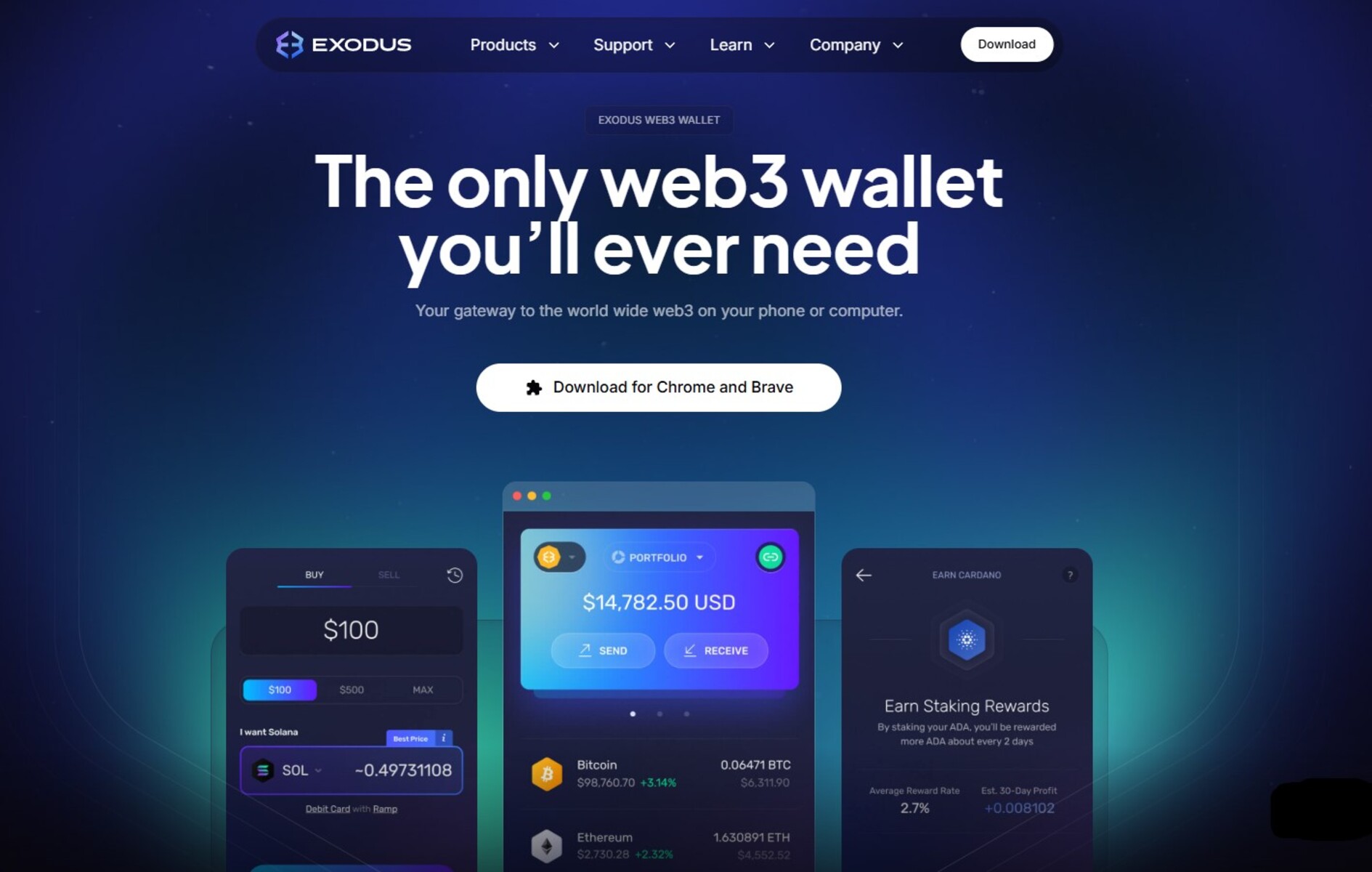
The post Is It Still Safe and Reliable? – CryptoNinjas appeared on BitcoinEthereumNews.com. Get to learn about Exodus Wallet’s safety, functionality, fees, and how it compares to other wallets via our Exodus Wallet Review, which can help you decide if it fits your crypto storage and trading needs. Exodus Wallet is a non-custodial cryptocurrency wallet known for its user-friendly design and multi-asset support. The platform offers features such as built-in crypto swaps, staking, fiat on-ramp, NFT integration, and support for over 50 blockchain networks, as well as over 280 cryptocurrencies. In addition to these features, Exodus Wallet is a safe and reliable platform for storing crypto and managing various assets in 2025. The wallet provides users with full control over their private keys, featuring local data encryption and backup via seed phrases. Exodus Wallet Review: What Is It? Exodus wallet is a widely used cryptocurrency wallet known for its clean design, strong security, and ease of use. It was launched in 2015 by JP Richardson and Daniel Castagnoli and has grown into one of the most trusted names in digital asset storage. As a non-custodial crypto wallet, it enables users to store, send, and receive digital currencies while maintaining full control over their private keys. No personal data is required, nor are passwords stored on company servers, giving users complete ownership of their assets. The wallet supports over 280 crypto assets, including cryptocurrencies such as Bitcoin, Ethereum, Solana, Cardano, Dogecoin, and leading stablecoins. The wallet is available across multiple platforms, including desktop (Windows, Mac, Linux), mobile (iOS and Android), and as a browser extension for Chrome and Brave. Exodus includes built-in tools for crypto swaps, staking options to earn passive income, portfolio tracking, and Web3 access, making it suitable for both beginners and experienced users. Additionally, it integrates seamlessly with cold wallets like Trezor and Ledger, providing users with extended security and enhanced…

Author: BitcoinEthereumNews
Exodus Wallet Review 2025: Is It Still Safe and Reliable?

Exodus Wallet Review 2025: Is It Still Safe and Reliable?

Get to learn about Exodus Wallet’s safety, functionality, fees, and how it compares to other wallets via our Exodus Wallet Review, which can help you decide if it fits your The post Exodus Wallet Review 2025: Is It Still Safe and Reliable? appeared first on CryptoNinjas.

Author: Crypto Ninjas