Oracle

Oracles are essential infrastructure components that feed real-time, off-chain data (such as price feeds, weather, or sports results) into blockchain smart contracts. Without decentralized oracles like Chainlink and Pyth, DeFi could not function. In 2026, oracles have evolved to support verifiable randomness and cross-chain data synchronization. This tag covers the technical evolution of data availability, tamper-proof price feeds, and the critical role oracles play in ensuring the deterministic execution of complex decentralized applications.

5085 Articles
Created: 2026/02/02 18:52
Updated: 2026/02/02 18:52
The next big thing in crypto: on-chain options

The next big thing in crypto: on-chain options

Source: variant.fund Compiled by: Zhou, ChainCatcher If the core value of cryptocurrencies lies in providing new financial pathways, then the lack of widespread adoption of on-chain options is perplexing. In the US stock market alone, daily trading volume for individual stock options is approximately $450 billion, representing about 0.7% of the total market capitalization of the $68 trillion US stock market. In contrast, daily trading volume for cryptocurrency options is approximately $2 billion, representing only 0.06% of the approximately $3 trillion market capitalization of cryptocurrencies (relatively 10 times lower than stocks). Although decentralized exchanges (DEXs) currently handle over 20% of cryptocurrency spot trading volume, almost all options trading is still conducted through centralized exchanges (CEXs) such as Deribit. The difference between traditional options markets and on-chain options markets stems from early design limitations and the lack of infrastructure that enabled them to meet two key elements of a healthy market: protecting liquidity providers from bad order flows and attracting good order flows. The infrastructure needed to address the former is now in place—liquidity providers can finally avoid being devoured by arbitrageurs. The remaining challenge, and the focus of this article, is the latter: how to develop effective market entry strategies (GTMs) to attract high-quality order flows. This article argues that on-chain options protocols can thrive by targeting two distinct sources of high-quality order flows: hedgers and retail investors. The Trials and Tribulations of On-Chain Options Similar to the spot market, the first on-chain options protocol draws on the order book, a market design that dominates traditional finance. In the early days of Ethereum, transaction activity was sparse and gas fees were relatively low. Therefore, order books seemed like a reasonable mechanism for options trading. The earliest example of options order books can be traced back to EtherOpt in March 2016 (EtherDelta, the first popular spot order book on Ethereum, was launched a few months later). However, in reality, on-chain market making is very difficult; gas fees and network latency make it challenging for market makers to provide accurate quotes and avoid losing trades. To address these issues, next-generation options protocols employ Automated Market Makers (AMMs). Instead of relying on individuals to conduct market transactions, AMMs obtain prices from either the internal token balance of liquidity pools or external price oracles. In the former case, the price is updated when traders buy or sell tokens in the liquidity pool (changing the pool's internal balance); the liquidity provider itself does not set the price. In the latter case, the price is updated periodically when a new oracle price is published on-chain. Protocols such as Opyn, Hegic, Dopex, and Ribbon adopted this approach from 2019 to 2021. Unfortunately, AMM-based protocols have not significantly increased the adoption of on-chain options. The reason why AMMs can save gas fees (i.e., prices are set by traders or lagging oracles rather than liquidity providers) is precisely because their characteristics make liquidity providers vulnerable to losses from arbitrageurs (i.e., adverse selection). However, what truly hinders the widespread adoption of options trading is perhaps that all early versions of options agreements (including those based on order books and automated market makers) required short positions to be fully collateralized. In other words, sold call options had to be hedged, and sold put options had to be cash-backed, making these agreements capital inefficient and depriving retail investors of a crucial source of leverage. Without this leverage, retail demand diminishes as the incentive disappears. Sustainable Options Exchanges: Attracting High-Quality Order Flows and Avoiding Low-Quality Order Flows Let's start with the basics. A healthy market needs two things: Liquidity providers' ability to avoid "bad order flows" (i.e., avoiding unnecessary losses). "Bad order flows" refer to arbitrageurs profiting at the expense of liquidity providers, thus gaining virtually risk-free profits. The strong demand stems from the need to provide a "high-quality order flow" (i.e., to make money). A "high-quality order flow" refers to traders who are not price-sensitive and who, after paying the spread, generate profits for the liquidity provider. A review of the history of on-chain option protocols reveals that their past failures stemmed from the failure to meet both of the above conditions: Early options protocols' technological infrastructure limitations prevented liquidity providers from avoiding bad order flows. The traditional method for liquidity providers to avoid bad order flows was to update quotes on the order book for free and frequently, but delays and fees in the order book protocol in 2016 made on-chain quote updates impossible. Migrating to Automated Market Makers (AMMs) also failed to solve this problem because their pricing mechanisms are relatively slow, putting liquidity providers at a disadvantage in competition with arbitrageurs. The requirement for full collateral eliminates the option function (leverage) valued by retail investors, which is a key source of high-quality order flow. Without other on-chain option usage solutions, high-quality order flow is impossible. Therefore, if we want to build an on-chain options protocol by 2025, we must ensure that both of these challenges are resolved. In recent years, numerous changes have demonstrated that we can now build infrastructure that enables liquidity providers to avoid bad order flows. The rise of application-specific (or industry-specific) infrastructure has significantly improved market design for liquidity providers across various financial application areas. Among the most important of these are: speed bumps for delayed order execution; order placement-only prioritization; order cancellation and price oracle updates; extremely low gas fees; and censorship resistance mechanisms in high-frequency trading. With the help of innovation at scale, we can now build applications that meet the requirements of a good order flow. For example, improvements in consensus mechanisms and zero-knowledge proofs have made block space costs low enough to enable sophisticated margin engines to be implemented on-chain without full collateralization. Solving the problem of bad order flow is primarily a technical issue, and in many ways, it's actually "relatively easy." Admittedly, building this infrastructure is technically complex, but that's not the real challenge. Even if the new infrastructure enables the protocol to attract good overflow traffic, it doesn't mean that good order flow will magically appear. Instead, the core question, and the focus of this article, is: assuming we now have the infrastructure to support good order flow, what kind of marketing strategy (GTM) should the project employ to attract this demand? If we can answer this question, we have a chance to build a sustainable on-chain options protocol. Price-insensitive demand characteristics (good order flow) As mentioned above, a good order flow refers to price-insensitive demand. Generally, price-insensitive demand for options mainly consists of two types of core customers: (1) hedgers and (2) retail customers. These two types of customers have different goals, and therefore use options in different ways. hedge funds Hedgers are institutions or businesses that believe risk reduction is valuable enough and are willing to pay a certain amount above market value. Options are attractive to hedgers because they allow them to precisely control downside risk by choosing the exact price level at which losses are stopped (the strike price). This differs from futures, where hedging is either/or; futures protect your position in all circumstances but do not allow you to specify the price at which protection takes effect. Currently, hedgers account for the vast majority of cryptocurrency options demand, and we expect this to come primarily from miners, who are the first "on-chain institutions." This is evident from the dominance of Bitcoin and Ethereum options trading volume, and the fact that mining/validation activity on these chains is more institutionalized than on other chains. Hedging is crucial for miners because their income is denominated in highly volatile crypto assets, while many of their expenses—such as salaries, hardware, hosting, etc.—are denominated in fiat currency. retail Retail investors refer to individual speculators who aim to profit but lack experience—they typically trade based on intuition, belief, or experience rather than models and algorithms. They generally prefer a simple and easy-to-use trading experience, and their driving force is getting rich quickly, rather than rationally considering risks and rewards. As mentioned above, retail investors have historically favored options due to their leverage. The explosive growth of zero-day options (0DTEs) in retail trading exemplifies this—0DTEs are widely regarded as a speculative leveraged trading instrument. In May 2025, 0DTEs accounted for over 61% of S&P 500 index option trading volume, with the majority of that volume coming from retail users (especially on the Robinhood platform). Despite the popularity of options in the financial trading world, retail investor acceptance of cryptocurrency options is virtually zero. This is because there is a better cryptocurrency tool for retail investors to leverage long and short positions, which is currently unavailable in the financial trading world: perpetual contracts. As we've seen in hedging, the biggest advantage of options lies in their level of sophistication. Options traders can consider going long/short, timeframe, and strike price, making options more flexible than spot, perpetual, or futures trading. While more combinations offer greater granularity, which is exactly what hedgers desire, they also require more decision-making, often overwhelming retail investors. In fact, the success of 0DTE options in retail trading can be largely attributed to the fact that 0DTE options improve the user experience of options by eliminating (or significantly simplifying) the time dimension (“zero day”), thus providing a simple and easy-to-use leveraged tool for going long or short. Options are not considered leverage tools in the cryptocurrency space because perpetual contracts are already very popular and are simpler and easier to leverage for long/short positions than 0DTE options. Perpetual contracts eliminate the factors of time and strike price, allowing users to continuously leverage long/short positions. In other words, perpetual contracts achieve the same goal as options (providing leverage for retail investors) with a simpler user experience. Therefore, the added value of options is significantly reduced. However, options and cryptocurrency retail investors are not entirely without hope. Beyond simple long/short operations using leverage, retail investors crave exciting and novel trading experiences. The sophisticated nature of options means they can deliver entirely new trading experiences. One particularly powerful feature is allowing participants to trade directly on volatility itself. Take, for example, the Bitcoin Volatility Index (BVOL) offered by FTX (now closed). BVOL tokenized implied volatility, allowing traders to directly bet on the magnitude of Bitcoin price fluctuations (regardless of direction) without managing complex options positions. It packaged trades that typically require straddles or straddles into a tradable token, making volatility speculation easy and convenient for retail users. Marketing strategies targeting price-insensitive demand (good order flow) Now that we have identified the characteristics of price-insensitive demand, let’s describe the GTM strategies that the protocol can use to attract good order flows to the on-chain options protocol for each characteristic. Hedgers GTM: Meet the miners where they are. We believe the best marketing strategy to capture hedging flows is to target hedgers, such as miners currently trading on centralized exchanges, and offer a product that allows them to own the protocol through tokens while minimizing changes to their existing custody setup. This strategy mirrors Babylon's user acquisition approach. When Babylon launched, a large number of off-chain Bitcoin hedge funds already existed, and miners (some of the largest Bitcoin holders) were likely already able to leverage these funds for liquidity. Babylon primarily built trust through custodians and staking providers (especially in Asia), catering to their existing needs; it didn't require them to try new wallets or key management systems, which often require additional trust assumptions. Miners' adoption of Babylon indicates their emphasis on the autonomy to choose custody options (whether self-custody or choosing another custodian), gaining ownership through token incentives, or both. Otherwise, Babylon's growth would be difficult to explain. Now is an excellent time to leverage this global trading platform (GTM). Coinbase's recent acquisition of Deribit, a leading centralized exchange in the options trading space, poses a risk to foreign miners who may be unwilling to deposit large sums of money in US-controlled entities. Furthermore, the improved viability of BitVM and the overall improvement in the quality of Bitcoin bridges are providing the necessary custodial guarantees for building an attractive on-chain alternative. Retail Marketing Promotion: Providing a Brand New Transaction Experience Instead of trying to compete with criminals using the same tricks they use, we believe the best way to attract retailers is to offer them novel products that simplify the user experience. As mentioned above, one of the most powerful features of options is the ability to directly observe volatility itself without considering price movements. On-chain options protocols can create a vault, allowing retail users to trade long and short positions on volatility through a simple user experience. Traditional options libraries (such as those on Dopex and Ribbon) were vulnerable to arbitrage by arbitrageurs due to their inadequate pricing mechanisms. However, as we mentioned earlier, recent innovations in specific infrastructure applications have provided clear reasons why it's possible to build an options library free from these problems. Options chains or options aggregations can leverage these advantages to improve the execution quality of long/short volatility options libraries while also enhancing order book liquidity and order flow. in conclusion The conditions for the success of on-chain options are finally gradually being met. The infrastructure is becoming increasingly mature, sufficient to support more efficient capital utilization schemes, and on-chain institutions now have a real reason to hedge directly on-chain. By building infrastructure that helps liquidity providers avoid bad order flows and by constructing on-chain options protocols around two price-insensitive user groups—hedging clients seeking precise trades and retail investors seeking entirely new trading experiences—a sustainable market can ultimately be established. With this foundation, options can become a core component of the on-chain financial system in unprecedented ways.

Author: PANews
The Only New Crypto Under $0.04 Close to 100% Allocation, Early Investors Rush in

The Only New Crypto Under $0.04 Close to 100% Allocation, Early Investors Rush in

The countdown is almost over. A new crypto that is priced below $0.04, is surging towards a complete allocation and investors are responding rapidly. As the demand is growing every hour, they believe that it may be one of the last opportunities to enter before the next big crypto price step. The Presale of Mutuum […]

Author: Cryptopolitan
Dell Stock Rallies Despite Q3 Revenue Miss—Here’s Why

Dell Stock Rallies Despite Q3 Revenue Miss—Here’s Why

The post Dell Stock Rallies Despite Q3 Revenue Miss—Here’s Why appeared on BitcoinEthereumNews.com. Topline Dell shares surged Wednesday alongside other tech stocks despite third quarter revenue falling short of Wall Street revenue expectations by $120 million, though the company was able to salvage the miss with stronger-than-expected earnings per share and a positive AI sale forecast. Dell shares jumped nearly 7% Wednesday. Omar Marques/SOPA Images/LightRocket via Getty Images Key Facts Dell’s stock closed up 5.8%, bringing shares to their highest point in 12 days. The company reported $27.01 billion in revenue for the third quarter, $120 million shy of the $27.13 billion expected by London Stock Exchange Group consensus estimates, according to CNBC, which noted Dell’s $2.59 in earnings per share was well above LSEG estimates of $2.47. Dell expects around $31.5 billion in sales in the fourth quarter, with AI server sales accounting for $9.4 billion. Dell joined a swath of other tech companies that traded positively Wednesday including Oracle (4%), AMD (3.9%), Microsoft (2.1%) and Nvidia (1.4%). Wednesday also marked a positive day for top indexes, with the S&P 500, Nasdaq Composite and Dow Jones Industrial Average all climbing at least 0.67%. Get Forbes Breaking News Text Alerts: We’re launching text message alerts so you’ll always know the biggest stories shaping the day’s headlines. Text “Alerts” to (201) 335-0739 or sign up here. Tangent Cannabis stocks also jumped alongside indexes after Bloomberg reported Medicare may cover CBD treatments for senior patients. The surge in cannabis stocks included Tilray Brands (4.7%), Innovative Industrial (1%) and Curaleaf (5%). An early version of the supposed Medicare plan applied to seniors in oncology and palliative care settings, according to Bloomberg. Read More Source: https://www.forbes.com/sites/antoniopequenoiv/2025/11/26/dell-stock-rallies-nearly-6-following-q3-revenue-miss-heres-why/

Author: BitcoinEthereumNews
Oracle’s Larry Ellison $9 Billion Richer And Becomes No. 3 Richest Again

Oracle’s Larry Ellison $9 Billion Richer And Becomes No. 3 Richest Again

The post Oracle’s Larry Ellison $9 Billion Richer And Becomes No. 3 Richest Again appeared on BitcoinEthereumNews.com. Topline Wall Street pulled back on bearish takes for Oracle, boosting the company’s stock and founder Larry Ellison’s spot as the world’s third-richest person ahead of Google cofounder Sergey Brin, as the markets continue to re-order the perceived winners in the AI race. Economists pulled back on bearish takes for Oracle, fueling a stock rebound for Ellison’s firm while returning billions to his net worth. Copyright 2025 The Associated Press. All rights reserved Key Facts Shares of Oracle rose more than 4% to around $205 as of Wednesday afternoon, marking a slight rebound for the stock after declining 35% from a high of $287 on Oct. 27 to a low of just over $185 on Tuesday. Alphabet’s shares traded down 1.4% to around $319, ending a 13% rally for the Google parent since Friday. The jostling for position among the richest in the world comes as the market has moved approvingly for Alphabet’s AI strategy, while cooling on many others, including Oracle’s and Microsoft’s (Brin’s Google cofounder, Larry Page, remains at No. 2 after supplanting Ellison and Microsoft founder Bill Gates). An advancement for Oracle’s shares follows a period of uncertainty surrounding the company, as more investors reportedly traded against the company as part of a broader bet against AI, though Deutsche Bank analysts disputed the concerns Wednesday, writing the company was getting “little if any credit” for its AI business. HSBC similarly issued a bullish opinion, arguing that investors were confused by Oracle’s lack of details when disclosing the company had $500 billion in future contracted work and that markets had been “filling in the blanks with little concrete information.” Forbes Valuation Ellison has an estimated net worth of $256.4 billion, ranking him the third-wealthiest person in the world after an increase in Oracle’s share price added $8.9 billion…

Author: BitcoinEthereumNews
What Crypto to Buy Now? DeepSnitch AI Best Option with Moonshot Potential this November as Bitcoin Drops to $87K

What Crypto to Buy Now? DeepSnitch AI Best Option with Moonshot Potential this November as Bitcoin Drops to $87K

Enjoy the videos and music you love, upload original content, and share it all with friends, family, and the world on YouTube.

Author: Blockchainreporter
US midday market brief: Dow rallies over 400 points as Oracle’s AI boost propels S&P 500, Nasdaq higher

US midday market brief: Dow rallies over 400 points as Oracle’s AI boost propels S&P 500, Nasdaq higher

Wall Street extended its winning streak to four consecutive sessions on Wednesday, with the Dow Jones Industrial Average climbing over 400 points by midday and the S&P 500 and Nasdaq Composite both gaining ground.The rally, driven by optimism over a potential Federal Reserve rate cut in December and renewed appetite for artificial intelligence stocks, found fresh fuel in strong earnings from Oracle and Dell Technologies.Traders are pricing in an 83% probability of a December rate cut, underpinning risk sentiment as markets head into the holiday-shortened trading week.​The broad-based momentum reflects investor confidence that the AI narrative remains intact despite earlier concerns about slowing growth and competitive pressures.Earnings beats from major technology firms continue to shift sentiment away from recession fears, with Dell’s record AI server demand providing particular encouragement for the infrastructure buildout that’s underpinning the sector’s comeback.​Oracle sparks tech gains, jobless data adds supportOracle shares climbed 4-5% on Wednesday after strategically positioning itself at the forefront of the AI infrastructure race.The software giant announced major partnerships with Nvidia and AMD to develop AI supercomputers for national labs, underscoring its role as a critical enabler in the AI economy.This move amplified broader tech enthusiasm, with Dell Technologies surging 6.7% after reporting record demand for AI servers and raising full-year guidance, a clear signal that corporate spending on artificial-intelligence infrastructure remains robust.​Sentiment received an additional boost from fresher labor-market data. Initial jobless claims for the week ending November 22 fell to 216,000 from 222,000, beating economist expectations of 225,000 and signaling that layoffs are easing.The softer labor reading, combined with earlier retail-sales misses and producer-price data that remained within expectations, has reinforced the case for a December Fed rate cut.The 10-year Treasury yield edged up to 4.03%, while the 2-year yield rose to 3.49%, as market participants repositioned ahead of the central bank’s December meeting.​Nvidia also added 2.5%, recovering from earlier losses related to competition from Alphabet ‘s AI chips.By midday, the tech-heavy Nasdaq 100 had posted a 1.1% gain, with all eleven S&P 500 sectors trading in positive territory, led by technology, materials, and consumer staples.​Retail trades strong, volatility fadesConsumer discretionary stocks also participated in the rally.Urban Outfitters surged 11.7% after earnings that beat Wall Street expectations, while Robinhood jumped nearly 8% following its announcement of a joint venture with Susquehanna International Group to acquire LedgerX for prediction-markets trading.Deere & Company, however, dropped nearly 4% after issuing a downbeat outlook, citing tariff pressures, a reminder that trade policy remains a headwind for some industrial sectors.​The CBOE Volatility Index (VIX), Wall Street’s “fear gauge,” extended its decline for a fourth straight session, falling more than 5% as risk-off sentiment faded.This suggests institutional investors are increasingly comfortable rotating into equities and away from defensive positions.The Nasdaq has gained more than 4% so far this holiday-shortened week, while the S&P 500 and Dow Jones Industrial Average are up 3.4% and 2.8%, respectively.​International markets tracked the rally, with Japan’s Nikkei 225 jumping 1.9%, Germany’s DAX gaining 0.7%, and France’s CAC 40 rising 0.6%, as major exporters and technology counters benefited from the synchronized optimism.​What to watch next: The US equity market will be closedon  Thursday for Thanksgiving and operate on shortened hourson  Friday, ending at 1 PM E.T.Focus will shift to December Fed rate-cut odds as additional economic data arrives and corporate guidance updates shape expectations heading into 2026.​The post US midday market brief: Dow rallies over 400 points as Oracle's AI boost propels S&P 500, Nasdaq higher appeared first on Invezz

Author: Coinstats
Oracle sube en bolsa después de que Deutsche Bank reiteró su recomendación de compra

Oracle sube en bolsa después de que Deutsche Bank reiteró su recomendación de compra

Los títulos de Oracle suben más de 4% a media jornada en miércoles en Wall Street después de que Deutsche Bank, el banco más grande de Alemania reiterara su visión optimista sobre las acciones de infraestructura en la nube.

Author: Eleconomista
Crypto Security for Financial Leaders

Crypto Security for Financial Leaders

There has been an increased pace of institutional involvement in digital assets in 2025. Polls, […] The post Crypto Security for Financial Leaders appeared first on FF News | Fintech Finance.

Author: ffnews
Why Oracle stock is surging today

Why Oracle stock is surging today

The post Why Oracle stock is surging today appeared on BitcoinEthereumNews.com. After recent volatile sessions, Oracle’s (NYSE: ORCL) share price is surging as investors react to Wall Street’s bullish outlook on the company’s key partnership in artificial intelligence. As of press time, ORCL stock was trading at $205, up over 4% for the day. Despite today’s gains, the stock remains down roughly 27% over the past month. ORCL one-month stock price chart. Source: Finbold The current momentum follows analysts at Deutsche Bank and HSBC defending the stock amid concerns over AI spending and OpenAI commitments. Deutsche Bank analyst Brad Zelnick noted that even with potential risks, the “bear case looks… bullish,” estimating only modest hits to long-term earnings and free cash flow if OpenAI revenue falls short.  The bank also said Oracle’s data center lease obligations offer flexibility and that the stock is undervalued relative to its AI business. Deutsche Bank maintained a ‘Buy’ rating on Oracle with a $375 price target, highlighting that the market has yet to fully value the growth potential from this collaboration.  Revenue expansion potential The firm emphasized that Oracle’s AI and cloud strategy could drive significant revenue expansion, particularly if the company capitalizes on its technological and infrastructure investments faster than competitors. HSBC also maintained a ‘Buy’ rating with a $382 target, noting that the company is effectively managing AI infrastructure margins and planning to meet its commitments.  Both analysts suggest that market fears may be overstated, with significant upside potential for the stock. Meanwhile, investment strategist Shay Boloor, in an X post on November 26, explained why the stock has faced recent pressure. He noted that Oracle is undertaking “the most aggressive capex plan in the industry,” funding a data center buildout that is outsized relative to its revenue base.  Why is $ORCL down 30% in the past month? Because Oracle is taking on…

Author: BitcoinEthereumNews
Myriad Surpasses $100M in USDC Trading Volume, Boosting Prediction Markets 10x in Just 3 Months

Myriad Surpasses $100M in USDC Trading Volume, Boosting Prediction Markets 10x in Just 3 Months

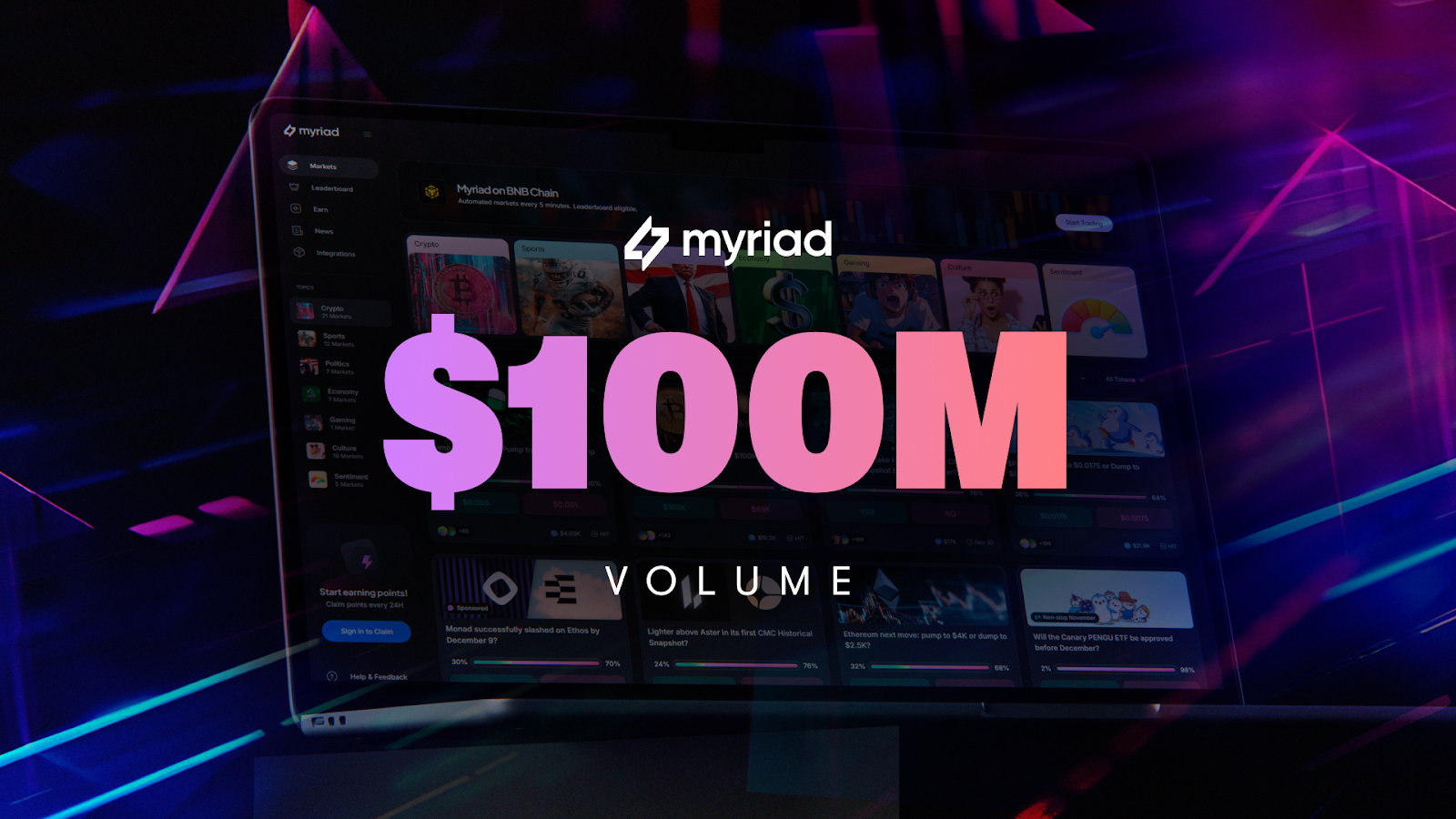
With more than 6.3 million trades, 7.3 million transactions, and over 400 thousand active traders across the platform, Myriad, the Web3 prediction market protocol, has now exceeded $100 million in USDC trading volume since its introduction. This is a growth of ten times in only three months, highlighting the quick

Author: Thenewscrypto